Friday, August 3, 2018

Telefonica S.A. (TEF) Given Average Rating of “Hold” by Brokerages

Telefonica S.A. (NYSE:TEF) has earned an average recommendation of “Hold” from the sixteen brokerages that are currently covering the firm, Marketbeat Ratings reports. Two equities research analysts have rated the stock with a sell rating, eight have issued a hold rating and five have given a buy rating to the company.
Several equities analysts have recently commented on the company. ValuEngine downgraded Telefonica from a “sell” rating to a “strong sell” rating in a research report on Monday, July 2nd. Zacks Investment Research downgraded Telefonica from a “hold” rating to a “strong sell” rating in a research report on Monday, April 30th. Morgan Stanley upgraded Telefonica to a “buy” rating in a research report on Wednesday, June 13th. Goldman Sachs Group downgraded Telefonica from a “buy” rating to a “neutral” rating in a research report on Friday, July 20th. Finally, TheStreet downgraded Telefonica from a “b-” rating to a “c+” rating in a research report on Monday, June 25th.

Get Telefonica alerts:

Several institutional investors have recently made changes to their positions in TEF. Advisor Partners LLC bought a new stake in shares of Telefonica in the second quarter worth about $105,000. Laurel Wealth Advisors Inc. bought a new stake in shares of Telefonica in the first quarter worth about $108,000. Dorsey & Whitney Trust CO LLC bought a new stake in shares of Telefonica in the first quarter worth about $111,000. Private Ocean LLC bought a new stake in shares of Telefonica in the first quarter worth about $120,000. Finally, Signaturefd LLC bought a new stake in shares of Telefonica in the first quarter worth about $128,000. Institutional investors and hedge funds own 0.80% of the company’s stock.

Shares of Telefonica stock opened at $8.87 on Friday. Telefonica has a 52 week low of $8.41 and a 52 week high of $11.58. The stock has a market capitalization of $46.94 billion, a PE ratio of 10.56 and a beta of 1.13. The company has a current ratio of 0.70, a quick ratio of 0.65 and a debt-to-equity ratio of 1.97.

Telefonica (NYSE:TEF) last announced its quarterly earnings data on Thursday, July 26th. The utilities provider reported $0.24 EPS for the quarter, beating the Thomson Reuters’ consensus estimate of $0.20 by $0.04. Telefonica had a return on equity of 16.12% and a net margin of 6.52%. The business had revenue of $14.49 billion for the quarter. equities research analysts anticipate that Telefonica will post 0.93 EPS for the current fiscal year.

About Telefonica

Telef贸nica, SA provides mobile and fixed communication services primarily in the European Union and Latin America. The company's mobile and related services and products comprise mobile voice, value added, mobile data and Internet, wholesale, corporate, roaming, fixed wireless, and trunking and paging services.

Further Reading: Understanding Average Daily Trade Volume

Analyst Recommendations for Telefonica (NYSE:TEF)

Thursday, August 2, 2018

FANG index of tech stocks tumbles into correction territory

The market's favorite technology stocks are tanking as investors are growing concerned over the companies' ambitious growth targets after disappointing financial results from Facebook and Netflix this month.

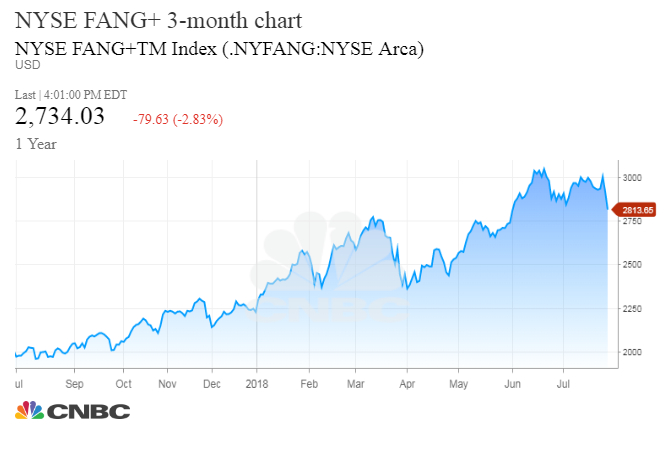
The NYSE FANG+ index is down more than 10 percent from its high of 3,062.88 in mid-June after its 2.8 percent drop Monday to the 2,734 level.

FANG is an acronym created by CNBC's Jim Cramer for the top-performing technology stocks �� Facebook, Amazon.com, Netflix and Alphabet (formerly Google).

The NYSE FANG+ index tracks the performance of FANG stocks along with several other high-growth technology shares such as Nvidia, Baidu and Tesla.

Larry McDonald of The Bear Traps Report and a CNBC contributor pointed to several reasons beyond the Facebook and Netflix earnings disappointments for the drop including the rising dollar hurting overseas profits and the risk of a political backlash against these tech giants here and around the globe.

WATCH: Is there a rotation coming? show chapters Growth vs. value: Is there a market rotation coming? Growth vs. value: Is there a market rotation coming?    12:55 PM ET Mon, 30 July 2018 | 06:57

Friday, July 20, 2018

Fed Chair Powell Worries About Cryptocurrencies

In his semiannual appearance Wednesday before the U.S. House Financial Services Committee, Fed Chair Jerome Powell said that cryptocurrencies “are great if you are trying to hide money or if you are trying to launder money,” but they have no “intrinsic value.”

Nor are they a particular problem for the Fed yet because they are�inconsequential in value compared with the money supply. The money supply (M1), comprised of all circulating cash and checking account deposits, totaled around $3.658 trillion in June.

The value of 1,649 cryptocurrencies is less than $300 billion, according to CoinMarketCap. Daily trading volume for bitcoin, the most liquid of the cryptocurrencies, reached about $5.8 billion on Wednesday, while average daily foreign exchange volumes hit an average of $1.84 trillion in London alone in the first half of this year. Globally the total daily dollar volume of the forex market is something like $5 trillion.

What Powell worries about is not the size of the market, but the risks to small investors:

I think there are significant investor risks. Investors, relatively unsophisticated investors, see the asset going up in price and they think “this is great I��ll buy this.”�� In fact, there is no promise behind that��. So I think there are investor and consumer protection issues as well.

Powell does not see cryptocurrencies as real fiat money:

It’s not really a currency, it doesn’t really have any intrinsic value�� Mainly I have concerns. If you think about what currencies do, they’re supposed to be a means of payment and a store of value basically and cryptocurrencies are not used very much in payment�� and in terms of the store of value, if you look at the volatility (or lack thereof), it’s just not there.

None of what Powell said is likely to deter interest and investment in cryptocurrencies. But it is instructive to note that the Fed is keeping an eye on them, even though Powell does not believe that they fall under any Fed regulatory control, nor, he says, is the Fed interested in providing any oversight of cryptocurrencies.

Thursday, July 19, 2018

Top Insurance Stocks To Own For 2019

tags:PRU,TOP,AON,WRB,

8 Ways for Agents to Answer ��What Do You Do?��

Working Past 70陆? Skip the 401(k) RMD Without Penalty

Republican Questions Constitutionality of Insurance Regulatory System

Aetna Inc. gained in New York trading after the Wall Street Journal reported that CVS Health Corp. is in talks to buy the insurer, offering more than $200 a share.

Aetna jumped 12% to $178.60, closing at a record high, while CVS fell 2.9% to $73.31. Spokesmen for Aetna and CVS declined to comment.

(Related: Anthem Breaks With Express Scripts, Will Start Own Drug Plan)

A deal would create a health-services giant and a bigger competitor for UnitedHealth Group Inc., which is the largest U.S. health insurer and has its own own clinics and a pharmacy benefits manager (PBM) unit. CVS runs drugstores and clinics, helps insurers manage their pharmacy benefits, and already sells a pharmacy-insurance plan for older people, known as Medicare Part D. The company has a market value of about $75 billion, while Aetna was valued at about $53 billion before surging on the Journal’s report.

Top Insurance Stocks To Own For 2019: Prudential Financial Inc.(PRU)

Advisors' Opinion:
  • [By Max Byerly]

    Flippin Bruce & Porter Inc. grew its holdings in shares of Prudential Financial (NYSE:PRU) by 2.3% in the 1st quarter, according to its most recent disclosure with the Securities and Exchange Commission (SEC). The institutional investor owned 61,363 shares of the financial services provider’s stock after acquiring an additional 1,391 shares during the period. Flippin Bruce & Porter Inc.’s holdings in Prudential Financial were worth $6,354,000 as of its most recent SEC filing.

  • [By Jason Hall, Chuck Saletta, and Reuben Gregg Brewer]

    But that doesn't mean you need to make risky bets to capture solid returns, either, and buying solid companies at reasonable prices can help create a margin of safety and improve your returns, while also decreasing your risk of permanent losses. Three stocks that meet these criteria are small healthcare real-estate specialist�Caretrust REIT Inc�(NASDAQ:CTRE), financial services giant�Prudential Financial Inc�(NYSE:PRU), and energy behemoth�ExxonMobil Corporation�(NYSE:XOM).�

  • [By Ethan Ryder]

    Get a free copy of the Zacks research report on Prudential Financial (PRU)

    For more information about research offerings from Zacks Investment Research, visit Zacks.com

  • [By Ethan Ryder]

    State of Tennessee Treasury Department lessened its position in Prudential Financial Inc (NYSE:PRU) by 29.7% during the first quarter, according to its most recent 13F filing with the SEC. The institutional investor owned 312,450 shares of the financial services provider’s stock after selling 132,238 shares during the period. State of Tennessee Treasury Department owned approximately 0.07% of Prudential Financial worth $32,354,000 at the end of the most recent reporting period.

  • [By Stephan Byrd]

    Symphony Asset Management LLC lowered its position in Prudential Financial Inc (NYSE:PRU) by 18.9% during the 1st quarter, according to the company in its most recent Form 13F filing with the SEC. The institutional investor owned 16,149 shares of the financial services provider’s stock after selling 3,765 shares during the period. Symphony Asset Management LLC’s holdings in Prudential Financial were worth $1,672,000 as of its most recent SEC filing.

Top Insurance Stocks To Own For 2019: Topdanmark A/S (TOP)

Advisors' Opinion:
  • [By Logan Wallace]

    TopCoin (CURRENCY:TOP) traded down 15.4% against the dollar during the 1-day period ending at 7:00 AM E.T. on June 21st. During the last seven days, TopCoin has traded up 4% against the dollar. TopCoin has a market cap of $0.00 and approximately $123.00 worth of TopCoin was traded on exchanges in the last day. One TopCoin coin can currently be bought for about $0.0010 or 0.00000015 BTC on popular exchanges.

Top Insurance Stocks To Own For 2019: Aon Corporation(AON)

Advisors' Opinion:
  • [By Joseph Griffin]

    AON (NYSE:AON) had its price target hoisted by Citigroup from $160.00 to $165.00 in a report issued on Tuesday morning. They currently have a buy rating on the financial services provider’s stock.

  • [By Shane Hupp]

    BB&T Securities LLC raised its holdings in Aon PLC (NYSE:AON) by 6.2% during the 1st quarter, HoldingsChannel.com reports. The institutional investor owned 23,068 shares of the financial services provider’s stock after purchasing an additional 1,352 shares during the period. BB&T Securities LLC’s holdings in AON were worth $3,237,000 as of its most recent filing with the Securities and Exchange Commission (SEC).

  • [By Logan Wallace]

    AON (NYSE: AON) and CorVel (NASDAQ:CRVL) are both finance companies, but which is the better investment? We will contrast the two companies based on the strength of their earnings, institutional ownership, valuation, profitability, risk, analyst recommendations and dividends.

  • [By Lisa Levin] Companies Reporting Before The Bell Celgene Corporation (NASDAQ: CELG) is projected to report quarterly earnings at $1.96 per share on revenue of $3.46 billion. Aon plc (NYSE: AON) is expected to report quarterly earnings at $2.8 per share on revenue of $2.93 billion. American Axle & Manufacturing Holdings, Inc. (NYSE: AXL) is estimated to report quarterly earnings at $0.81 per share on revenue of $1.75 billion. Alibaba Group Holding Limited (NYSE: BABA) is expected to report quarterly earnings at $0.88 per share on revenue of $9.27 billion. LifePoint Health, Inc. (NASDAQ: LPNT) is projected to report quarterly earnings at $1.13 per share on revenue of $1.62 billion. V.F. Corporation (NYSE: VFC) is estimated to report quarterly earnings at $0.65 per share on revenue of $2.90 billion. Newell Brands Inc. (NYSE: NWL) is expected to report quarterly earnings at $0.26 per share on revenue of $3.05 billion. Titan International, Inc. (NYSE: TWI) is projected to report quarterly earnings at $0.04 per share on revenue of $407.27 million. Boise Cascade Company (NYSE: BCC) is expected to report quarterly earnings at $0.45 per share on revenue of $1.09 billion. Cheniere Energy, Inc. (NYSE: LNG) is estimated to report quarterly earnings at $0.39 per share on revenue of $1.59 billion. Cboe Global Markets, Inc. (NASDAQ: CBOE) is projected to report quarterly earnings at $1.24 per share on revenue of $308.05 million. ITT Inc. (NYSE: ITT) is estimated to report quarterly earnings at $0.73 per share on revenue of $683.96 million. Fred's, Inc. (NASDAQ: FRED) is expected to report quarterly loss at $0.19 per share on revenue of $551.00 million. Virtu Financial, Inc. (NASDAQ: VIRT) is projected to report quarterly earnings at $0.52 per share on revenue of $288.31 million. Cheniere Energy Partners, L.P. (NYSE: CQP) is expected to report quarterly earnings at $0.57 per share on revenue of $1.38 billion. Genesis Energy, L.P
  • [By Logan Wallace]

    Get a free copy of the Zacks research report on AON (AON)

    For more information about research offerings from Zacks Investment Research, visit Zacks.com

Top Insurance Stocks To Own For 2019: W.R. Berkley Corporation(WRB)

Advisors' Opinion:
  • [By Joseph Griffin]

    Get a free copy of the Zacks research report on W. R. Berkley (WRB)

    For more information about research offerings from Zacks Investment Research, visit Zacks.com

  • [By Ethan Ryder]

    ValuEngine cut shares of W. R. Berkley (NYSE:WRB) from a buy rating to a hold rating in a report released on Monday morning.

    WRB has been the topic of a number of other research reports. Bank of America cut shares of W. R. Berkley from a neutral rating to an underperform rating and set a $74.00 target price on the stock. in a report on Thursday, June 14th. They noted that the move was a valuation call. Zacks Investment Research cut shares of W. R. Berkley from a buy rating to a hold rating in a report on Tuesday, February 20th. Boenning Scattergood restated a hold rating on shares of W. R. Berkley in a report on Wednesday, April 25th. Finally, Goldman Sachs Group started coverage on shares of W. R. Berkley in a report on Monday. They set a sell rating and a $74.00 target price on the stock. They noted that the move was a valuation call. Four analysts have rated the stock with a sell rating and eight have issued a hold rating to the stock. W. R. Berkley currently has a consensus rating of Hold and a consensus price target of $70.78.

  • [By Logan Wallace]

    W. R. Berkley (NYSE: WRB) and State Auto Financial (NASDAQ:STFC) are both finance companies, but which is the superior investment? We will compare the two companies based on the strength of their valuation, institutional ownership, dividends, earnings, profitability, analyst recommendations and risk.

  • [By Stephan Byrd]

    Get a free copy of the Zacks research report on W. R. Berkley (WRB)

    For more information about research offerings from Zacks Investment Research, visit Zacks.com

Friday, July 13, 2018

Major Semiconductor Stocks Scare Off Short Sellers

Semiconductor trends are considered to be leading indicators of technology and broader electronics demand. In a wider sense, semiconductor and tech stocks are considered to be leading indicators for the markets in general. A strong rally in the tech sector pushed many of these companies to new highs, but with the return of volatility, semiconductors will have to rally again if markets want to return to record levels.

The June 29 short interest data have been compared with the previous report. Short interest in most of these selected semiconductor stocks decreased.

Intel Corp. (NASDAQ: INTC) saw its short interest increase to 86.75 million shares. The previous level was 85.64 million. Intel shares were last seen trading at $51.20, in a 52-week range of $34.12 to $57.60.

The number of Advanced Micro Devices Inc. (NASDAQ: AMD) shares short decreased to 164.31 million from the previous level of 172.02 million. Shares recently traded at $16.27, in a 52-week range of $9.04 to $17.34.

Qualcomm Inc. (NASDAQ: QCOM) saw the number of its shares short fall to 17.57 million from the 20.92 million reported in the previous period. Shares were changing hands at $57.30, in a 52-week trading range of $48.56 to $69.28.

Short interest in Applied Materials Inc. (NASDAQ: AMAT) fell to 16.35 million shares. The previous reading was 18.30 million. Shares were trading at $45.20, in a 52-week range of $41.94 to $62.40.

Micron Technology Inc. (NASDAQ: MU) saw its short interest increase to 53.85 million shares from the previous reading of 50.58 million. Shares were trading at $54.18, in a 52-week range of $26.85 to $64.66.

And the short interest in Broadcom Ltd. (NASDAQ: AVGO) shrank to 6.70 million shares from the previous level of 7.00 million. Shares were last seen trading at $243.44, in a 52-week range of $221.98 to $285.68.

ALSO READ: The 5 Most Shorted Nasdaq Stocks

Wednesday, July 11, 2018

Best Tech Stocks For 2019

tags:NEWR,DDD,RUBI,CVLT,

Corning's (NYSE:GLW) cutting-edge glass technology can already be found everywhere from smartphones to LCD TVs, advanced optics systems, lab science equipment, and even the ceramic substrates and particulate filters underlying pollution control systems in millions of vehicles today.�But Corning is ready to take its show on the road in a much more visible way.

At the 2017 Consumer Electronics Show earlier this month, Corning unveiled its ambitious vision for the "ultimate driving experience." To demonstrate that experience, Corning even built its own fully operational electric vehicle prototype showcasing how its most advanced glass technologies can be used in the automotive space.

Corning's fully operational electric vehicle prototype features an array of its glass technologies. Image source: Corning.

"Cleaner, safer, more enhanced automotive solutions"

First, the sleek electric vehicle features a Gorilla Glass hybrid windshield that's not only two times more durable than conventional soda lime glass (resulting in 50% fewer windshield cracks and replacements) but also offers substantial weight reduction for increased fuel efficiency, and a threefold increase in optical clarity.

Best Tech Stocks For 2019: New Relic, Inc.(NEWR)

Advisors' Opinion:
  • [By ]

    Tech has simply become too good to ignore, especially with stocks like Micron Technology (MU) up 24% for the year and New Relic (NEWR) soaring 14% today on great earnings.

  • [By Ethan Ryder]

    New Relic Inc (NYSE:NEWR) CFO Mark Sachleben sold 7,500 shares of New Relic stock in a transaction on Thursday, June 7th. The shares were sold at an average price of $107.18, for a total transaction of $803,850.00. The transaction was disclosed in a document filed with the Securities & Exchange Commission, which can be accessed through this hyperlink.

  • [By ]

    The seven companies cited by Cramer are Salesforce.com Inc.  (CRM) , Workday Inc. (WDAY) , ServiceNow Inc. (NOW) , Splunk Inc. (SPLK) , New Relic Inc. (NEWR) , VMWare Inc. (VMW) , and Adobe Systems Incorporated (ADBE) .

Best Tech Stocks For 2019: 3D Systems Corporation(DDD)

Advisors' Opinion:
  • [By Logan Wallace]

    Get a free copy of the Zacks research report on 3D Systems (DDD)

    For more information about research offerings from Zacks Investment Research, visit Zacks.com

  • [By Chris Lange]

    3D Systems Corp. (NYSE: DDD) is set to release its most recent quarterly results on Wednesday. The consensus forecast calls for breakeven earnings and $164.7 million in revenue. Shares closed on Friday at $12.05. The consensus price target is $9.83, and the 52-week range is $7.92 to $23.70.

  • [By Paul Ausick]

    Short interest in 3D Systems Corp. (NYSE: DDD) rose by 1.3% to 35.05 million shares. Some 32% of the company’s float was short. Days to cover rose from 22 to 23. In the two-week short interest period, the share price rose by 0.7%. The stock’s 52-week trading range is $7.92 to $23.70, and shares closed at $12.02 on Wednesday, up about 9% on the day.

  • [By Paul Ausick]

    Short interest in 3D Systems Corp. (NYSE: DDD) fell by 1.9% to 35.03 million shares. Some 32.1% of the company’s float was short. Days to cover rose from 12 to 15. In the two-week short interest period, the share price rose by 27.3%. The stock’s 52-week trading range is $7.92 to $23.70, and shares closed at $10.68 on Wednesday, up about 0.7% on the day.

Best Tech Stocks For 2019: The Rubicon Project, Inc.(RUBI)

Advisors' Opinion:
  • [By Ethan Ryder]

    The Rubicon Project Inc (NYSE:RUBI) saw unusually-high trading volume on Wednesday . Approximately 1,541,600 shares traded hands during trading, an increase of 150% from the previous session’s volume of 615,518 shares.The stock last traded at $3.22 and had previously closed at $2.90.

  • [By Ethan Ryder]

    Rubicon Project (NYSE: RUBI) is one of 44 publicly-traded companies in the “Computer programming, data processing, & other computer related” industry, but how does it weigh in compared to its competitors? We will compare Rubicon Project to related companies based on the strength of its analyst recommendations, valuation, institutional ownership, dividends, profitability, earnings and risk.

  • [By Max Byerly]

    Rubicon Project (NYSE:RUBI) was upgraded by stock analysts at ValuEngine from a “strong sell” rating to a “sell” rating in a research report issued on Wednesday.

Best Tech Stocks For 2019: CommVault Systems, Inc.(CVLT)

Advisors' Opinion:
  • [By Shane Hupp]

    CommVault Systems, Inc. (NASDAQ:CVLT) VP Brian Carolan sold 5,484 shares of the stock in a transaction that occurred on Wednesday, June 13th. The stock was sold at an average price of $71.90, for a total transaction of $394,299.60. Following the completion of the sale, the vice president now owns 102,796 shares in the company, valued at $7,391,032.40. The transaction was disclosed in a filing with the SEC, which is available through this link.

  • [By ]

    In addition, Elliott Management, which often pushes for M&A and other strategic transactions at targeted companies, made investments in EQT Corp. (EQT) , CommVault Systems Inc. (CVLT) , Sabre Corp. (SABR) , Teradyne Inc. (TER)  and Windstream Holdings Inc. (WIN)

  • [By Ethan Ryder]

    Get a free copy of the Zacks research report on CommVault Systems (CVLT)

    For more information about research offerings from Zacks Investment Research, visit Zacks.com

Monday, July 9, 2018

Best Clean Energy Stocks To Invest In Right Now

tags:ARW,TGA,AIMT,QUIK,TCP,AWI, &l;p&g;&l;img class=&q;dam-image getty size-large wp-image-508336438&q; src=&q;https://specials-images.forbesimg.com/dam/imageserve/508336438/960x0.jpg?fit=scale&q; data-height=&q;637&q; data-width=&q;960&q;&g; An aerial view of the solar mirrors at the Noor 1 Concentrated Solar Power plant in Morocco. The North African country has approved a new $2.4bn 800MW scheme. (FADEL SENNA/AFP/Getty Images)

Emerging markets dominated investment in clean energy in the first quarter of 2018, with more than 40% of funding going to projects in China, while there were notable developments in Mexico, Morocco, Indonesia and Vietnam.

Total investment for the first three months of the year was $61.1 billion, 10% lower than the same period in 2017, according to Bloomberg New Energy Finance (BNEF). Using slightly different criteria, Clean Energy Pipeline said that the figure was $62.1 billion.

One reason for the fall in investment was a 19% drop in solar funding, partly as a result of a 7% fall in the price of photovoltaic equipment over the past year, and partly because of weaker activity in some markets.

Best Clean Energy Stocks To Invest In Right Now: Arrow Electronics, Inc.(ARW)

Advisors' Opinion:
  • [By Lee Jackson]

    This award-winning company looks poised to come in strong for the quarter. Arrow Electronics Inc. (NYSE: ARW) is a worldwide provider of products, services and solutions to industrial and commercial users of electronic components and enterprise computing solutions.

  • [By Ethan Ryder]

    PNC Financial Services Group Inc. increased its holdings in Arrow Electronics, Inc. (NYSE:ARW) by 29.7% in the first quarter, HoldingsChannel.com reports. The firm owned 19,225 shares of the technology company’s stock after buying an additional 4,405 shares during the quarter. PNC Financial Services Group Inc.’s holdings in Arrow Electronics were worth $1,480,000 at the end of the most recent reporting period.

  • [By Stephan Byrd]

    Get a free copy of the Zacks research report on Arrow Electronics (ARW)

    For more information about research offerings from Zacks Investment Research, visit Zacks.com

  • [By Stephan Byrd]

    Arrow Electronics (NYSE:ARW) was downgraded by analysts at Zacks Investment Research from a buy rating to a hold rating. According to Zacks, “Arrow Electronics reported better-than-expected results for first-quarter 2018. The figures also came above the mid-point of the company’s guidance ranges and marked year-over-year improvement. Moreover, the electronic component distributor provided an optimistic guidance for second-quarter 2018. We believe that the company’s core strength in providing best-in-class services and easy-to-acquire technologies should drive growth in the long run. Moreover, the company has secured a significant market share through a broad portfolio of products and services, and continued efforts to maximize consumer satisfaction. Additionally, incremental sales from strategic acquisitions and partnerships are expected to boost the top line. However, an uncertain economic environment, high debt burden and competition remain the concerns. Notably, the stock has outperformed the industry in the last one year.”

Best Clean Energy Stocks To Invest In Right Now: Transglobe Energy Corp(TGA)

Advisors' Opinion:
  • [By Lisa Levin] Gainers SenesTech, Inc. (NASDAQ: SNES) shares surged 296.07 percent to close at $1.25 on Monday after the California Department of Pesticide Regulation proposed to register the company's ContraPest for sale and use in California. AgEagle Aerial Systems, Inc. (NASDAQ: UAVS) shares gained 19.59 percent to close at $2.93. TransGlobe Energy Corporation (NASDAQ: TGA) rose 18.39 percent to close at $2.64 on Monday. Sears Hometown and Outlet Stores, Inc. (NASDAQ: SHOS) shares gained 15.91 percent to close at $2.55. VAALCO Energy, Inc. (NYSE: EGY) shares jumped 14.9 percent to close at $2.39. Resonant Inc. (NASDAQ: RESN) climbed 13.96 percent to close at $4.49. Chesapeake Energy Corporation (NYSE: CHK) shares rose 13.55 percent to close at $4.61 on Monday. Lilis Energy, Inc. (NYSE: LLEX) surged 13.09 percent to close at $5.01. MB Financial, Inc. (NASDAQ: MBFI) gained 12.9 percent to close at $49.28. Fifth Third Bancorp (NASDAQ: FITB) agreed to acquire MB Financial for $54.70 per share in cash and stock. TransEnterix, Inc. (NYSE: TRXC) shares rose 12.83 percent to close at $3.43. World Wrestling Entertainment, Inc. (NYSE: WWE) jumped 12.52 percent to close at $57.86 on Reports that it has reached a deal with Fox for Its 'Smackdown Live' program. Eastman Kodak Company (NASDAQ: KODK) rose 12.38 percent to close at $5.90. NuCana plc (NASDAQ: NCNA) climbed 11.94 percent to close at $26.44. NuCana appointed Dr. Cyrille Leperlier to its Board as an independent non-executive Director. Aqua Metals, Inc. (NASDAQ: AQMS) rose 11.83 percent to close at $3.97 on Monday. Huami Corporation (NYSE: HMI) shares jumped 11.27 percent to close at $10.17 following Q1 results. 21Vianet Group, Inc. (NASDAQ: VNET) gained 9.55 percent to close at $7.34. Boxlight Corporation (NASDAQ: BOXL) rose 8.56 percent to close at $7.86 after the company announced an exclusive partnership with Multi Touch Interactives to strengthen the de
  • [By Max Byerly]

    According to Zacks, “TransGlobe Energy Corporation (TGA) is an oil exploration and production company. It is a Calgary-based, growth-oriented oil and gas exploration and development company. TransGlobe is dedicated on improving productivity through promoting good oilfield development and exploitation practices including the implementation of industry leading secondary and tertiary recovery methods as well as improvements to production and transportation infrastructure. The Company conducts its operations through the Arab Republic of Egypt segment. It is primarily engaged in oil exploration, development, production and the acquisition of properties. TransGlobe Energy Corporation, through its subsidiaries, explores for, develops, and produces crude oil and natural gas liquids in Egypt and Canada. It holds working interests in West Gharib, West Bakr, North West Gharib, South West Gharib, South East Gharib, South Ghazalat, South Alamein, and North West Sitra production sharing contracts. “

  • [By Lisa Levin] Gainers SenesTech, Inc. (NASDAQ: SNES) shares jumped 113.5 percent to $0.6737 after the California Department of Pesticide Regulation proposed to register the company's ContraPest for sale and use in California. AgEagle Aerial Systems, Inc. (NASDAQ: UAVS) shares rose 35.34 percent to close at $3.32. Art's-Way Manufacturing Co., Inc. (NASDAQ: ARTW) shares gained 30.36 percent to $3.65. Xtant Medical Holdings, Inc. (NYSE: XTNT) shares jumped 25.6 percent to $7.4701 after the company disclosed that it has received the FDA clearance for InTice™-C Porous Titanium Cervical Interbody System. VAALCO Energy, Inc. (NYSE: EGY) shares surged 20 percent to $2.495. TransGlobe Energy Corporation (NASDAQ: TGA) surged 17.04 percent to $2.61. Boxlight Corporation (NASDAQ: BOXL) gained 15 percent to $8.32 after the company announced an exclusive partnership with Multi Touch Interactives to strengthen the development of next generation interactive educational activities. Arcimoto, Inc. (NASDAQ: FUV) gained 15 percent to $3.39. MB Financial, Inc. (NASDAQ: MBFI) rose 13.7 percent to $49.64. Fifth Third Bancorp (NASDAQ: FITB) agreed to acquire MB Financial for $54.70 per share in cash and stock. FRONTEO, Inc. (NASDAQ: FTEO) shares rose 11.8 percent to $20.956. TransEnterix, Inc. (NYSE: TRXC) shares jumped 11.1 percent to $3.38. 21Vianet Group, Inc. (NASDAQ: VNET) rose 10.6 percent to $7.41. NII Holdings, Inc. (NASDAQ: NIHD) shares gained 9 percent to $2.32. Kelly Services, Inc. (NASDAQ: KELYA) rose 7.6 percent to $24.19. Northcoast Research upgraded Kelly Services from Neutral to Buy. LaSalle Hotel Properties (NYSE: LHO) shares climbed 5.6 percent to $33.70. Blackstone Group LP (NYSE: BX) will buy LaSalle Hotel Properties in a $4.8 billion deal, Bloomberg reported. Alteryx, Inc. (NYSE: AYX) gained 5.5 percent to $32.56. KeyBanc upgraded Alteryx from Sector Weight to Overweight. Energizer Holdings, Inc. (NYSE:
  • [By Max Byerly]

    Atlas Energy Group (OTCMKTS: ATLS) and Transglobe Energy (NASDAQ:TGA) are both small-cap oils/energy companies, but which is the better business? We will compare the two companies based on the strength of their analyst recommendations, institutional ownership, profitability, valuation, risk, dividends and earnings.

  • [By Logan Wallace]

    News articles about TransGlobe Energy (NASDAQ:TGA) (TSE:TGL) have trended somewhat positive recently, according to Accern. Accern scores the sentiment of press coverage by reviewing more than twenty million news and blog sources in real-time. Accern ranks coverage of companies on a scale of negative one to one, with scores nearest to one being the most favorable. TransGlobe Energy earned a coverage optimism score of 0.09 on Accern’s scale. Accern also assigned media coverage about the basic materials company an impact score of 45.8745142486822 out of 100, indicating that recent press coverage is somewhat unlikely to have an effect on the stock’s share price in the near future.

Best Clean Energy Stocks To Invest In Right Now: Aimmune Therapeutics, Inc.(AIMT)

Advisors' Opinion:
  • [By Chris Lange]

    Aimmune Therapeutics Inc. (NASDAQ: AIMT) is looking for Phase 3 data for in its Palisade trial of AR101 in February. Specifically, this trial is looking to treat peanut allergies. Shares closed trading most recently at $37.13, with a consensus price target of $55.50 and a 52-week range of $15.97 to $40.65.

  • [By ]

    Aimmune Therapeutics (AIMT) : "I do like it. That's an important niche business. "

    Ingersoll-Rand (IR) : "I like Ingersoll-Rand. They work well at this phase in the cycle."

  • [By Chris Lange]

    Buy-dip on several “Potential Blockbusters” Aimmune Therapeutics, Inc. (NASDAQ: AIMT), Audentes Therapeutics, Inc. (NASDAQ: BOLD), AveXis, Inc. (NASDAQ: AVXS), Bluebird Bio, Inc. (NASDAQ: BLUE), Esperion Therapeutics, Inc. (NASDAQ: ESPR), and Sage Therapeutics, Inc. (NASDAQ: SAGE) are buy-dip candidates given their bullish trends and favorable technical patterns. Intercept Pharmaceuticals, Inc. (NASDAQ: ICPT), Prothena Corp. PLC (NASDAQ: PRTA), Tesaro, Inc. (NASDAQ: TSRO) and Ultragenyx Pharmaceutical Inc. (NASDAQ: RARE) have bearish set-ups. Heron Therapeutics, Inc. (NASDAQ: HRTX) is bigger picture bullish, but may correct further on a move below $19.55. Clovis Oncology, Inc. (NASDAQ: CLVS) has bearish set-up and bulls need to push above $69 to invalidate.

Best Clean Energy Stocks To Invest In Right Now: QuickLogic Corporation(QUIK)

Advisors' Opinion:
  • [By Stephan Byrd]

    Get a free copy of the Zacks research report on QuickLogic (QUIK)

    For more information about research offerings from Zacks Investment Research, visit Zacks.com

  • [By Logan Wallace]

    Media headlines about QuickLogic (NASDAQ:QUIK) have trended somewhat positive recently, according to Accern Sentiment Analysis. The research firm identifies negative and positive media coverage by monitoring more than 20 million news and blog sources in real time. Accern ranks coverage of publicly-traded companies on a scale of negative one to one, with scores nearest to one being the most favorable. QuickLogic earned a coverage optimism score of 0.11 on Accern’s scale. Accern also assigned headlines about the semiconductor company an impact score of 46.5432440392545 out of 100, indicating that recent media coverage is somewhat unlikely to have an impact on the stock’s share price in the next several days.

  • [By Shane Hupp]

    News coverage about QuickLogic (NASDAQ:QUIK) has been trending somewhat positive this week, Accern Sentiment Analysis reports. The research group scores the sentiment of news coverage by monitoring more than 20 million blog and news sources in real time. Accern ranks coverage of public companies on a scale of negative one to one, with scores closest to one being the most favorable. QuickLogic earned a daily sentiment score of 0.11 on Accern’s scale. Accern also assigned press coverage about the semiconductor company an impact score of 47.5146776135294 out of 100, indicating that recent news coverage is somewhat unlikely to have an effect on the stock’s share price in the near future.

Best Clean Energy Stocks To Invest In Right Now: TC PipeLines, LP(TCP)

Advisors' Opinion:
  • [By Matthew DiLallo]

    Most investors have probably heard of energy giants Royal Dutch Shell (NYSE:RDS-A) (NYSE:RDS-B), Dominion Energy (NYSE:D), and TransCanada (NYSE:TRP). Fewer, however, are likely familiar with their publicly traded master limited partnerships (MLPs): Shell Midstream Partners (NYSE:SHLX), Dominion Energy Midstream Partners (NYSE:DM), and TC Pipelines (NYSE:TCP). That might be a good thing, as the market has beaten up the latter trio this year, sending their valuations south.

  • [By Matthew DiLallo]

    For years, Canadian pipeline giant TransCanada (NYSE:TRP) has used its master limited partnership (MLP) TC Pipelines (NYSE:TCP) as a source of capital by dropping down assets to that entity in exchange for cash. However, a regulatory policy change earlier in the year hit TC Pipelines hard, which caused the MLP to slash its distribution to investors. These changes have weighed heavily on the MLP's valuation and access to capital. Because of that, TransCanada no longer believes it can use TC Pipelines as a viable funding option.

  • [By Matthew DiLallo]

    That funding progress is important given an unexpected development in the quarter when the Federal Regulatory Commission (FERC) revised a long-standing policy and will no longer allow master limited partnerships to collect an allowance for income taxes on certain pipelines. That change could have a major impact on the cash flows of TransCanada's MLP TC Pipelines, LP (NYSE:TCP). While TC Pipelines isn't sure how much this change will impact its cash flow, it took precautionary actions by slashing its distribution to investors. That payout reduction and the related uncertainty has weighed significantly on TC Pipelines' valuation. Because of that, Girling said that "further dropdowns of assets by TransCanada into TC Pipelines is not considered a viable funding option at this time," and he isn't sure if it will be one in the future. However, he did clarify that even without future dropdowns to TC Pipelines, TransCanada believes it has the "financial capacity to fund our existing capital program through our predictable and growing cash flow from operations as well as several other funding alternatives."

  • [By Lisa Levin] Gainers Shineco, Inc. (NASDAQ: TYHT) rose 34.7 percent to $2.29 in pre-market trading following Q3 results. Shineco posted Q3 earnings of $0.21 per share on sales of $13.3 million. Carver Bancorp, Inc. (NASDAQ: CARV) rose 15.8 percent to $12.74 in pre-market trading after surging 201.37 percent on Thursday. LiveXLive Media, Inc. (NASDAQ: LIVX) shares rose 11.5 percent to $7.75 in pre-market trading after climbing 64.50 percent on Thursday. Eiger BioPharmaceuticals, Inc. (NASDAQ: EIGR) rose 9 percent to $18.30 in pre-market trading after climbing 41.77 percent on Thursday. AmTrust Financial Services Inc (NASDAQ: AFSI) rose 6.2 percent to $14.25 in pre-market trading after a 13D filing from Carl Icahn shows a new 9.38 percent stake in the company. The filing also shows language from Icahn that strongly opposes a go-private transaction. Cerner Corporation (NASDAQ: CERN) rose 5.6 percent to $64.02 in pre-market trading after the Department of Veterans Affairs reported an agreement with Cerner Government Services, Inc. to provide seamless care for veterans. PetroChina Company Limited (NYSE: PTR) shares rose 5.3 percent to $82.05 in pre-market trading. TC PipeLines, LP (NYSE: TCP) shares rose 5.2 percent to $26.59 in the pre-market trading session. IQVIA Holdings Inc. (NYSE: IQV) shares rose 4.8 percent to $102.50 in pre-market trading as the company pulled secondary offering 'in light of recent market conditions'. Axon Enterprise, Inc. (NASDAQ: AAXN) rose 4.5 percent to $59.70 in pre-market trading. On Thursday, Axon priced its 4.3 million share offering of common stock at $53 per share. The Trade Desk, Inc. (NASDAQ: TTD) rose 4.5 percent to $84 in pre-market trading. PetIQ Inc (NASDAQ: PETQ) rose 3.9 percent to $18.96 in pre-market trading after a 13G filing shows a new 5.05 percent stake by the State of New Jersey's Division of Investment. Mattel, Inc. (NASDAQ: MAT) shares rose 3.7 percent to $15.85 in pre-market
  • [By Lisa Levin] Gainers Integrated Media Technology Limited (NASDAQ: IMTE) rose 30.8 percent to $22.00 in pre-market trading after declining 18.63 percent on Monday. Nevsun Resources Ltd. (NYSE: NSU) rose 14.5 percent to $3.40 in pre-market trading after Lundin Mining Corporation and Euro Sun Mining Inc. proposed to acquire Nevsun Resources for around C$1.5 billion. Sharing Economy International Inc. (NASDAQ: SEII) rose 15.2 percent to $4.25 in pre-market trading after the company disclosed that it entered into a license agreement with Ecrent Capital Holdings Limited. Veeco Instruments Inc. (NASDAQ: VECO) shares rose 14.1 percent to $19.50 in pre-market trading after reporting stronger-than-expected earnings for its first quarter. Impinj, Inc. (NASDAQ: PI) rose 13.4 percent to $15.40 in pre-market trading after reporting Q1 results. SandRidge Energy, Inc. (NYSE: SD) shares rose 13.2 percent to $16.45 in pre-market trading following Q1 results. Blink Charging Co. (NASDAQ: BLNK) rose 12.6 percent to $4.55 in pre-market trading after jumping 171.14 percent on Monday. Crocs, Inc. (NASDAQ: CROX) shares rose 10 percent to $16.66 in pre-market trading after the company reported better-than-expected earnings for its first quarter and issued strong sales forecast for the second quarter. Pareteum Corporation (NASDAQ: TEUM) rose 9.7 percent to $3.05 in pre-market trading after announcing Q1 results. Dean Foods Company (NYSE: DF) rose 8 percent to $9.00 in pre-market trading after reporting upbeat Q1 earnings. Fiesta Restaurant Group, Inc. (NASDAQ: FRGI) rose 7.3 percent to $23.45 in pre-market trading following Q1 results. IAMGOLD Corporation (NYSE: IAG) rose 7.1 percent to $6.09 in pre-market trading after reporting upbeat Q1 earnings. TC PipeLines, LP (NYSE: TCP) rose 6.4 percent to $27 in pre-market trading after gaining 2.08 percent on Monday. Carrols Restaurant Group, Inc. (NASDAQ: TAST) rose 6.3 percent to $11.75 in pre-market trading fol

Best Clean Energy Stocks To Invest In Right Now: Armstrong World Industries Inc(AWI)

Advisors' Opinion:
  • [By Ethan Ryder]

    AptarGroup (NYSE: ATR) and Armstrong World Industries (NYSE:AWI) are both mid-cap industrial products companies, but which is the better stock? We will contrast the two companies based on the strength of their valuation, risk, dividends, analyst recommendations, earnings, institutional ownership and profitability.

Thursday, July 5, 2018

Pan American Silver (PAAS) Earning Somewhat Positive Media Coverage, Accern Reports

Headlines about Pan American Silver (NASDAQ:PAAS) (TSE:PAAS) have trended somewhat positive recently, Accern Sentiment reports. The research firm identifies negative and positive media coverage by analyzing more than 20 million blog and news sources. Accern ranks coverage of companies on a scale of negative one to positive one, with scores nearest to one being the most favorable. Pan American Silver earned a news sentiment score of 0.11 on Accern’s scale. Accern also gave media headlines about the basic materials company an impact score of 46.7119428227578 out of 100, meaning that recent media coverage is somewhat unlikely to have an effect on the company’s share price in the immediate future.

These are some of the news stories that may have impacted Accern’s analysis:

Get Pan American Silver alerts: Analyzing McEwen Mining (MUX) & Pan American Silver (PAAS) (americanbankingnews.com) Brokerages Anticipate Pan American Silver Corp. (PAAS) Will Post Quarterly Sales of $216.36 Million (americanbankingnews.com) Pan American Silver Corp. (PAAS) Given Average Recommendation of “Buy” by Brokerages (americanbankingnews.com) Pan American Silver Corp. (PAAS) Expected to Post Earnings of $0.16 Per Share (americanbankingnews.com)

Several analysts have weighed in on PAAS shares. BidaskClub cut shares of Pan American Silver from a “hold” rating to a “sell” rating in a research note on Wednesday, June 6th. ValuEngine upgraded shares of Pan American Silver from a “sell” rating to a “hold” rating in a research note on Friday, March 23rd. Canaccord Genuity restated a “buy” rating and issued a $19.50 target price on shares of Pan American Silver in a research report on Wednesday, April 4th. Finally, Deutsche Bank dropped their target price on shares of Pan American Silver from $20.00 to $19.00 and set a “buy” rating for the company in a research report on Thursday, March 15th. Four investment analysts have rated the stock with a hold rating and eleven have given a buy rating to the company’s stock. Pan American Silver has a consensus rating of “Buy” and a consensus target price of $21.10.

PAAS traded up $0.49 during trading on Wednesday, reaching $18.24. 707,109 shares of the company’s stock were exchanged, compared to its average volume of 896,743. Pan American Silver has a one year low of $13.99 and a one year high of $19.56. The firm has a market capitalization of $2.72 billion, a price-to-earnings ratio of 35.76, a PEG ratio of 6.25 and a beta of 0.30.

Pan American Silver (NASDAQ:PAAS) (TSE:PAAS) last posted its earnings results on Wednesday, May 9th. The basic materials company reported $0.20 earnings per share for the quarter, topping the Zacks’ consensus estimate of $0.16 by $0.04. Pan American Silver had a net margin of 18.19% and a return on equity of 6.35%. The firm had revenue of $206.96 million for the quarter, compared to analyst estimates of $215.73 million. During the same period in the previous year, the firm posted $0.06 EPS. The company’s revenue for the quarter was up 4.2% compared to the same quarter last year. research analysts expect that Pan American Silver will post 0.71 EPS for the current fiscal year.

The firm also recently announced a quarterly dividend, which was paid on Monday, June 4th. Shareholders of record on Tuesday, May 22nd were issued a dividend of $0.035 per share. This represents a $0.14 dividend on an annualized basis and a yield of 0.77%. The ex-dividend date was Monday, May 21st. Pan American Silver’s payout ratio is 27.45%.

About Pan American Silver

Pan American Silver Corp., together with its subsidiaries, engages in exploration, extraction, processing, refining, and reclamation of silver mines. The company owns and operates silver mines located in Peru, Mexico, Argentina, and Bolivia. It also produces and sells gold, zinc, lead, and copper. The company holds interests in the La Colorada, Dolores, Alamo Dorado, Huaron, Morococha, Manantial Espejo, and San Vicente mines.

Insider Buying and Selling by Quarter for Pan American Silver (NASDAQ:PAAS)

Monday, July 2, 2018

Zacks Investment Research Lowers Orange (ORAN) to Sell

Orange (NYSE:ORAN) was downgraded by Zacks Investment Research from a “hold” rating to a “sell” rating in a report released on Saturday.

According to Zacks, “Orange SA provides telecommunications services. It offers a range of fixed telephony and mobile telecommunications, data transmission, Internet and multimedia, and other value-added services to consumers, businesses, and other telecommunications operators under the Orange brand worldwide. Orange SA, formerly known as France Telecom S.A., is based in Paris, France. “

Get Orange alerts:

Separately, ValuEngine lowered shares of Orange from a “buy” rating to a “hold” rating in a research note on Monday, May 7th. Two research analysts have rated the stock with a sell rating, three have issued a hold rating and two have assigned a buy rating to the company. The stock presently has an average rating of “Hold” and a consensus price target of $19.00.

NYSE ORAN opened at $16.67 on Friday. Orange has a 52 week low of $15.82 and a 52 week high of $18.57. The company has a debt-to-equity ratio of 0.83, a quick ratio of 0.68 and a current ratio of 0.71. The firm has a market cap of $44.18 billion, a PE ratio of 23.81, a PEG ratio of 0.52 and a beta of 0.66.

Large investors have recently modified their holdings of the stock. Goldman Sachs Group Inc. increased its stake in shares of Orange by 1.7% in the fourth quarter. Goldman Sachs Group Inc. now owns 731,349 shares of the technology company’s stock worth $12,726,000 after buying an additional 11,937 shares during the last quarter. Pittenger & Anderson Inc. increased its stake in shares of Orange by 23.7% in the fourth quarter. Pittenger & Anderson Inc. now owns 78,375 shares of the technology company’s stock worth $1,364,000 after buying an additional 15,000 shares during the last quarter. Mackenzie Financial Corp bought a new stake in shares of Orange in the fourth quarter worth $256,000. Elkfork Partners LLC bought a new stake in shares of Orange in the fourth quarter worth $388,000. Finally, Guggenheim Capital LLC increased its stake in shares of Orange by 9.5% in the fourth quarter. Guggenheim Capital LLC now owns 228,283 shares of the technology company’s stock worth $3,972,000 after buying an additional 19,784 shares during the last quarter. Institutional investors and hedge funds own 1.40% of the company’s stock.

Orange Company Profile

Orange SA provides a range of fixed telephony and mobile telecommunications, data transmission, and other value-added services to consumers, businesses, and other telecommunications operators in Europe, Africa, and the Middle East. It offers mobile, fixed-line telephony, fixed broadband, business solutions and networks, and carrier services; sells mobile devices, equipment, and accessories; and sells and rents fixed-line equipment.

Get a free copy of the Zacks research report on Orange (ORAN)

For more information about research offerings from Zacks Investment Research, visit Zacks.com

Monday, June 25, 2018

Shares of Gray Television Jump 10% After a Compelling Transaction

What happened

Shares of Gray Television, Inc. (NYSE:GTN), the owner and operator of more than 100 television stations spanning 57 television markets, are up 10% as of 11:07 a.m. EDT after the company agreed to buy Raycom Media in a $3.6 billion deal. The combined company will now have 142 full-power television stations serving 92 markets.

So what

The market loves the transaction as Raycom Media is one of the nation's largest privately owned local media companies and the combined company will create the single largest owner of top-rated local television stations. Including anticipated synergies, the transaction price is roughly a 7.5 multiple of Raycom's blended average 2018/2019 estimated operating cash flow.

Interior of a television station studio desk and camera.

Image source: Getty Images.

"Together, this new portfolio of leading local media outlets will excel at what they do best, which is to provide the local news that local communities trust, the entertainment and sports content that viewers crave, and the incredible reach that advertisers demand. Indeed, this is a transaction in which there can be no doubt that local community standards will be honored and embraced," said Hilton H. Howell, Jr., Gray's chairman, president, and CEO, in a press release.

Now what

The combined company will reach 24% of U.S. television households at a time when traditional media companies need to leverage their reach and audience for advertising revenue. Investors can expect more deals similar to this one as traditional TV, radio, and even newspaper companies try to compete with emerging online media. As the market suggests by pushing shares 10% higher Monday, Gray Television combined with Raycom Media is definitely more competitive and compelling.

Sunday, June 24, 2018

Why Scotts Miracle-Gro Remains A Solid Long-Term Play

Source: company website

A lot of the recent commentary concerning Scotts Miracle-Gro (NYSE:SMG) must be taken with a grain of salt, as it caters primarily to traders and not long-term investors.

The main catalyst that has generated a weaker outlook for the company was the cooler and longer-lasting spring which cut significantly into Scotts' sales for the important season.

Even the release of solid lawn and garden sales for May, climbing to a record $565 million, wasn't enough to move the needle much for a company that has dropped by over 20 percent since the beginning of 2018. The record sales still wasn't enough to overcome the weak numbers in the first half.

Raymond James also recently downgraded Scotts, citing "the elimination of $20M annual payments from Bayer-Monsanto due to a revised marketing agreement, $20M higher commodity and transportation costs, $20M more in incentive compensation, and $20M more in wage and benefit inflation."

While I agree this could have some potential to put downward pressure on the shares for the remainder of 2018, I don't see it being as important in the long term.

Even though the added costs will endure, the company is adding more revenue streams and should be able to lower commodity and transportation costs going forward.

Another temporary dilutive factor is the acquisition of Sunlight Supply's hydroponics business, which isn't expected to be accretive to the company until 2019.

With the market focusing on short-term catalysts, I see this as a good time to take a position in, or add to an existing position in Scotts Miracle-Gro, as once it takes off, it'll be a long time before the opportunity to get in at this bargain price will occur again.

Latest earnings

Sales in the most recent quarter dropped to $1.01 billion, down from $1.08 billion year over year, or 7 percent. The bulk of that came from the late start to the lawn and garden season, and the weakness in the Hawthorne segment, which dropped 29 percent to $41.8 million.

The main issue surrounding Hawthorne is the cannabis market in California, which accounted for 55 percent of that segment's sales last year.

What's happening is a very complex licensing system that is moving much slower than Scotts believed it would. As of the earnings report, only 12 of the 58 counties in California granted licenses to producers and dispensaries, with about 3,200 licenses issued at the time.

The problem is each community is making individual decisions concerning zoning requirement, many of which are different from county to county. Even the regulations could be different in each community.

Consequently, the company sees the best-cast scenario for Hawthorne for 2018 will be for sales to end flat for the year.

As a result of lower sales, gross margins dropped to 40.4 percent, a decline of 240 basis points. Other factors attributing to that were higher distribution costs and an increase in trade program expenses.

Another challenge was the abundance of supply in 2017, which exceeded demand, according to industry experts the company talked to. For the above reasons, Hawthorne will probably weigh on the performance of the company for the remainder of 2018. For the fiscal first half, sales from Hawthorne were down 4 percent to $118.5 million. During the same period, gross margin was 35.9 percent, down 290 basis points.

SG&A expenses came in at $274.2 million, down 3 percent.

How to think of Scotts Miracle-Gro

For a long time, Scotts had been a business almost solely dependent on lawn and garden sales in the spring for its performance. Anything that disrupted that meant it would struggle for the year.

So it wasn't surprising to hear the company underperformed because of the cooler and longer-lasting weather conditions, which caused consumers to put off their spring purchases, and in many cases, lower the amount spent on supplies.

That said, the company has been transitioning to a picks and shovels company for the hydroponic and cannabis business, and that will help alleviate some of the overall dependence on spring sales for the company, because cannabis and hydroponics are usually year-round operations.

Its Hawthorne division, which will fold Sunlight Supply into it, is projected to grow in the range of 25 percent to 30 percent for fiscal 2018. Excluding Sunlight, the unit is projected to have sales finish the year modestly down.

This aligns with the already-mentioned impact from weather, but also reinforces my thesis that the company will increasingly be less reliant on spring sales as the major catalysts for revenue. This will be from improved product mix and consistency of sales in the cannabis and hydroponic industries.

In the short term, the real risk would be if there is another cold and prolonged spring, which would once again eat into company sales. After the first half of 2019, I don't see that being as risky to the company as it has been in the past. That's not to say lawn and garden sales in the early part of the year aren't important, only that they won't have the negative impact in a down year as they have before the transition to an expanded product mix.

Something else to take into account is that this was one of the worst springs in a long time. Chairman and CEO Jim Hagedorn said this:

��The start to this lawn and garden season has been delayed to a greater extent than we have seen in recent memory....��

That suggests it's unlikely we'll see something as prolonged in the near future. And even if there is, as mentioned, the company is shrinking its exposure to spring with its changing business strategy.

Also take into consideration this wasn't unique to Scotts. Other companies with spring lawn and garden exposure like Lowe's (NYSE:LOW) and Home Depot (NYSE:HD) also suffered lower sales. What I mean is there isn't something systemic within Scotts that caused it to lose sales in the spring; it was nothing more than the weather not cooperating.

Cannabis exposure

The future growth segment of the company, as it stands today, is in its supplying of the cannabis industry with various products for production purposes.

Some of the uncertainty in the U.S. market continues to weigh on the company in that regard, though the trend, even with pot remaining illegal at the federal level in the U.S., is moving toward more acceptance for medical and recreational marijuana use.

It's inevitable that many more states will legalize cannabis, and Scotts is positioned well to grow along with that market. With all the focus on Canada recently because of the legalization of recreational pot, the U.S. market is far larger in potential, and because of the legal issue at the federal level, has been held back significantly in a number of ways, including sentiment.

What's important to me, beyond the obvious growth potential, is the fact this isn't a seasonal industry. Scotts will be able to consistently sell into this market for many years, and as that product mix increases in percentage, it will level out its quarterly performances, taking a lot of uncertainty and volatility out of it.

Lawn and garden sales will continue to be important; they just won't have the impact they have had in the past when the weather is colder than normal for a longer period of time in the early part of the year. It'll take a couple of years at least to get to that place, but once it does, there should be predictable and sustainable growth for some time into the future.

Conclusion

For the latter half of 2018, Scotts will be under some pressure, as it recently lowered its full-year adjusted EPS guidance. It now expects it to be in a range of $3.70-$3.90 per share, including the dilution associated with the acquisition of Sunlight. It also downwardly revised its guidance for its gross margin rate from a decline of 50-100 basis points to a decline of 250-300 basis points.

Approximately 100 basis points of that is attributed to the Sunlight deal. Other elements were lower volume and distribution costs being higher than previously expected.

In my view, volume will definitely increase, and the company is already working on cutting costs, which I think it will successfully execute. That and the upcoming increase in sales to the cannabis industry implies to me that the company is in a temporary holding pattern that will turn around in 2019, assuming there isn't another prolonged cold spring.

For those reasons, I think Scotts is at a good entry point, and for the patient investor, it should provide some nice returns over the long term. In the short term, it's going to struggle to gain any traction.

Scotts isn't going to be a good stock for traders, but a very good one for those holding on to it.

Disclosure: I/we have no positions in any stocks mentioned, and no plans to initiate any positions within the next 72 hours.

I wrote this article myself, and it expresses my own opinions. I am not receiving compensation for it (other than from Seeking Alpha). I have no business relationship with any company whose stock is mentioned in this article.

Wednesday, June 20, 2018

Electronic Arts: This Rally Is Just The Start

EA at a Glance

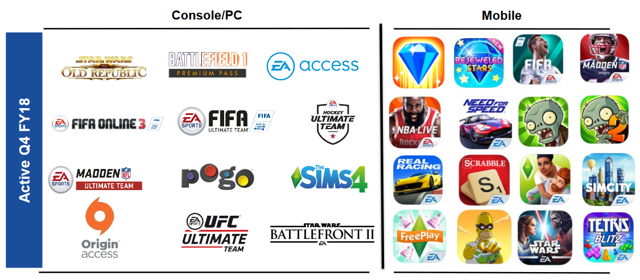
EA Games (EA) is a multinational software company that designs standalone and franchise video games for a multitude of different hardware devices. The company runs a multitude of different franchises within the gaming space, including Battlefield, the Sims, Fifa, and Madden, just to name a few. Devices this software is designed for range across mobile, Xbox, PC, PlayStation, and other major gaming consoles.

(Source: EA Games 1Q2018 Earnings Call Slides)
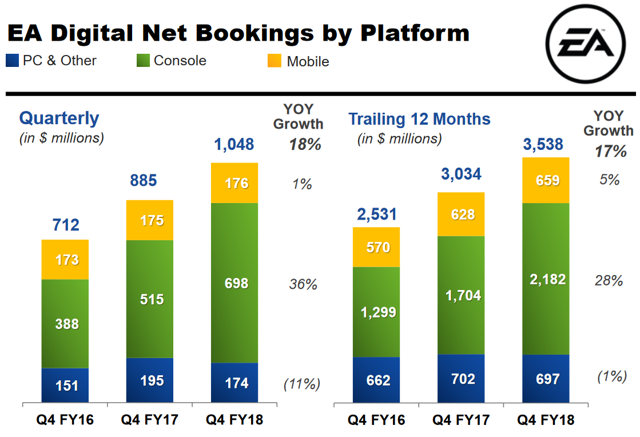
EA is generally coming out of a period of evolution and changes within the gaming industry. Over recent years, the industry has been fundamentally moved by the two major trends of the death of retail and the exponential growth of the cloud. This has allowed software companies to reallocate all of their services to download licensing and other non-physical delivery of products to ultimate end users. At the same time, this has also led to a general widening of margins for many companies within the space, as packaging design and other expenses have been taken out of the equation.

These changes have also led to another industry-wide trend in the software space, namely what is referred to as software as a service (SaaS). This premise encompasses the idea that software products are provided as a service through the cloud and hosted on company-owned servers and accessible from multiple devices through the internet. This is in contrast to the previous decade involving local installation of software on one's computer or device.

This idea of SaaS provides software producers with a major advantage however in that they are now able to actively update files and add content on a rolling basis. The games which used to be standalone titles with very distinct iterations have grown into moreso living games which have full content updates and additions that are much more expansive than simple patches. This provides producers with a key advantage in that, under this model, they can sustain a user base on an individual title by providing constant engagement and updates to keep users from getting bored and moving to other games. Rather than being forced to create an entirely new entity of a game and throw an arbitrary number at the end of the title, the individual entities have much longer lives. This ultimately allows producers to save costs through not needing to create an entirely new standalone title. Furthermore, users feel more engaged as a result, due to both the constant content updates and also the sense of community that each game in and of itself facilitates.

This trend can be seen substantially in the recent growth of the company's revenues, which are seeing explosive growth through digital platforms relative to traditional delivery methods.

(Source: EA Games 1Q2019 Earnings Call)
The Gaming Revolution of 2017/2018

2017 and 2018 ultimately represented a major shifting point in the mainstream presence of the gaming industry. While many people will simply refer to Fortnite as being the catalyst for this widespread acceptance, it was simply the last in a series of games that allowed the industry to reach the critical mass necessary to reach the mainstream.

What has ultimately led to the rise of gaming over recent years is the enhanced prevalence of esports being taken seriously, with substantial prize pools and competitive followings growing to the level of almost professional sports. One can see the substantial, multimillion prize pools that exist for top players in the spaces. Competitive games such as Dota 2, League of Legends, Overwatch, and others have cultivated massive followings, with League of Legends experiencing more than 100 MM live viewers for top-level tournaments.

This is similarly the case with EA in that they host competitive games such as Madden, Fifa, and other sports titles which have substantial prize support and competitive infrastructure in-place to keep the titles relevant for years to come. Furthermore, the company's virtual monopoly on the sports franchises creates a massive competitive moat for it that many of its peers' premier franchises lack. The battle royale and MOBA content seen over recent years has reached overly competitive levels, with borderline copies of games being released by other studios with blatant disregard for IP, especially in China and international markets. EA, however, due to their decision to retain focus on their key franchises, have faced much less impending competition as a result.

Furthermore, EA represents one of the few companies that continues to develop standalone titles in a more aggressive manner with a goal of ultimately adding them to their core portfolio. For instance, upcoming game Anthem is being hyped up as an incredibly developed game that will be a core EA franchise for years to come.

Impending Shift to Subscription Model Extremely Likely

A massive decision undertaken by the company recently is the test drive of a subscription service for PC content. This marks a major evolution of the gaming industry as typically the industry is incredibly seasonal. New titles hit the market in late fall and early winter to coincide with cold weather and generally more electronic device use, and producers hope to reap as much profit as possible in the initial period after release. The subscription model on the other hand solves this key issue of seasonality, and what has historically been volatility in revenue for these content producers.

While this is currently only set for use on the company's PC content, rhetoric put out by the company during its last earnings call leads us to believe this is moreso a markets test that will lead to a full company rollout across all consoles in the future.

Fiscal 2018 was a record year for Electronic Arts as measured against almost every major financial metric, from revenue to operating income to cash flow. Our success is driven by the way we have changed and continue to change our relationship with players. They want more depth in their favorite games and fresh content that can hold their attention year-round.

As a result, we've gone from one-off interactions at a moment in time to ongoing engagements with consistently changing dynamic worlds. It's a situation analogous to the transition we've seen in the software-as-a-service industry. Consequently, our business already looks very SaaS-like, with live services and subscription making up a greater and greater portion of our revenue. This has made our business much more stable and enabled us to deliver a dependable and growing cash flow to investors.

-Blake Jorgensen, CFO

(Source: EA Games 1Q2019 Earnings Call Prepared Remarks)

The company appears to have fully embraced this idea, as this was reiterated time and time again on the call when addressing analysts during Q&A.

So let me grab the first one. At its very core, you've heard us talk a lot about subscription plus cloud gaming and the opportunity for those two things to fundamentally disrupt the way people access and enjoy games like nothing before, much in the same way as it's disrupted enjoyment and engagement in movies and music.

And so we've talked about a three to five-year time horizon. We believe that cloud gaming is going to make a meaningful contribution to the way players engage with games. And of course, what that does mean is it really doesn't matter what device you're accessing it by. The experience that you have is governed by the size of the screen and the amount of time you have to play

And so everything we're building right now, we are thinking about a world where we will not be bound by device. We will not be bound by local compute or memory, but much of these experiences will exist in the cloud, and you'll access them based on whatever device you have access to at the time.

-Andrew Wilson, CEO

(Source: EA Games 1Q2019 Earnings Call Q&A)

Ultimately, this seems like a no brainer for the company. Current pricing plans are for $15 per month or $100 per year on the PC subscription service. Most of the major concern regarding this model lies with the boom factor that many releases have. If subscribers have access to these upon release, this could impact ultimate new game sales. However, as the exact structure hasn't been finalized and is still in the beta-testing phase with the market, these quirks will be refined. There's the possibility for things like "Early access" to new releases for some amount with the first 6 months post-release being a free access blackout period. The way the company could monetize this concept is endless while still taking in the monthly premiums from subscribers.

Increased Monetization of All Titles Drives Growth

Furthermore, through giving subscribers access to a multitude of older titles, it allows them to stick their hands into a multitude of games. This ultimately leads to more micro-transactions for in-game content which will be a major driver of producers' revenues moving forward. While EA received substantial backlash for the Star Wars loot box fiasco, which was essentially a pay-to-win monetization, the shift to making in-game purchased content primarily aesthetic and has minimal implications on actual gameplay has received absolutely zero backlash. On top of this, in a game where everyone's avatar is generally fairly generic, the ability to customize appearances is an extremely sought after and enjoyed experience for users.

Not only that, but shifting to a subscription service could allow for account-wide transactions, with single items being purchased in microtransactions being able to be applied retrospectively across all games. For instance, say purchasing your favorite World Cup teams jersey and having some form of it be equipped aesthetically for all multiplayer games from Sims to Fifa to Battlefield. This would not only create more value for consumers as they wouldn't have to worry about their purchases being useless if they stopped playing a single game, but it would also allow substantially more marketing of events to all users across the company's entire gamer base.

Buyback Program Supports Shareholders

Another attractive facet of EA's current management plan is its unique approach to returning value to shareholders. While many companies traditionally supply a quarterly dividend, EA opts to rather use substantial share buybacks when free cash flow permits. This creates an extremely flexible capital budgeting methodology for management, so if the company sees attractive investments in new content through either development or acquisition, cash can be diverted from expanded buybacks to these capital growth opportunities, which will ultimately drive further unlocking of value. Meanwhile, if buybacks are not extended, there will likely be no share-price impact relative to if this were a dividend cut, as the buyback programs are detailed in their entirety and must be extended or reinstated after their initial planned ending. This idea of capital flexibility was furthermore touched upon in the company's recent earnings call.

I'll hit that first. It's all three of those things. As Andrew mentioned, running a broad subscription service requires great content. And so we're always looking for great content and really great studios that can build that content. We partnered with Respawn for some time to get to know them. We believe they're a studio that can build not just the great games they're building today, but great games for a long time to come. And so it's a great studio and great partners that we can bring to the table in both mobile and console and PC, but also technology that will help us either in subscriptions or streaming, and you'll probably see some of that stuff to come.

Most of it is probably more small to midsized than large just because there's not that many large companies out there, but we'll look at everything, and we want to maintain that flexibility. And that was really the primary reason for not doing a dividend is that we felt if we started a dividend it would be much harder to stop it if there was some reason to flex up to do something larger. And that's the reason we decided to stay with the buyback. We feel it's the most efficient way to do it and it gives you full flexibility going forward.

- Blake Jorgensen, CFO

Additionally, looking at the company's current buybacks, they were most recently doubled to $2.4 bn for the next two years. Furthermore, the company has over $4 bn in free cash on its balance sheet currently set for no defined use. It is likely that as momentum in the gaming industry continues over the coming years, a further acceleration of buybacks per year from the current $1.20 bn per year is virtually guaranteed barring an industry-wide collapse in popularity.

Projections and Valuation

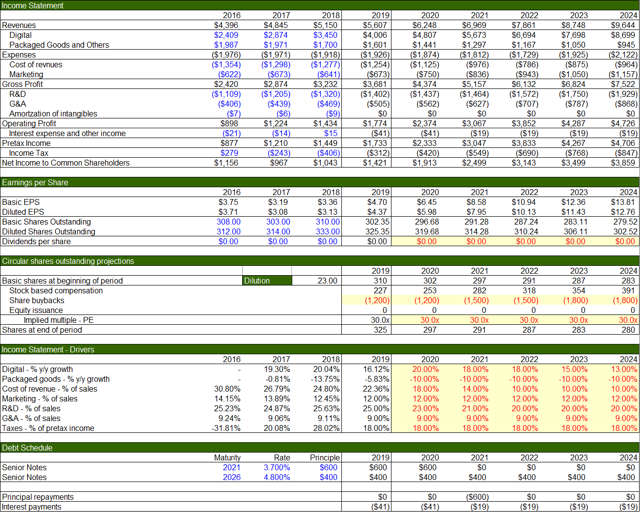
For our analysis of EA Games, we built out a revenue build and income statement and valued the company on both a multiples basis and a DCF basis using an exit multiple and perpetuity growth rate. Looking first at our revenue build assumptions below:

(Source: Self-made Model; Historicals from Company Filings; Some numbers backed into based on audited and unaudited Company reported numbers)
Major assumptions of note are the revenue growth rates and the substantial declines through time of cost of revenues and R&D. Furthermore, we also assumed a fairly large buyback level; however, these buybacks are all substantially within free cash flow while leaving an excess cushion, so we find them to be relatively likely given our other assumptions. The substantial decline in cost of revenue as a percentage of sales is driven by the company's increasing emphasis on developing live content and the planned shift to subscription services. We reduced this through time as the subscription model shift and increasing player base should keep these costs fairly fixed to declining through time. Even looking at the company's implied definition of this line item, one can see the extreme likelihood of margins continuing to expand against this backdrop:

Cost of product revenue consists of (1) manufacturing royalties, net of volume discounts and other vendor reimbursements, (2) certain royalty expenses for celebrities, professional sports leagues, movie studios and other organizations, and independent software developers, (3) inventory costs, (4) expenses for defective products, (5) write-offs of post launch prepaid royalty costs and losses on previously unrecognized licensed intellectual property commitments, (6) amortization of certain intangible assets, (7) personnel-related costs, and (8) warehousing and distribution costs. We generally recognize volume discounts when they are earned from the manufacturer (typically in connection with the achievement of unit-based milestones); whereas other vendor reimbursements are generally recognized as the related revenue is recognized.

(Source: EA Games 2019 10-K)

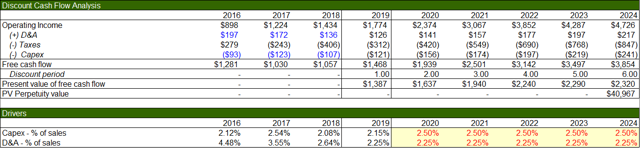
Looking at our free cash flow projections below, this leads to the following basic DCF buildout. Please note we did not project out working capital due to the extremely low working capital needs inherent in the company's business model:

(Source: Self-made Model; Historicals from Company Filings; Some numbers backed into based on audited and unaudited Company reported numbers)
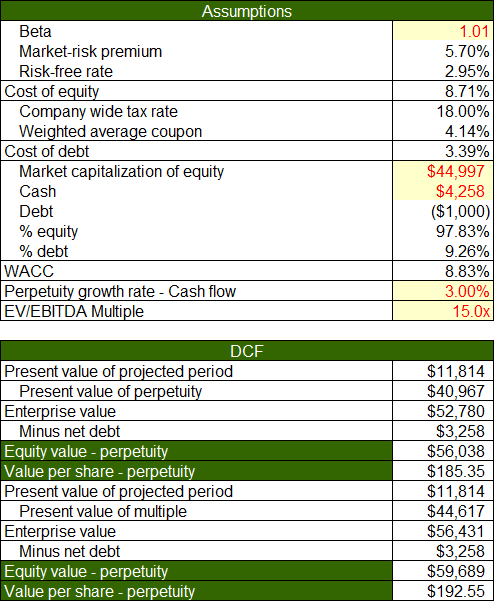
This then leads to our WACC build (note we used weighted average coupon versus YTM for COD due to not having access to secondary market debt pricing at this time) and ultimate DCF valuations:

(Source: Self-made Model; Historicals from Company Filings; Markets based numbers from Yahoo Finance)
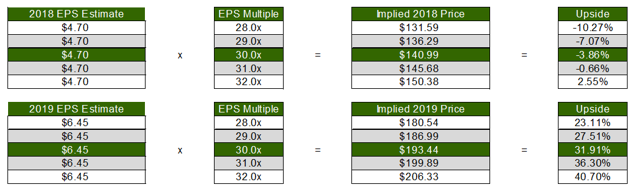
Contrasting this to our PE valuation below:

(Source: Self-made Model)

As one can see, based on our assumptions, there appears to be another 30-40% upside in the company's stock price from current levels. Given the relative momentum and favor of tech right now, alongside the positive earnings growth story that will likely continue to play out through 3Q2018, we feel comfortable taking exposure to EA even after the recent trade up. We primarily attribute the undervaluation to the recent decision to begin the slow transition to a subscriber model, but ultimately will likely see multiple expansion for the company similar to, though likely not to the same extreme extent as, Netflix (NASDAQ:NFLX). As increased clarity and guidance is given on the business model shift, in addition to increasingly successful monetization efforts of microtransaction content, we expect the price to rapidly converge with the upside presented here.

Risks

The largest risk with regards to EA is the risk of failure in the business model shift to a subscription-driven service. If the company makes any errors to create a lack of trust or favorability for EA relative to peers with this model, the company would likely face substantial PR backlash or poor market performance of the service. We see this as a tail risk. However, it is a fairly substantial tail risk, and thus the company's decisions as this shift is rolled out will be analyzed extensively, and if any negative sentiment begins to materialize, a sale of the stock would be warranted.

Another risk associated with the company is if the recent video game fanaticism is simply a fad rather than a larger consumer trend within the space, top-line revenue growth numbers will likely be less than we have predicted, with margins widening at a slower pace than we predict. This is a risk. However, given the extensive growth of esports over recent years, we also view this risk as very unlikely.

Conclusion

Overall, we view EA as our top pick within the gaming software peer group, as the company's competitive moat with such standalone franchises as Battlefield, Fifa, Madden, and Anthem prevent the market share wars many peers in the MOBA and battle royale style offerings currently face. We further view the company's decision to begin developing a more rigorous subscription model as a key driver within the space, as EAs offering of titles is substantially more supportive of this relative to its peers which focus more on the esports and competitive gaming revenue streams. Finally, with substantial share buybacks for the near future, likely to be expanded into the future, there will be continued support of the share price by management as excess cash is returned to shareholders.

Overall, we view EA Games as our top video game stock and continue to hold our position into the immediate future barring a material change in fundamentals or market trends.

Disclosure: I am/we are long EA.

I wrote this article myself, and it expresses my own opinions. I am not receiving compensation for it (other than from Seeking Alpha). I have no business relationship with any company whose stock is mentioned in this article.

Monday, May 28, 2018

Zacks: Brokerages Anticipate Rockwell Medical Inc (RMTI) Will Announce Earnings of -$0.13 Per Share

Equities analysts predict that Rockwell Medical Inc (NASDAQ:RMTI) will announce ($0.13) earnings per share for the current quarter, Zacks reports. Zero analysts have issued estimates for Rockwell Medical’s earnings, with estimates ranging from ($0.13) to ($0.12). Rockwell Medical posted earnings of ($0.14) per share in the same quarter last year, which suggests a positive year over year growth rate of 7.1%. The company is scheduled to issue its next quarterly earnings results on Wednesday, August 8th.

On average, analysts expect that Rockwell Medical will report full year earnings of ($0.38) per share for the current year, with EPS estimates ranging from ($0.49) to ($0.26). For the next financial year, analysts anticipate that the business will post earnings of $0.04 per share. Zacks Investment Research’s EPS averages are an average based on a survey of sell-side analysts that that provide coverage for Rockwell Medical.

Get Rockwell Medical alerts:

Rockwell Medical (NASDAQ:RMTI) last released its earnings results on Thursday, May 10th. The company reported ($0.13) earnings per share for the quarter, topping the Thomson Reuters’ consensus estimate of ($0.14) by $0.01. The company had revenue of $14.95 million during the quarter. Rockwell Medical had a negative net margin of 48.06% and a negative return on equity of 76.49%.

Several equities research analysts have recently weighed in on RMTI shares. BidaskClub raised shares of Rockwell Medical from a “sell” rating to a “hold” rating in a research report on Tuesday, March 13th. Zacks Investment Research downgraded shares of Rockwell Medical from a “hold” rating to a “sell” rating in a research report on Thursday, May 17th. Finally, ValuEngine downgraded shares of Rockwell Medical from a “sell” rating to a “strong sell” rating in a research report on Friday, February 2nd.

Several institutional investors and hedge funds have recently added to or reduced their stakes in RMTI. MetLife Investment Advisors LLC bought a new stake in shares of Rockwell Medical in the 4th quarter worth about $110,000. Goldman Sachs Group Inc. increased its position in shares of Rockwell Medical by 117.3% in the 4th quarter. Goldman Sachs Group Inc. now owns 27,139 shares of the company’s stock worth $158,000 after purchasing an additional 14,648 shares during the last quarter. Millennium Management LLC bought a new stake in shares of Rockwell Medical during the 4th quarter valued at about $217,000. Schwab Charles Investment Management Inc. grew its position in shares of Rockwell Medical by 21.9% during the 1st quarter. Schwab Charles Investment Management Inc. now owns 95,900 shares of the company’s stock valued at $500,000 after buying an additional 17,200 shares during the last quarter. Finally, Deutsche Bank AG grew its position in shares of Rockwell Medical by 107.7% during the 4th quarter. Deutsche Bank AG now owns 121,202 shares of the company’s stock valued at $704,000 after buying an additional 62,842 shares during the last quarter. 21.21% of the stock is owned by institutional investors.

RMTI opened at $5.68 on Thursday. The stock has a market capitalization of $307.50 million, a PE ratio of -11.14 and a beta of 2.18. Rockwell Medical has a 1-year low of $4.84 and a 1-year high of $8.70.

About Rockwell Medical

Rockwell Medical, Inc operates as an integrated biopharmaceutical company targeting end-stage renal and chronic kidney diseases in the United States and internationally. The company's lead drug includes Triferic, an iron maintenance therapy that replaces the iron lost by patients during hemodialysis treatment.

Get a free copy of the Zacks research report on Rockwell Medical (RMTI)

For more information about research offerings from Zacks Investment Research, visit Zacks.com

Friday, May 25, 2018

Toronto Dominion Bank (TD) Q2 2018 Earnings Conference Call Transcript

Logo of jester cap with thought bubble with words 'Fool Transcripts' below it

Image source: The Motley Fool.

Toronto Dominion Bank (NYSE:TD)Q2 2018 Earnings Conference CallMay 24, 2018, 1:30 p.m. ET

Contents: Prepared Remarks Questions and Answers Call Participants Prepared Remarks:

Operator

Good afternoon, ladies and gentlemen. Welcome to the TD Bank Group Q2 2018 conference call. Please be advised that this call is being recorded. I would now like to turn the meeting over to Ms. Gillian Manning, Head of Investor Relations. Please go ahead.

Gillian Manning -- Head of Investor Relations

Thank you. Good afternoon, and welcome to TD Bank Group's second quarter 2018 investor presentation. My name is Gillian Manning, and I am the Head of Investor Relations at the Bank.

We will begin today's presentation with remarks from Bharat Masrani, the Bank's CEO, after which Riaz Ahmed, the Bank's CFO, will present our second quarter operating results. Ajai Bambawale, Chief Risk Officer will then offer comments on credit quality, after which we will invite questions from prequalified analysts and investors on the phone.

Also present to answer your questions today are Teri Currie, Group Head, Canadian Personal Banking; Greg Braca, President and CEO, TD Bank, America's Most Convenient Bank; and Bob Dorrance, Group Head, Wholesale Banking.

Please turn to slide 2. At this time, I would like to caution our listeners that this presentation contains forward-looking statements, that there are risks, that actual results could differ materially from what is discussed, and that certain material factors or assumptions were applied in making these forward-looking statements. Any forward-looking statements contained in this presentation represent the views of management and are presented for the purpose of assisting the Bank's shareholders and analysts in understanding the Bank's financial position, objectives and priorities, and anticipated financial performance.

Forward-looking statements may not be appropriate for other purposes. I would also like to remind listeners that the Bank uses non-GAAP financial measures to arrive at adjusted results to assess each of its businesses and to measure overall Bank performance. The Bank believes that adjusted results provide readers with a better understanding of how management views the Bank's performance. Bharat will be referring to adjusted results in his remarks. Additional information on items of note, the Bank's reported results and factors and assumptions related to forward-looking information are all available in our Q2 2018 report to shareholders. With that, let me turn the presentation over to Bharat.

Bharat Masrani -- Group President and Chief Executive Officer

Thank you, Gillian, and thank you everyone for joining us today. Q2 was another terrific quarter for TD. Earnings increased 20%, crossing the $3 billion threshold for the first time and EPS rose 21% to $1.62. All of our businesses performed well. Revenue growth was strong, as we continued to drive new business to a differentiated customer experience. We managed expenses well, delivering positive operating leverage across the enterprise and lowering our efficiency ratio.

Our capital and liquidity metrics are robust, with our CET1 ratio ending the quarter at 11.8%, up 120 basis points from the prior quarter, helped by the new Basel II floor and continued organic capital generation. Our return on equity increased to 18%, reflecting an improving profitability profile. These impressive results speak to the power of our customer-centric model, the advantages of our scale and diversification, and the discipline we have shown in growing our businesses while staying within our risk appetite.

They also reflect good execution against our strategic priorities. Over the last few years, we've been investing in our businesses to elevate our customer service proposition and position ourselves to succeed in a digital world. We've continued to evolve our distribution network to make sure we are providing customers and clients with the right touch points in the right channels at the right time. We are reimagining every step of the customer journey to deliver richer, more seamless experiences. We are leveraging new technology to help them engage with us more easily and offer personalized solutions they can trust and rely on.

To further extend our innovation leadership, we recently became the first Canadian bank to the join the Canadian Institute for Cybersecurity at the University of New Brunswick. This builds on our cybersecurity office, which opened in Tel Aviv last fall. Our growing catalog of patent filings and our acquisition of artificial intelligence leader, Layer 6, earlier this year. These investments are central to our ability to design the next generation of legendary customer and colleague experiences by tapping into some of the world's top technology ecosystems while developing homegrown talent in Canada and at TD, all in the name of building the better bank.

Our strong performance this quarter demonstrates our ability to innovate, execute, and deliver for all our stakeholders. Let me now turn to our business segment results. Canadian Retail had a banner quarter, with net income up 17%. Strength was broad-based, with our banking, wealth, and insurance businesses all delivering double-digit earnings growth. We added volumes in key product lines by winning more of our customers' trust and business. We benefited from our No. 1 share in core deposits with rising rates driving further margin expansion.

We reached a milestone in our auto finance business, with TD Auto Finance ranking highest in dealer satisfaction among non-captive retail lenders by J.D. Power. Our first time in the top spot, up from the No. 3 position in 2017, demonstrating the success we've had in growing this business. Credit quality remains strong, reflecting our disciplined underwriting practices in variable economic conditions.

We also continued innovating to serve our customers better. In our real estate secure lending business, we enhanced our digital homeowners' journey with the addition of a new mortgage pre-approval tool. Customers can now complete the online application in minutes and are contacted by a phone channel representative promptly. This best-in-class capability empowers our customers to get the advice they need in the moment for one of the most important purchases they'll ever make.

In everyday banking, we are proud to be the first of the Big 5 Banks to partner with the Canada Revenue Agency to automate direct deposit enrollment this quarter, a simple but powerful innovation that is helping to deliver income tax refunds more quickly and securely.

In our direct investing business, the online account opening platform we launched in February is driving strong engagement and new client acquisition. The new onboarding tool provides a digital gateway to our web broker platform, complete with e-signature and the ability to transfer accounts to TD with ease, and end-to-end self-service capability that no other Canadian bank offers.

These tools and platforms add to our portfolio of apps, like TD MySpend, TD MyAdvantage, and TD for Me, and complement the advice specialists we've been adding in our branch and phone channels, as well as the professionals in our unique design center of excellence. Together, they form a set of omnichannel capabilities that allow us to give customers and clients the care and insight they need to feel more confident about their financial lives. This commitment to delivering personal, connected experiences is how we built a premier retail franchise in Canada and the investments we are making today will power the next leg of our success.

South of the border, our US Retail bank also delivered impressive results this quarter, with earnings up 21%, to $673 million US dollars. The strong performance was supported by peer-leading growth in loan and deposit volumes, higher margins from the rising rate environment, and a lower tax rate. We delivered another quarter of positive operating leverage while continuing to invest in our business. With the contribution from TD Ameritrade up almost 90% from a year ago, segment earnings push further above the $1 billion Canadian dollar mark and segment return on equity rose to nearly 13%.

Our US Retail franchise is benefiting from strong tailwinds and we are taking advantage of the opportunity. As I mentioned last quarter, we've been adding frontline staff in key areas and building out our small business banking offering. We also continue to enhance our core capabilities and infrastructure. We recently launched a new mortgage and home equity platform which will help us get to yes faster and improve the customer experience. Our efforts are bearing fruit. This quarter, TD Bank, America's Most Convenient Bank, received the highest customer satisfaction with retail banking in Florida, according to J.D. Power 2018 US Retail Banking Study.

Rounding out our businesses, our wholesale bank also had a strong quarter. Earnings were up 8%, reflecting higher trading revenue and continued environments in the rollout of our US dollar strategy. TD Securities continued its record of winning significant mandates that highlight our top-tiered dealer status in Canada and our growing global execution capabilities. We advised Choice Properties REIT on their $6 billion acquisition of Canadian REIT, the largest ever public M&A and debt financing in the Canadian real estate sector, underwriting $3.6 billion of committed credit facilities and acting as book earner for their additional debt offering.

We continue to be active in the sustainable and green bond space, acting as joint lead on $600 million US dollars in issuance, including the World Bank's 1.2 billion Swedish Krona and 500 million Norwegian Krona issues, our first sustainable mandates in the se currencies, as well as the Province of Quebec's $500 million Canadian dollar green bond. We were named Canada Derivatives House of the Year, coming forth in fig bonds and most impressive SSA housing Australian, Canadian, and New Zealand dollars by Global Capital, a testament to the strides we've made in building our capital markets business.

As I look back on the first half of the year, I'm very pleased with our performance. Total bank earnings are up 17% year-to-date and EPS is up 19%, reflecting momentum in our franchise businesses and a macro environment that remains more resilient than many expected. While we expect year-over-year earnings growth to moderate in the second half of the year due in part to a very strong third quarter in 2017, our full-year results are on pace to exceed our medium-term targets.

As always, we are taking advantage of this strong performance to invest in our continued growth and transformation, as well as in the success of those we serve. We were proud to launch the ready commitment at our annual meeting in March and have targeted $1 billion in total by 2030 in four areas that we believe are critical to building confidence in an inclusive tomorrow: increasing access to the opportunities people need to build greater financial security; improving the quality of our environment so people in economies can thrive; creating opportunities for everyone to participate and feel more connected to their communities; and supporting better health outcomes for all.

The TD brand stands for trust, confidence, and legendary experiences. The ready commitment is an extension of this promise and will help prepare millions of people across North America to seize the opportunities and navigate the challenges of our rapidly changing world.

To wrap up, it's been a great first half of 2018. We are delivering strong results today while laying a solid foundation for our continued growth. I'd like to thank all of our 85,000 colleagues for their hard work and dedication. United by our purpose to enrich the lives of our customers, colleagues, and communities, I know there is nothing we cannot accomplish together. With that, I'll turn things over to Riaz.

Riaz Ahmed -- Group Head and Chief Financial Officer

Thank you, Bharat. Please turn to Slide 5. This quarter, the Bank reported earnings of $2.9 billion and EPS of $1.54. Adjusted earnings were $3 billion, up 20% year-over-year, and adjusted EPS was $1.62, up 21%. Results were strong across all our businesses. Revenue increased 12%. On a taxable equivalent basis, revenue increased 6%, reflecting higher volumes and margins in the Canadian and US Retail segments.

Credit losses declined quarter-over-quarter, reflecting the higher PCL in Stages 1 and 2, taken in the first quarter, and a stable economic outlook. Expenses were up 1%. We expect the rate of expense growth to be higher in the second half of the year, as we take the opportunity to make further investments in our businesses.

Please turn to Slide 6. The Canadian Retail segment net income was $1.8 billion, up 17% year-over-year on good revenue growth, lower PCL, and very strong operating leverage. Revenue increased on volume growth, rising margins, and higher non-interest income in the insurance, wealth, and banking businesses. Loans and deposits grew by 6% year-over-year, with increases in both personal and business volumes. Margin was 2.91%, up 3 basis points quarter-over-quarter due to rising rates. Net interest margin has risen 10 basis points year-over-year.

Total PCL declined by 19% quarter-over-quarter. PCL impaired decreased by 8%, reflecting strong credit performance in personal and business banking. PCL performing was nil this quarter. Total PCL as an annualized percentage of credit volume was 23 basis points, down 4 basis points quarter-over-quarter, remaining at cyclical lows. Expenses increased 1% year-over-year.

I'd also like to bring to your attention that we have introduced new disclosures this quarter for our Canadian real estate secured lending portfolio. In our MD&A and sub-pact, we are now showing the breakdown of amortizing and non-amortizing balances for our HELOC portfolio. As we note on Slide 22 of this presentation, 55% of our HELOC portfolio is amortizing.

Please turn to Slide 7. US Retail net income was $770 million in US dollars on a reported basis and $287 million on an adjusted basis, up 30% year-over-year. The US Retail bank earned $663 million in US dollars on a reported basis, up 20% year-over-year. The strong result was driven by 9% revenue growth, reflecting higher volumes, wider margins and fee income, and the benefit of a Scottrade transaction, as well as a lower corporate tax rate.

Average loan volumes increased by 5%, reflecting growth in the personal and business customer segments. Deposit growth of 8%, including strong growth in core checking accounts of 8%, and a 17% increase in sweep deposits from TD Ameritrade due mainly to the Scottrade transaction. Net interest margin was 3.23%, up 4 basis points quarter-over-quarter, driven by higher deposit margins, partially offset by balance sheet mix. Year-over-year, net interest margin has increased by 18 basis points.

Total PCL decreased 17% quarter-over-quarter. The decline was driven mainly by reduction in PCL performing due to seasonal trends in the credit card and auto portfolios, coupled with lower volume growth in the US commercial portfolios. Last quarter, we began providing the PCL ratio for the US Retail bank excluding the retail program partners contractual share of PCL for the strategic cards portfolio, which is held in the corporate segment and offset in corporate non-interest expenses. This net US Retail PCL ratio was 45 basis points in Q2, down 7 basis points from last quarter.

Expenses increased 7% year-over-year on a reported basis, reflecting higher investments in business initiatives, business volume growth, higher employee-related costs, and charges associated with the Scottrade transaction partially offset by productivity savings.

The contribution from our environment in TD Ameritrade increased by 30% year-over-year on a reported basis and 88% adjusted for TD's share of the charges related to the Scottrade integration. Segment ROE was 11.9% on a reported basis and 12.7% on an adjusted basis, up 270 basis points from a year ago.

Please turn to Slide 8. Net income for whole segments was $267 million, up 8% reflecting higher revenue, partially offset by higher PCL, and higher non-interest expenses. Revenue increased 7%, reflecting higher trading related revenue. Total PCL was $16 million. PCL impaired was a net recovery of $8 million quarter-over-quarter, reflecting a recovery of provisions in the Oil & Gas sector, and PCL performing was $24 million, reflecting credit migration and the release of provisions in the prior quarter.

Non-interest expenses rose 4%, reflecting continued environments in client-facing employees, supporting the global expansion of wholesale banking's US dollar strategy.

Please turn to Slide 9. The Corporate segment reported a net loss of $163 million in the quarter, up 2% year-over-year. The higher loss is driven by higher amortization of intangibles and lower non-controlling interest in the current quarter, partially offset by higher other items. The higher contribution from other items was largely due to high revenue from Treasury and balance sheet management activities in the current quarter.

Please turn to Slide 10. Our Common Equity Tier 1 ratio was 11.8% at the end of the second quarter, up 123 basis points from the first quarter. We had strong organic capital generation this quarter, which added 37 basis points to our capital position, which was mostly offset by growth in risk-weighted assets.

Our capital ratio position benefited from the traditional Basel II floor, which came into effect in the second quarter. As the new floor is not currently binding for TD, this added 120 basis points to the CET1 ratio. We do not expect the floor to be binding to us for some time. Our leverage ratio was 4.1%, and our liquidity coverage ratio was 123%. I will now turn the call over to Ajai.

Ajai Bambawale -- Group Head and Chief Risk Officer

Thank you, Riaz. Good afternoon, everyone. Please turn to Slide 11. Credit quality remains strong in the second quarter across all business segments, as evidenced by reductions in gross impaired loans formations, gross impaired loans, and credit losses. Gross impaired loan formations were $1.15 billion, or 18 basis points, down 2 basis points quarter-over-quarter, and stable year-over-year. The decrease in the quarter was driven by the US Retail segment, largely due to seasonal trends. Canadian Retail remains segment and there were no new formations in the wholesale segment.

Please turn to Slide 12. Gross impaired loans ended the quarter at $2.99 billion, down 2 basis points quarter-over-quarter, and down 6 basis points, year-over-year. Canadian Retail gross impaired loans remain stable at 20 basis points. Gross impaired loans in our US Retail segment were down US $48 million quarter-over-quarter, but more than offset by our foreign exchange impact of $81 million. Whole segment gross impaired loans decreased $31 million, quarter-over-quarter, to a zero impaired loan balance due to the full resolution of all impaired Oil & Gas exposures.

Please turn to Slide 13. This quarter, our presentation has been amended to report PCL ratios, both gross and net of the partners' share of the US strategic credit card losses. In doing so, we remind you that the Bank's contractual portion of the credit losses is reported in the US Retail segment, whereas the partners' share is reported in the Corporate segment. The Bank's provisions for credit losses in the quarter were $562 million, or 36 basis points, down 9 basis points quarter-over-quarter, and stable year-over-year.

The decrease in PCL in the quarter was driven by continued strong credit performance in the Canadian Retail segment and seasonal trends in the US credit card and auto portfolios, reflected in lower US Retail PCL, and specifically for the US strategic card partners' share in the lower US Corporate segment PCL.

Please turn to Slide 14. Quarter-over-quarter, a $40 million decrease in impaired PCL primarily reflects continued strong credit performance in Canadian Retail and seasonal trends in the US credit card and indirect auto portfolios. The quarter-over-quarter $100 million decrease in performing PCL is due to, again, US seasonal trends, lower volume growth in the US commercial portfolio, and the prior quarter bill in Canadian Retail.

In summary, credit quality continues to be strong across all the Bank's portfolios, and we remain well positioned for continued growth. With that, Operator, we are now ready to begin the Q&A session.

Questions and Answers:

Operator

Thank you. If you would like to ask a question, please signal by pressing *1 on your telephone keypad. If you are using a speakerphone, please make sure your mute function is turned off to allow your signal to reach your equipment. Again, that is *1 if you would like to ask a question.

We'll now take a question from Meny Grauman from Cormark Securities.

Meny Grauman -- Cormark Securities -- Analyst

Good afternoon. I want to ask about the PCL ratio, the stepdown in Canada. Specifically, how sustainable do you think that stepdown is? If you could give us a little more color in terms of what's driving it? Is it just the very low unemployment rate and some guidance going forward in terms of where you expect that PCL ratio to trend?

Unidentified Speaker

I am seeing good credit quality across the Canadian book, I'll say, certainly on personal. It's pretty stable on commercial as well. I think it's the economic environment that's causing that. If I look forward and I look at history for Canada, PCLs tend to be quite stable. I do expect overall if you recollect, I've given guidance around 40 to 45 basis points for the overall enterprise. I think if the macro environment remains supportive, I do expect overall to be at the lower end of that range for the full-year.

Meny Grauman -- Cormark Securities -- Analyst

Okay. Thanks for that. If I could just ask on the insurance business, it looks like quarter-over-quarter improvement in earnings quite strong actually. We heard that the quarter wasn't so great. That's an understatement for auto insurance in particular. That performance seems a little bit out of whack with just the bigger picture view of the P&C insurance business for the quarter. I was wondering what was driving that? If there's any additional insight you can provide on that business, specifically.

Teri Currie -- Group Head, Canadian Personal Banking

Thanks. It's Teri. We feel good about the growth of the insurance business this quarter, as you've cited. Definitely premium growth is looking good in the business. There was an item in the quarter that we did note. In revenue, there was renewal of some international reinsurance contracts. Those, just the timing of which were, a portion of those renewed in Q2. Some of that was offsetting claims or that would've been offsetting claims.

Having said that, if we just look at the core performance of the business, we're feeling good about how the business is performing. In terms of auto specifically, we would've continued to see elevated claims costs for the repair of vehicles that we talked about last quarter. That is consistent with the industry. Having said that, our prior year development was more favorable than that and more than offset that trend.

Meny Grauman -- Cormark Securities -- Analyst

Is there anything, I see if I go back to 2017 as well, it looks like for the past two years, Q2 has been a very strong quarter. Is there any seasonality there or something that's changed that would make Q2 sort of the strongest quarter of the year in that business?

Teri Currie -- Group Head, Canadian Personal Banking

Q2 versus Q3, you can sometimes a weather impact in Q3, for instance. That didn't happen last year. I would say there have been a number of investments we've been making in this business over time to improve our customer experience and to improve our capabilities and our claim capabilities. I think those things are paying off, including collision centers that we've opened to help customers who find themselves in a difficult situation.

Meny Grauman -- Cormark Securities -- Analyst

Thank you.

Operator

We'll now take a question from Steve Theriault with Eight Capital.

Steve Theriault -- Eight Capital -- Analyst

Thanks very much. Maybe first for Bharat. Bharat, you've got a near 12% CTE1 and a relatively 1% buyback in place. Wondering now with the elimination of the floor, should we expect you to be more active in terms of repurchases given the excess capital? Is 1% the right sizing for the buyback, given where you are capital-wise?

Bharat Masrani -- Group President and Chief Executive Officer

Steve, a few things I'd say. We've been consistent on this. Firstly, while the regulatory issues around capital have been less uncertain now, but there's totally not clear and there's Basel III floor, the output floor. I think [inaudible] has suggested they'll be coming out with some kind of guidance soon. There are a lot of moving parts there, although I would acknowledge that it is much more certain today than we had a while ago. But from TD's perspective, we've been consistent on this.

Our capital deployment framework has not changed. We do want to make sure that we have more than adequate capital to invest in our core strategies. We want to make sure that we have the flexibility should we need to use our capital to build on capabilities we think are critical for the Bank's growth on an ongoing basis. We have signaled that we are keen on acquisitions in certain types of markets in the US, certain types of offerings and/or products and we continue to look for those. I've also said that in Canada, of course, we would look at anything and everything that comes around. We look at it seriously as long as all these acquisition opportunities meet our strategy and there is financial hurdles that are appropriate and are within our risk appetite.

Then, of course, with all that, if we think that we've done all that and we still have excess capital, we will certainly think about buying back our shares. So that's how we are thinking about it. Nothing has changed here. We will review this on an ongoing basis. As you rightly pointed out, we did announce a buyback and that is in the market, as you know. We had a press release out last month. We will continue to consider that and we like our position overall on the capital side.

Steve Theriault -- Eight Capital -- Analyst

Okay. Thanks for that color. Then maybe just a quick follow-up for Teri, the new disclosure around the HELOC, the mix of amortizing versus non-amortizing versus the 55% you give in the disclosure. Can you tell us has there been any change on this front with rates rising? Has it been pretty steady around half for the last year, couple years? Is there any movement on that?

Teri Currie -- Group Head, Canadian Personal Banking

So if you think back to some of the prior conversations we've had on this topic, part of the reasons for amending the disclosure is to try to make this growth story more clear. You have seen and continue to see in this quarter, year-over-year growth specifically in amortizing HELOC. That has been a strategy. It is an area where we have an embedded growth opportunity and it's a great product, very convenient and flexible for the right TD customer. So, in fact, that growth in the amortizing portion has exceeded and, in fact, continued to grow. So, proportionately, it would continue to be a more important part of the HELOC portfolio, I would expect, going forward.

Steve Theriault -- Eight Capital -- Analyst

Okay. I may follow up, but thanks for that color. I appreciate it.

Operator

We'll now take a question from Ebrahim Poonawala with Bank of America.

Ebrahim Poonawala -- Bank of America Merrill Lynch -- Analyst

Good afternoon. I just want to follow up. Riaz, I think you mentioned expense growth was 1% up year-over-year. You've seen pretty significant improvement in the efficiency ratio year-over-year, down to like 50.1% adjusted basis. I just wanted to get a little more color in terms of how much higher expense growth we should expect for the back half of the year and what that implies in your view for the efficiency ratio?

Riaz Ahmed -- Group Head and Chief Financial Officer

Thanks for that, Ebrahim. As we called out in Quarter 1, we are looking at opportunities to accelerate some of our investments consistent with our overall strategy and priority. I repeat that this quarter. We have a number of, let's say a couple hundred million dollars of additional expense initiatives that are in the hopper to be able to execute. I think if we are able to execute on all of them by Q3/Q4, I think you could see overall expense growth rate rise by maybe 1% to 1.4% for the year.

I think if you look at the expenses on a 6-month basis, you also have to keep in mind that the foreign exchange rate does play a role in this. So, expense growth ex-FX on a 6-month basis would've been closer to 2%. I think if we end the year at 3%, 3.5%, I think that would be reasonable.

Ebrahim Poonawala -- Bank of America Merrill Lynch -- Analyst

Understood. That helped. Thank you. I do want to follow up on Steve's question on capital. Should we assume that you may operate with a little elevated capital level for the time being until you find the right M&A opportunity or until we get better clarity on Basel floor? I'm just wondering do you see a need to quickly bring this capital ratio down closer to 11% or not?

Bharat Masrani -- Group President and Chief Executive Officer

We won't feel compelled to bring it down quickly just for the sake of it. As I said, if there are M&A opportunities, then we do look at them. We are a quality buyer and we are viewed as such. That's our brand. So, we look at enough of these. But at the end of it, if we come to the conclusion that for the next little while there is not going to be much use of it, then we will seriously consider increasing our buyback as well. So, that's how I position it, Ebrahim. I don't think we put timelines that by such-and-such date if we don't find something, then we ought to bring our capital down. That's not how we would operate.

We would look at what's in the market, what are the opportunities, what might be coming down the pike as well. Because given our size and stated view and what kind of markets we would be interested in acquiring, a lot of inquiries are made of us. So, we look at all of those and at the end of the day, if there are none that are acceptable or interesting, then of course we would look at buybacks as well.

Ebrahim Poonawala -- Bank of America Merrill Lynch -- Analyst

Just on M&A, I think you previously talked about interest in the US [inaudible] Bank M&A is concerned. Does the environment today within -- one transaction happened earlier this week. Do the valuations, any of those look prohibitive to you in terms of doing deal or do you think you are in a better place right now from a regulatory standpoint to be able to do a US bank M&A?

Bharat Masrani -- Group President and Chief Executive Officer

As you rightly point out, when you get into a better environment, the values are not as attractive. That's part of the M&A world. We continue to look at the Florida market. The Southeast of the US is really interesting to us. We have a fantastic franchise there. We worked hard to build it, but we feel there are huge growth opportunities given our footprint in the US. The Northeast, a lot of folks in the Northeast do have homes or vacation in the Southeast of the United States. It also helps our Canadian business. I think we've talked about this before. We have a few stores that we opened on the West Coast of Florida that, for the most part, cater to our Canadian clientele. Those are doing very well for us.

So we like the Florida market; we like the Southeast market. There are some opportunities there that are more interesting than others. But values will be an important consideration for us. As I've said before, not only do they have to fit strategically, they have to make financial sense and, of course, they have to be within our risk appetite as well. So that's why we've been more measured. Sometimes you meet one or the other and others, you know, all of them are not suitable for us. But that would be an interesting one for us to look at.

I think we've also said, given our experience in these partnership deals in the credit card field, that continues to be of interest to us. I know there is a lot of discussion on whether this is the right time in the cycle to be looking at those types of transactions. We feel that if we get the right partners, these businesses are attractive through the cycle and if the right opportunities were to present themselves, we'd look at it seriously. So that's what we've said in the US.

Of course, in Canada, given our positioning here, any kind of acquisition if it were to come along, we would look at seriously. So, that's our approach here. But I think your key question, are values elevated? Of course they are. But there is some offset in the environment and the prospects for the business going forward.

Ebrahim Poonawala -- Bank of America Merrill Lynch -- Analyst

Very helpful. Thank you.

Operator

We'll now take a question from Gabriel Dechaine with National Bank Financial.

Gabriel Dechaine -- National Bank Financial -- Analyst

Good afternoon. Just a clarification on one of your earlier responses. Riaz, you said expense growth 1% to 1.5% for the year and back half something like 3% to 3.5%. Did I hear that correctly.

Riaz Ahmed -- Group Head and Chief Financial Officer

No, Gabriel. I was referring to the whole year. So, if you look at the first 6 months and say that expenses without taking FX into account would be up 2%, then if we [inaudible] another couple of hundred millions into Q3 and Q4, that should give us another 1% growth, so that we'd end up in the 3%, 3.5% territory for the whole year.

Gabriel Dechaine -- National Bank Financial -- Analyst

Gotcha, OK. Thank you. Just want to ask about, and this is for Teri. Some of the pricing action we've seen from the Bank in the last month or so on the mortgages, some on the 5-year fixed and then on the variable rate, I guess that's gotten more competitive, and then also TD specifically the fees, so some of the banking fees, we've seen some tweaks there. Am I going to notice that? Should I make a big deal about it? Because it could have some tailwind effect.

Teri Currie -- Group Head, Canadian Personal Banking

Let me take [inaudible] pricing and then fees as two separate topics. On the real estate secured lending side, for certain, we're constantly watching two things for posted rates, in particular. The cost of funds and then the competitive situation. Certainly at the end of April for the 5-year fixed rate, our feeling was that from a yield perspective, there was opportunity to raise that rate and others followed us. In terms of the variable interest rate mortgage, as you cited, some competitive dynamic there. We're still comfortable that we're originating deals at customer rates that are competitive and continue to feel comfortable with our growth guidance that we've given as well around mid-single digits for Fiscal '18 for total proprietary real estate secured lending.

On the fee side, some of the revenue performance that you would've seen this Q2 would've been the decisions we made around overall fees last year playing their way across our businesses. Having said that, there are a variety of things we look at. You may recall last year we actually took away the fee for many of our checking customers to make e-transfers. We actually do not charge a TD fee for non-TD ATM use.

Notwithstanding, we made a portfolio of changes to fees across our businesses, we also in this quarter we have earned through some of those changes we made to give back value to our customers in areas that are important to them. So net-net, I would say the fees that you might've seen communicated this year would've been the same kind of thing. We look across the portfolio. We consider where we can add value to customers. We consider how we're doing competitively. We communicate to customers ways that they could perhaps not pay a fee through different behaviors or activities with us and we make those assessments.

In terms of looking out and saying how material would that be, I'd say in the overall scheme of things, these were more tweaks overall for pricing changes in '18. I wouldn't expect them to be material the back half of this year into next year.

Gabriel Dechaine -- National Bank Financial -- Analyst

Thanks, Teri. That's a great response. Then my last one here -- and this is maybe a bit of a random one, but if I look across you cards portfolio, balances are flat year-over-year. If I look at the non-amortizing HELOC portfolio, if I can find it here. Yeah, it's also pretty flat. And if I look at our Canadian commercial real estate portfolio, in the wholesale book it's growing, but at about a quarter of the rate that I'm seeing from some of the other banks. I'm just wondering if I'm being, if there's anything there. Are there are markets where you're maybe pulling back? You're seeing things you don't like? Or is this something that you view and you're not happy with it and you want to actually change it?

Teri Currie -- Group Head, Canadian Personal Banking

Let me do that one in three pieces as well then. So, on the commercial loan front, we are growing commercial loans, albeit at a lower pace than our overall -- sorry, commercial real estate loans at a lower pace than our overall commercial loans. I would say we're happy with the growth of that business and the risk profile of that business. As Paul and his team work in the market to deal with our customers, they're not shy to not do business that they don't think makes sense from a risk perspective.

If you talk about the float HELOC, that again is that strategy that we've been deploying around the improvements we made to our amortizing HELOC product as a credible mortgage substitute for customers, and you may recall we have an embedded growth opportunity where we didn't have those product enhancements or that exact capability to make it a mortgage substitute for customers over the past few years. We enhanced the competitiveness of that product. So, really, we look at total real estate secured lending growth. Those amortizing balances have been growing more quickly than the float balances and we're completely comfortable with that. Again, hitting the growth that we've been communicating.

As it relates to cards, if you look at the portfolio overall, the Visa products are doing particularly well. These are the enhancements we've made to our lineup, in particular on cash back and everyday rewards, where we're performing better than what we'd expected when we launched those products. Overall, our Visa retail sales are above the Visa industry average. So, very comfortable not only with our leadership position in cards, but the growth in the Visa portfolio.

We have been rationalizing and streamlining the overall cards business. I talked about this in the past period of time. We did sell a portion of the [inaudible] portfolio, some in Q1, some in Q2. We've done less retail card services business. Those are completely aligned with our expectations. We've been continuing to improve the profitability of our MBNA business by doing fewer, lower yielding promotional loans, for instance. Putting it all together, the portfolio itself is not overall growing quickly, as you said, but the parts of that which are strategic for the growth for the future are doing particularly well.

Gabriel Dechaine -- National Bank Financial -- Analyst

It sounds, well, the MBNA is a little higher, I guess further out on the risk curve if you're not pushing that one as much as you are the VISA? It sounds similar, I guess, to what's taking place in the float HELOC in the sense that you're not chasing growth in those markets.

Teri Currie -- Group Head, Canadian Personal Banking

On the MBNA for sure, what we're not, we're really looking at a volume sort of profitability trade-off there. The promotional loans is less of [inaudible] decision, more of a we want to make sure we're getting paid for the business we're doing. But overall, we definitely are not in the business of chasing risk that's outside our appetite in any lending product.

Gabriel Dechaine -- National Bank Financial -- Analyst

All right. Thank you for the discussion.

Operator

We'll now take a question from Sumit Malhotra from Scotia Bank.

Sumit Malhotra -- Scotia Capital -- Analyst

Thanks. Good afternoon. Teri, I'll stay with you for a minute. First couple banks we've heard from, there's been some differing comments on the trend in the real estate secured book. When I look at your new disclosure with the amortizing HELOCs and the mortgages, your year-over-year growth is in the 5% to 6% range. Actually, it didn't look too bad sequentially either, in what sometimes is a slower period. As you look out to the second half of the year, historically we can agree that we have seen stronger real estate-related loan growth from the banks in the second half of the fiscal year. Is that your expectation that you should have a relatively normal rate of growth in the range you're at on a year-over-year basis, or are there still some impact to be felt from the changes that have taken place over the past year?

Teri Currie -- Group Head, Canadian Personal Banking

For sure overall, we would expect to hit the mid-single digit guidance for Fiscal '18. We've, as you've noted, on a proprietary basis, been about 6% total res'l growth year-to-date. The higher end of that range, if by the end of the year we were at the lower end of that range, I would expect us through the year to deliver similarly to the proprietary res'l growth we had last year. We did have some pull forward in Q2 for sure of November and December pre-approvals and Q2 applications were a little bit lighter. Having said that, we're starting to see a little bit of the spring market come to fruition. We've made significant investments in this business, which gives me the confidence to stand behind the guidance we have been adding to our mobile mortgage specialists in high-growth markets.

We've continued to invest in our credit operations center so that we can, for our customers who, the only question they want answered is, do I qualify? They can get that answer more quickly. In terms of our branch advisors, we've been tooling them up and giving them more training. As Bharat mentioned, we've been significantly enhancing our digital capabilities for real estate secured lending for mortgages in particular. As Bharat cited, now have not only the ability for buyers to understand how much they can afford to connect seamlessly to a branch or an advisor to, in a proprietary and exclusive experience, seek listings that are in their desired neighborhoods to work through a pre-approval, hold the rate for 120 days, and get a mortgage specialist on the phone to help them through the process.

So, because of all of those investments, I feel confident in the guidance.

Sumit Malhotra -- Scotia Capital -- Analyst

One of the areas of differentiation with the group has been utilization or willingness to use the third-party or independent broker channel. You're still one of the banks that, at least from the data I've seen, is involved there. How would you characterize from a distribution perspective, your use of the third-party independent broker channel? Is that something that you're comfortable with pricing, documentation, those type of issues? Or is it an area that you've pulled back from in any way?

Teri Currie -- Group Head, Canadian Personal Banking

We want to be available for our customers in their channel of choice. That could be digitally, as I just described, through the branch, through the mobile mortgage specialists or many customers do seek out the help of a broker and we don't want that to preclude them from becoming a customer of TD on a franchise basis. We've very careful in ensuring that any partner that we deal with at the bank meets our risk appetite. Those loans are underwritten to TD standards. There's good second line overview of the adjudication that happens. We don't feel like we're overpaying for those deals versus other deals that we make. So, it's a great client acquisition strategy for us.

Sumit Malhotra -- Scotia Capital -- Analyst

Thanks for that. Last one for me is for Bharat. When we talk about M&A with TD, I think the -- and maybe I shouldn't, but the talking points haven't changed much for a number of years, whether it's credit card portfolios or perhaps adding capabilities in the Southeast US. One area we don't talk too much about is your investment in Ameritrade. It's probably our fault because it's been a really strong investment for the Bank for a number of years now. This year, we're seeing a big increase in part because some of the changes in the US, but also your participation in the Scottrade deal. When it comes to capital deployment, how do you think through the merits of helping Ameritrade develop its business? Is that something that your partners with that company drive? Or is the fact that you own a smaller stake mean you're more focused on growing your own bank business in the US?

Bharat Masrani -- Group President and Chief Executive Officer

I'm so glad you brought it up, Sumit. As you rightly point out, it is TD Ameritrade. We've been involved in this sector for many, many years. In fact, we entered the United States in 1996 in the online brokerage business. So, it is very much part of our thinking. As you know, when TD Ameritrade looked at Scottrade, TD was happy, willing to participate in the transaction by acquiring Scottrade Bank. So we are committed. It's been a great business for us. It continues to be a great business. We have ongoing programs that are critical for TD to ensure that we have the right offerings for our mass affluent clientele in the United States. That is in the millions.

So, as I said, it is an important offering that we have for our clients as well. So, it is very much part of TD. Of course, if there are opportunities there, as was the case with Scottrade, we would look at it very seriously and make sure that if it made sense for TD Ameritrade and TD Bank, that we would do whatever it takes to further the strategic advantage that business has in its market. So, it is an important business for us and we are happy to support it. It's done remarkably well for us, as you rightly point out.

Sumit Malhotra -- Scotia Capital -- Analyst

Thanks for your time.

Gillian Manning -- Head of Investor Relations

I'm just going to break in to say that we're a little bit short on time, so I'd like to ask the analysts to try to stick to one question.

Operator

We'll now take a question from Robert Sedran with CIBC Capital Markets.

Robert Sedran -- CIBC World Markets -- Analyst

I guess I'm the first one to stick to one question today then. Riaz, I just want to follow up on your expense comment. I'm sorry if I missed it. As you think about accelerating investment in the second half, is there a particular business segment or geography in which that's going to happen? Is it more directed to the US because that's where the tax benefit is coming from or is it more platformwide?

Riaz Ahmed -- Group Head and Chief Financial Officer

I think, Rob, you can think of it as platform wide. We have priorities both in Canada, as well as the US, and across all three segments. I think you can expect it to be widely dispersed. Does that help, Rob?

Robert Sedran -- CIBC World Markets -- Analyst

I had another question clarification, but I'll take it offline, thanks.

Riaz Ahmed -- Group Head and Chief Financial Officer

Thank you. Thanks, Rob.

Operator

We'll now take a question from Nigel D'Souza with Veritas Investment Research.

Nigel D'Souza -- Veritas Investment Research -- Analyst

Thank you, good afternoon. I just had a follow-up for Teri on the new HELOC disclosure. I just wanted to make sure I understand the mix there between fixed and floating. Am I correct in saying that the non-amortizing portion is essentially entirely floating and the amortizing is fixed? Or is it a mix between floating and mixed for that book as well?

Teri Currie -- Group Head, Canadian Personal Banking

You were right the first way that you described it. The amortizing is the fixed. The non-amortizing is the float.

Nigel D'Souza -- Veritas Investment Research -- Analyst

Okay, got it. And on the mid-single digit growth rate for FY18, is that on the entire res'l book or just the amortizing portion of your res'l book?

Teri Currie -- Group Head, Canadian Personal Banking

We think about it as total real estate secured lending, which would include both. Amortizing has been growing more quickly, in fact, than non-amortizing in our past history, our recent history. It would be proprietary growth.

Nigel D'Souza -- Veritas Investment Research -- Analyst

Okay, so just to follow up on that point, are you expecting in the back half the amortizing HELOC balance to offset sequential decline to flattish res mortgage book we're seeing in Q2?

Teri Currie -- Group Head, Canadian Personal Banking

Again, we've been offering this to customers where it makes sense for them, as a mortgage substitute. So, for some customers a mortgage might be the right product. For others, it might be an amortizing HELOC or a fixed-term HELOC, so I'd consider them as one from a customer perspective and then it would be which is right for which customer.

Nigel D'Souza -- Veritas Investment Research -- Analyst

That's really helpful. Thank you.

Operator

We'll now take a question from Sohrab Movahedi from BMO Capital Markets.

Sohrab Movahedi -- BMO Capital Markets -- Analyst

Teri, are you in a position to talk about what the decline rate in the commercial lending business has been? In other words, you said your guys are not shy about turning down deals. Can you comment on if the decline rate has been trending higher or lower and whether or not they're spread on the new book? How does that compare with the back book?

Teri Currie -- Group Head, Canadian Personal Banking

I probably don't have those specifics, so I'd probably take that one offline.

Sohrab Movahedi -- BMO Capital Markets -- Analyst

Okay, thank you.

Operator

We'll now take a question from Darko Mihelic with RBB Capital Markets.

Darko Mihelic -- RBB Capital Markets -- Analyst

Hi, thank you. Just a quick question on the US NIM and the rather big jump quarter-over-quarter. I wonder if you can just speak to expectations for that going forward. Maybe mix in a little bit of rate hike sensitivity for me again. It caught me a little bit off guard and I'm wondering if there's something in there that might make it decline over the next quarter or two. Thanks.

Unidentified Speaker

Darko, thank you for the question. Quarter-over-quarter obviously up 4 basis points. The main drivers there would be increase in rates and deposit rates, in particular. We're seeing lending rates pretty flat and the offset to the rate hikes that we've seen would be the mix of the business that we continue to grow the deposit book on an absolute dollar basis faster than the loan book. That would be the offset there. As we've talked about before, the way we should think about this is some have priced in a June rate hike and all things being equal and depending on mix and yield curve and all the other things that go into that, we would certainly see an environment for improving NIM should rate hikes continue to occur.

Darko Mihelic -- RBB Capital Markets -- Analyst

Thank you.

Operator

We'll now take a question from Mike Rizvanovic from Macquarie Capital Markets Canada.

Mike Rizvanovic -- Macquarie Capital Markets Canada -- Analyst

Good afternoon. I just want to go back to Teri on your fee-based revenue in Canada. So, what I'm wondering is we hear a lot about the cost savings that are set to come in the coming years. What is your view on the risk to revenue? I'll tell you why I'm asking. When I do look at other jurisdictions that are far ahead of Canada in terms of the digital transformation, their fee structures are significantly different than what we see here. What are your thoughts on that? It's more of a longer term view.

Teri Currie -- Group Head, Canadian Personal Banking

So, for certain, if that were to play out here, it would be an industry impact as opposed to a TD-specific impact. I think we're continuously ensuring, as we think about the products and services that we offer to our customers that they're meeting their expectations and delivering value. There have been times in the past when some of those fee dynamics have changed and we've continued to evolve the product construct or the cost of doing business to allow us to continue to produce good results notwithstanding those changes.

Mike Rizvanovic -- Macquarie Capital Markets Canada -- Analyst

When you do see the J.D. Power rankings come out and for a number of years now we've seen the online platforms that do offer free everyday banking fees or no-fee banking, if you will, do es that concern you at all? I know it's probably mostly millennials, I would imagine, but they are going to make a growing portion of your client base over time.

Teri Currie -- Group Head, Canadian Personal Banking

When we do research with customers in Canada, what they tell us, even our most digitally active customers, is that it's important for them to have a branch-based capability with their bank. They call it a "real" bank. We're continuing to ensure that we're delivering, as Bharat said, legendary personal connected experiences, omnichannel experiences, and for customers that even the most digitally active, that ability to have someplace to go when they have a problem or when their questions are more complex, continues to play an important role for them in selecting their financial institution.

Mike Rizvanovic -- Macquarie Capital Markets Canada -- Analyst

Okay. That's helpful. Thank you.

Operator

We'll now take a question from Scott Chan with Canaccord Genuity.

Scott Chan -- Canaccord Genuity -- Analyst

Thanks. Just on the US side, if I look at the loan book in US dollars on the personal side, it seemed kind of flattish across many of the portfolios -- HELOCs, mortgages, cards, etc. In terms of looking forward, should we think more about the year-over-year growth rate that you exhibited there? Was there something in the quarter that kind of just caused slowness? Because I just noticed versus other US peers, that it seemed a bit slower than I saw.

Unidentified Speaker

Scott, thank you for the question. I just want to make sure you're clarifying your "flattish sort of growth" comment. You're talking about Q over Q, Q1 to Q2, right?

Scott Chan -- Canaccord Genuity -- Analyst

Yeah, that's right.

Unidentified Speaker

So, if you go back to last year, it's not dissimilar to what we would've seen in Q1 to Q2 in 2017. I do think on the personal lending side, you do get the seasonality of people paying down cards and forms of debt coming out of the holiday season, receipt of tax refunds and things like that. So, that's not uncommon. But more generally, as I think about the year-over-year business, up 5%, certainly we're leading peers. We still remain bullish in our ability to outtake share from our competitors really across many asset classes. If you look at year-over-year basis, auto loans are growing 7%, cards up 15%. The commercial story is a little bit different. In commercial, we've seen a lot of paydowns, all-time low utilization rates, and many outlets for commercial assets these days. But again, there we see ourselves as underweight in certain various commercial businesses and we still see for quite some time to come, our ability to take share there as well.

Scott Chan -- Canaccord Genuity -- Analyst

Okay. That's very helpful, thank you.

Operator

Thank you. AT this time, I would like to turn the call back to Mr. Bharat Masrani for closing remarks.

Bharat Masrani -- Group President and Chief Executive Officer

Thank you, Operator. Another terrific quarter from TD. I'd like to take this opportunity to thank our 85,000 TD colleagues around the world for continuing to deliver for all of our stakeholders, particularly our shareholders. Thank you for that. For folks on the phone, thank you for joining us this afternoon. We will see you next quarter. Thanks very much.

Operator

Once again, that does conclude today's conference. We thank you all for your participation. You may now disconnect.

Duration: 63 minutes

Call participants:

Bharat Masrani -- Group President and Chief Executive Officer

Gillian Manning -- Head of Investor Relations

Riaz Ahmed -- Group Head and Chief Financial Officer

Teri Currie -- Group Head, Canadian Personal Banking

Meny Grauman -- Cormark Securities -- Analyst

Steve Theriault -- Eight Capital -- Analyst

Ebrahim Poonawala -- Bank of America Merrill Lynch -- Analyst

Gabriel Dechaine -- National Bank Financial -- Analyst

Sumit Malhotra -- Scotia Capital -- Analyst

Robert Sedran -- CIBC World Markets -- Analyst

Nigel D'Souza -- Veritas Investment Research -- Analyst

Sohrab Movahedi -- BMO Capital Markets -- Analyst

Darko Mihelic -- RBB Capital Markets -- Analyst

Mike Rizvanovic -- Macquarie Capital Markets Canada -- Analyst

Scott Chan -- Canaccord Genuity -- Analyst

More TD analysis

This article is a transcript of this conference call produced for The Motley Fool. While we strive for our Foolish Best, there may be errors, omissions, or inaccuracies in this transcript. As with all our articles, The Motley Fool does not assume any responsibility for your use of this content, and we strongly encourage you to do your own research, including listening to the call yourself and reading the company's SEC filings. Please see our Terms and Conditions�for additional details, including our Obligatory Capitalized Disclaimers of Liability.

10 stocks we like better than The Toronto-Dominion BankWhen investing geniuses David and Tom Gardner have a stock tip, it can pay to listen. After all, the newsletter they have run for over a decade, Motley Fool Stock Advisor, has quadrupled the market.*

David and Tom just revealed what they believe are the 10 best stocks for investors to buy right now... and The Toronto-Dominion Bank wasn't one of them! That's right -- they think these 10 stocks are even better buys.

Click here to learn about these picks!

*Stock Advisor returns as of May 8, 2018