Monday, April 1, 2019

4 Retail Stocks on the Move

U.S. equities are pushing higher on Thursday, keeping the S&P 500 over critical support near the 2,800 level. While interest rates remain in focus, with weakness on the long end of the Treasury yield curve, stocks seem to be strengthening on President Donald Trump’s tailwinds this week (Russia probe wrapping up, pressure on OPEC to lower oil prices) as well as ongoing dovishness from the major central banks.

Some strength in the U.S. dollar is helping U.S. equities as well, attracting foreign inflows chasing currency carry trades.

As a result, a number of stocks in the consumer sector are perking up. While the economic data has been soft lately, the job market remains red hot. And that is driving expectations of an ongoing surge in retail spending.

Here are four stocks in the area worth a look:


Compare Brokers

Retail Stocks to Watch: Lululemon (LULU)Retail Stocks to Watch: Lululemon (LULU)

Retail Stocks to Watch: Lululemon (LULU)

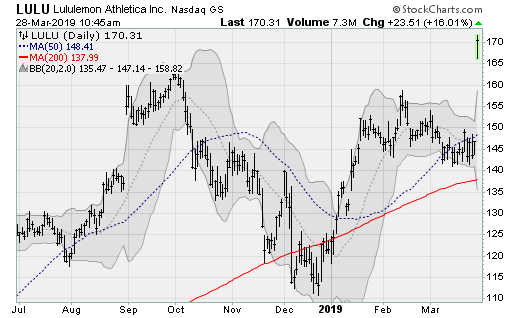
Shares of Lululemon (NASDAQ:LULU) are surging higher — up more than 15% as I write this — thanks to the reporting of better-than-expected results after the close on Wednesday. Earnings of $1.85 beat estimates by 10 cents on $1.2 billion in revenue. Forward guidance was strong as well on confidence in its online business.

The company will next report results on June 26 after the close. Analysts at Canaccord raised their price target on a belief that positive catalysts, including product mix and consumer engagement, will continue.


Compare Brokers

Bed Bath & Beyond (BBBY)

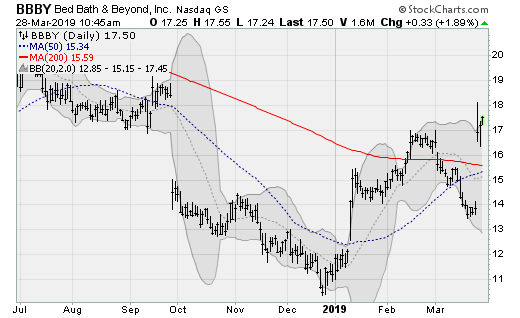
Bed Bath & Beyond (NASDAQ:BBBY) stock is rising up and over its late February highs, definitively moving away from its 200-day moving average to return to levels not seen since September. The move could well mark the end of a downtrend going all the way back to early 2015 that saw shares fall from a high near $74 to a low of around $10.35 late last year — a loss of nearly 90%.

The company will next report results on April 10 after the close. Analysts are looking for earnings of $1.10 per share on revenues of $3.3 billion. When the company last reported on Jan. 9, earnings of 18 cents per share beat estimates by a penny on a 2.6% rise in revenues. Analysts at Telsey Advisory Group recently raised their price target on expectations of management changes.


Compare Brokers

American Eagle Outfitters (AEO)

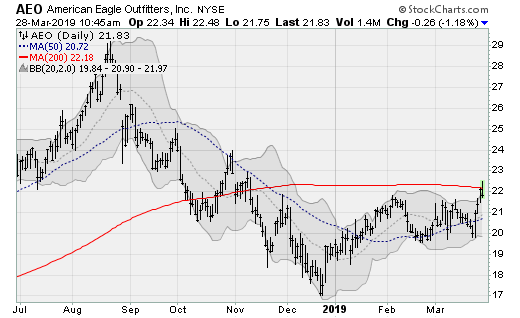
Shares of American Eagle Outfitters (NYSE:AEO) are challenging their 200-day moving average, setting up a breakout from its post-November consolidation range. The company has enjoyed steady success in the notoriously finicky teen retail segment, posting 16 consecutive quarters of positive comp-store sales growth.

The company will next report results on May 30 after the close. Analysts are looking for earnings of 21 cents per share on revenues of $855 million. When the company last reported on March 6, earnings of 43 cents per share beat estimates by a penny on a 1.2% rise in revenues.


Compare Brokers

Kohl’s (KSS)

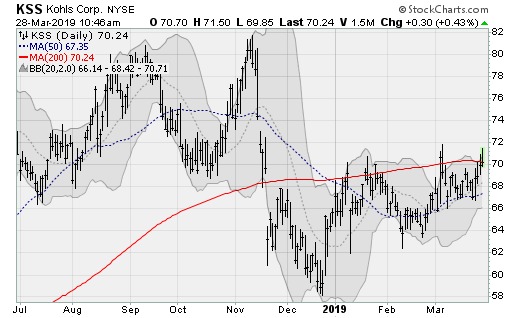
Kohl’s (NYSE:KSS) shares are attempting another breakout above their 200-day moving average, challenging resistance from a five-month consolidation range and setting up a run at the high set in November. The stock was recently upgraded by analysts at Atlantic Equities thanks to new initiatives like a partnership with Planet Fitness (NYSE:PLNT).

The company will next report results on May 21 before the bell. Analysts are looking for earnings of 70 cents per share on revenues of nearly $4 billion. When the company last reported on March 5, earnings of $2.24 beat estimates by six cents on a 3.4% drop in revenues.

As of this writing, William Roth did not hold a position in any of the aforementioned

Saturday, March 30, 2019

Brexit: EU Control The Outcome

&l;p&g;&l;img class=&q;dam-image getty size-large wp-image-1137343314&q; src=&q;https://specials-images.forbesimg.com/dam/imageserve/1137343314/960x0.jpg?fit=scale&q; data-height=&q;515&q; data-width=&q;960&q;&g; (photo credit: Getty)

It is now the situation that the outcome of Brexit is down to the EU.

These are the five options:

&l;strong&g;1. Revoke article 50&l;/strong&g;

This kills Brexit, once revoked it would never be reissued. On the surface at least, the EU can&a;rsquo;t say no to that. This would utterly humiliate the U.K. and remove any leverage on negotiations about the future of the EU, beyond the U.K. being 10% of the population of the EU and a reasonable sized region of Europe.

&l;strong&g;2. A second referendum&l;/strong&g;

This has been voted off the option list by the British parliament but if it was to be revived, the EU would have to agree to an extension and if it didn&a;rsquo;t, a hard Brexit would most likely follow, unless the twice rejected deal was suddenly signed off on. At this point it would be down to the EU whether a second referendum was callable.

&l;strong&g;3. Sign the pre-negotiated EU exit deal

&l;/strong&g;This is a slam dunk but the British representatives, the MPs (members of Parliament) have already turned that down twice. It would be frankly weird if they agreed to it third time around. It&a;rsquo;s not impossible but highly unlikely. This would place the U.K. into a kind of EU limbo. The U.K. would get lots of benefits but would be in many minds half in and half out of the EU and with no voice in future decisions.

The U.K. would be half ruled but unrepresented by the EU. It would leave the U.K. able to detach further or move closer, but the Remainers hate the option as much as the Brexiters. That joint loathing should be a good pointer that it&a;rsquo;s the right deal, but Parliament isn&a;rsquo;t having it and are unlikely to change their tune.

&l;strong&g;4. A hard Brexit&l;/strong&g;

The U.K. would be like any other country outside of the U.K. block but so much of the U.K. economy is hardwired to be inside that the trauma of a breach is too much for most to countenance. The Remainers don&a;rsquo;t want any Brexit, let alone a violent rupture, and even many Brexiters don&a;rsquo;t want to end up in the cold outside the high wall of the richest economic zone in the global economy. However, many voters don&a;rsquo;t care what kind of Brexit they get, they just want out, but the key thing is, Europe can inflict this on the U.K. unless article 50 is revoked. Without revoking article 50, the U.K. can fall out of the EU and at the moment it has till April 12 to do just that if it can&s;t sign off on the current deal.

&l;strong&g;5. Parliament build a deal they can sign up for and present it to the EU&l;/strong&g;

Would the EU play ball? Very probably not. You can bet that all parties since the beginning of the process, including David Cameron&a;rsquo;s failed attempt to do a better deal with the EU for staying in the U.K., have tried all possible angles. The EU have simply said, &a;ldquo;no.&a;rdquo; The EU have made it crystal clear the current unpalatable deal won&a;rsquo;t be reopened. Unless the proposed deal was worse for the U.K., it&a;rsquo;s hard to imagine them agreeing a different one now. The EU has stated it has finished preparation for a hard Brexit; that implies they consider that a bigger probability than the U.K. does, but no one in the U.K. appears to be listening. In many U.K. minds, it is still the case that the continent will be cut off from the U.K., not the other way around.

So the outcome seems to be very likely to be &a;lsquo;Dead Brexit&a;rsquo; or &a;lsquo;Hard Brexit.&a;rsquo; Make no mistake, the vast majority of MPs want a dead Brexit and while they are trying to put the blame anywhere but on themselves of killing Brexit, they may run out of time and end up with a hard Brexit.

A hard Brexit is deemed by the betting markets as very unlikely, but sometimes it&a;rsquo;s the worse outcome that is the most likely, simply because the situation is so toxic.

A toxic outcome is possible for these 5 reasons:

&l;/p&g;&l;ol&g;&l;li&g;Nailing the U.K. via a hard Brexit will send a message to all the populations of the fiddly little awkward countries in the EU that leaving the EU would be economic suicide, and demonstrate to their politicians that the process is political suicide. The latter is already clear, the former is yet to be underlined.&l;/li&g;

&l;li&g;The U.K. politicians will find it easy to blame other politicians for the hard Brexit outcome and will be able to blame the EU for being beastly.&l;/li&g;

&l;li&g;Without the U.K. in the EU, Europe will be able to move ahead towards super-state status, the logical destiny of Europe, which the U.K. has been sabotaging the whole time.&l;/li&g;

&l;li&g;The EU will take over the U.K.&a;rsquo;s position as Europe&a;rsquo;s financial center and get a boost from all those companies using the U.K. as an English-speaking platform for the EU. That will amount to a significant GDP boost, something needed in most of the EU.&l;/li&g;

&l;li&g;The U.K. has demonstrably 50% of its people against being in the EU, not a recipe for harmony as the EU continues to develop into a closer political and economic block.&l;/li&g;

&l;/ol&g;

It&a;rsquo;s easy to say anything could happen and it really could but Brexit or No-Exit are going to be the high probability outcomes and they will be on the EU&a;rsquo;s terms not the U.K.&a;rsquo;s.

The EU is likely to prove that like Hotel California, once you enter you can never leave. Even if the U.K. does, then it will be the only country that ever will and it will pay for its independence with a long period of hard times.

It is no wonder so many British people want to remain under the umbrella of the EU, when their local regional government, that of the British parliament in Westminster, is so utterly hopeless and weak.

If the betting is to be believed the U.K. is heading for a soft Brexit but only a bizarre set of turns of events will bring that to pass.

&l;em&g;Clem Chambers is the CEO of private investors web site&l;/em&g;&l;span&g;&l;em&g;&a;nbsp;&l;/em&g;&l;/span&g;&l;a href=&q;http://www.advfn.com/&q; target=&q;_blank&q;&g;&l;em&g;ADVFN.com&l;/em&g;&l;/a&g;&l;em&g; and author of &l;/em&g;&l;a href=&q;http://www.amazon.com/dp/B00R3ABO9G&q; target=&q;_blank&q;&g;Be Rich&l;/a&g;&l;em&g;, &l;/em&g;&l;a href=&q;http://www.amazon.com/dp/B00HCOUWS2&q; target=&q;_blank&q;&g;&l;em&g;The Game in Wall Street&l;/em&g;&l;/a&g;&l;em&g; and&l;/em&g; &l;a href=&q;https://www.amazon.com/dp/B077D9ZZ7P&q; target=&q;_blank&q;&g;&l;em&g;Trading Cryptocurrencies: A Beginner&a;rsquo;s Guide&l;/em&g;&l;/a&g;&l;em&g;.&l;/em&g;

In 2018, Chambers won Journalist of the Year in the Business Market Commentary category in the State Street U.K. Institutional Press Awards.

Saturday, March 23, 2019

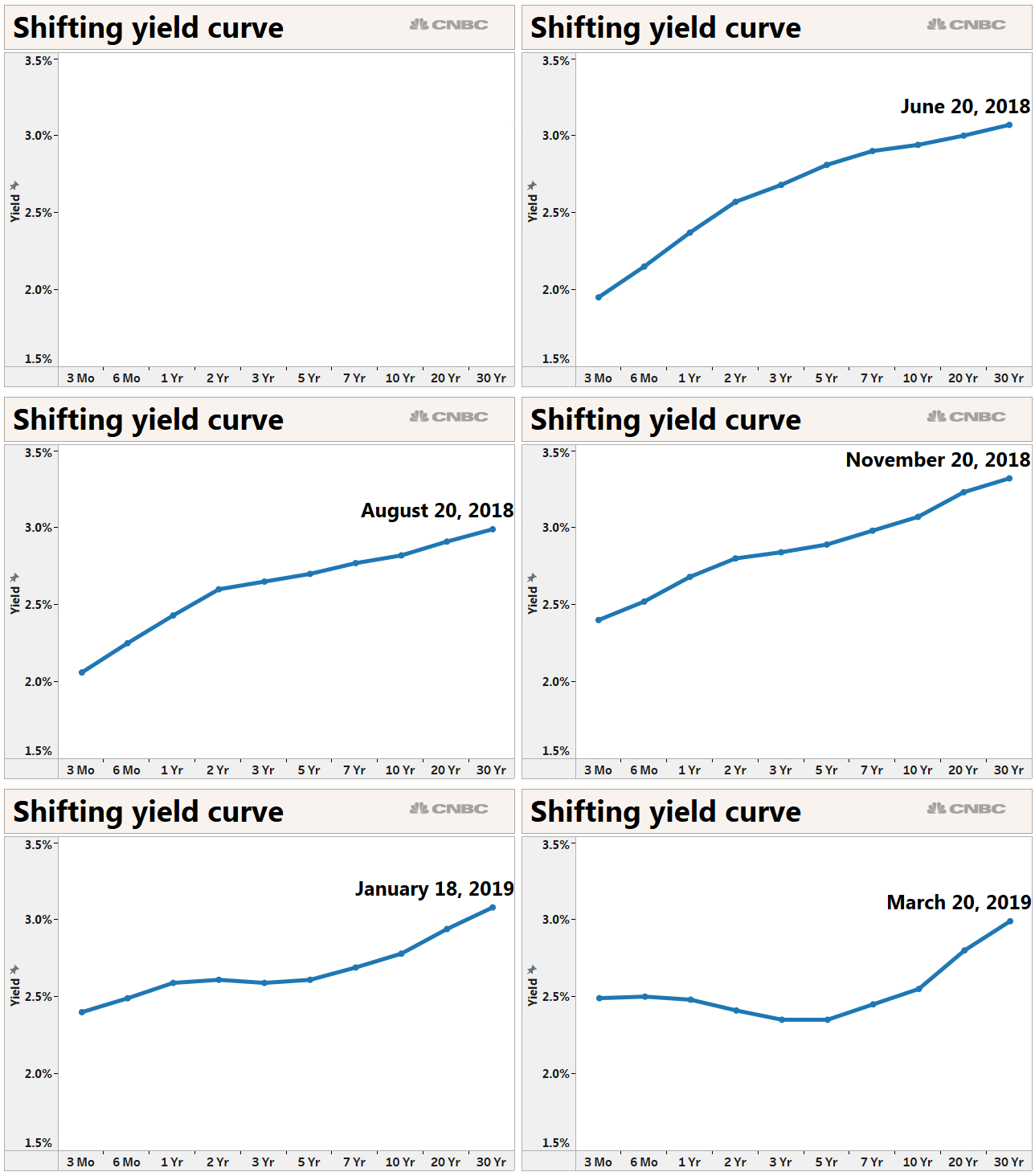
A key recession indicator just did something that hasn't happened in 12 years

Federal Reserve Chairman Jerome Powell's assertion this week that the U.S. economy remains strong is facing a stern test from the bond market.

In fact, government fixed income yields are delivering, by one measure, a possible recession indication that hasn't happened since 2007

The spread, or yield curve, between the 3-month and 10-year Treasury notes just broke the longest streak ever of being above 10 basis points, or 0.1 percentage point. The two maturities were last below that level in September 2007, a run of 3,009 trading days, according to Bespoke Investment Group. In Thursday afternoon trading, the spread was just 5 basis points, or as close to inversion as just before the financial crisis.

show chapters The yield curve is its flattest since before the financial crisis Yield curve flattest since before financial crisis    3:48 PM ET Tue, 4 Dec 2018 | 02:35

Economists see the yield compression as a dark signal for an economy coming off its best year since the recovery began in mid-2009.

"Yield curves are responding to what they see, to what I believe is a global economic slowdown," said Peter Boockvar, chief investment officer at Bleakley Advisory Group. "You don't see this kind of move in curves, not just here but everywhere, unless you get one."

Short-term yields moving ahead of their longer-duration counterparts is seen as a sign that growth will be higher now than it will be in the future. New York Fed research considered by many to be seminal on the spread between yields found that the most-telling relationship was between the 3-month and 10-year notes.

The Federal Open Market Committee, which sets monetary policy for the Fed, said Wednesday that it won't be raising rates anytime soon — likely for at least the rest of the year — unless economic conditions change.

Powell said the U.S. economy is "in a good place" though it is facing pressure from slowdowns in Europe and China. He and his colleagues collectively lowered their expectations for GDP growth domestically, now seeing just a 2.1 percent gain in GDP for all of 2019 and 1.9 percent in 2020.

Bond market warning

Bond market investors are showing they think growth could be a good deal beneath even those tepid levels. Financial markets always factor into Fed decisions, so the yield picture likely played a role in the FOMC forecast that no further rate hikes will be coming this year, even though members indicated that two were likely as recently as December 2018.

"All anyone needs to do is read the first paragraph of the Fed press statement to see that the central bank has marked down its assessment of the economic landscape – the choice of words suggests far more than the tweaking that was done to the numerical projections," David Rosenberg, chief economist and strategist at Gluskin Sheff, said in his daily note Thursday.

Like other financial market observers, Rosenberg noted the diverse reactions between the bond and stock markets — fixed income yields are falling, indicating lower growth, while the stock market is rising.

"The stock market may not agree with the recessionary message from the Treasury market, but it would be foolish to disregard this bond curve move entirely," he wrote. "The real yield [compared to inflation] on a 10-year note has collapsed to a 14-month low of 0.56% — it never got his low during any part of the 2008/09 Great Recession, for some perspective."

There's some indication in the market that the Fed's move Wednesday to telegraph a decidedly dovish stance could help widen the spread somewhat.

However, the challenges for the economy remain.

"It will come down to the U.S. consumer. That's the last thing that's holding us up," Boockvar said. "We'll need a decline in the stock market to tip over the consumer. So if the stock market can hang in, I think the U.S. can continue to see some growth. If we start to go back to the December lows again, that could be enough to tip us over."

Saturday, March 16, 2019

Allied Motion Technologies, Inc. Announces Quarterly Dividend of $0.03 (AMOT)

Allied Motion Technologies, Inc. (NASDAQ:AMOT) announced a quarterly dividend on Thursday, March 14th, Wall Street Journal reports. Shareholders of record on Thursday, March 28th will be given a dividend of 0.03 per share by the technology company on Wednesday, April 10th. This represents a $0.12 dividend on an annualized basis and a yield of 0.30%. The ex-dividend date of this dividend is Wednesday, March 27th.

Allied Motion Technologies has raised its dividend payment by an average of 4.8% annually over the last three years. Allied Motion Technologies has a payout ratio of 7.2% meaning its dividend is sufficiently covered by earnings. Research analysts expect Allied Motion Technologies to earn $2.34 per share next year, which means the company should continue to be able to cover its $0.12 annual dividend with an expected future payout ratio of 5.1%.

Get Allied Motion Technologies alerts:

AMOT stock traded down $1.18 during midday trading on Thursday, reaching $40.49. The company’s stock had a trading volume of 297,211 shares, compared to its average volume of 36,378. The company has a quick ratio of 1.39, a current ratio of 2.44 and a debt-to-equity ratio of 0.62. Allied Motion Technologies has a 1 year low of $33.57 and a 1 year high of $55.47. The firm has a market cap of $392.42 million, a price-to-earnings ratio of 33.19, a PEG ratio of 1.77 and a beta of 1.68.

Allied Motion Technologies (NASDAQ:AMOT) last released its earnings results on Wednesday, March 13th. The technology company reported $0.28 earnings per share for the quarter, missing analysts’ consensus estimates of $0.43 by ($0.15). Allied Motion Technologies had a return on equity of 17.59% and a net margin of 4.43%. The business had revenue of $73.96 million during the quarter. Research analysts expect that Allied Motion Technologies will post 1.86 EPS for the current year.

A number of research firms have weighed in on AMOT. Zacks Investment Research lowered Allied Motion Technologies from a “buy” rating to a “hold” rating in a research note on Wednesday, February 13th. BidaskClub lowered Allied Motion Technologies from a “sell” rating to a “strong sell” rating in a research note on Thursday, January 24th. Craig Hallum set a $66.00 price target on Allied Motion Technologies and gave the company a “buy” rating in a research note on Friday, December 7th. Finally, ValuEngine upgraded Allied Motion Technologies from a “hold” rating to a “buy” rating in a research note on Wednesday, January 2nd. One equities research analyst has rated the stock with a sell rating, one has given a hold rating and three have issued a buy rating to the stock. Allied Motion Technologies presently has a consensus rating of “Hold” and a consensus price target of $57.00.

WARNING: This story was originally posted by Ticker Report and is the property of of Ticker Report. If you are viewing this story on another domain, it was illegally stolen and republished in violation of United States and international trademark & copyright law. The correct version of this story can be viewed at https://www.tickerreport.com/banking-finance/4221609/allied-motion-technologies-inc-announces-quarterly-dividend-of-0-03-amot.html.

About Allied Motion Technologies

Allied Motion Technologies, Inc designs, manufactures, and sells precision and specialty motion control components and systems that are used in a range of industries worldwide. It provides automotive brushless (BL) DC motors, power steering solutions, and special purpose motors; fractional horsepower permanent magnet DC and BLDC motors serving a range of original equipment applications; and high performance BLDC motors, including servo motors, frameless motors, torque motors, slot less motors, high resolution encoders, and motor/encoder assemblies.

Featured Article: What is the Dow Jones Industrial Average (DJIA)?

Dividend History for Allied Motion Technologies (NASDAQ:AMOT)

Wednesday, March 13, 2019

Is Sierra Wireless a Buy?

Sierra Wireless (NASDAQ:SWIR) was once one of the hotter names in the Internet of Things space, but the stock has fallen on hard times recently. While the S&P index is up about 9.8% for the year, Sierra Wireless is down 6.1% for 2019 and 24% over the past one-year period. 

SWIR Year to Date Total Returns (Daily) Chart

SWIR Year to Date Total Returns (Daily) data by YCharts

Sierra makes embedded modules, gateways, modems, and the integrated software for "smart" equipment manufacturers and enterprise customers.

The company has been caught up in the economic slowdown brought on by the U.S.-China trade war, compounded by some managerial missteps. But after the recent swoon, should bargain hunters be dialing up Sierra?

A sierra product map across Smart IoT Airvantage and Managed IoT platforms.

Image source: Sierra Wireless.

Headwinds

On its recent Q4 earnings report, Sierra disappointed investors by forecasting flat revenue for 2019 and a big adjusted earnings decline, going from about $0.90 in non-GAAP EPS in 2018 to just $0.30 in 2019. That is on top of a 2018 that was already less profitable than the $1.05 per share in earnings that the company put up in 2017.

It's no secret that much of the technology hardware industry is in a downturn -- it's coming off a large investment cycle over the prior two years, and also suffering under the cloud of the U.S.-China trade war.

In particular, Sierra's significant exposure to the automobile industry is currently problematic, as that sector has slowed meaningfully in both China and Europe. Sierra has also missed the mark in its PC and networking business, where it has lost market share to competitors. CEO Kent Thexton explained on the recent call with analysts:

Before taking over as CEO, certain product investment decisions were made that favored investing in automotive to the detriment of some requirements of our mobile computing and networking customers. Consequently, while we are enjoying success in the automotive segment, we expect our market share to decline in mobile computing until the next cycle of 5G design wins.

Adding fuel to the fire, tariffs on Chinese-made goods also caused Sierra to move some production from China to Vietnam. That cost the company $1.1 million in Q4, and will $300,000 or so in the current quarter.

The turnaround plan

Sierra does, however, have brand new leadership in CEO Kent Thexton, who just took the reins in October 2018. And he's embarking on an involved turnaround plan. 2019 will be a transition year -- Sierra will implement a cost-cutting plan aiming to take $40-$50 million out of the business to reinvest into its next wave of products, in two specific areas: LPWA modules (low-power wide area network) and 5G equipment.

5G modules will replace Sierra's current 3G and 4G modules in PCs, automobiles, and networking equipment. More interesting -- and potentially more profitable -- will be the LPWA venture. LPWA are sensors that are attached to machines and other equipment that feed data back to a cloud-based management system. The proper installation of these sensors can save customers big time on maintenance costs, and these modules are just beginning to be widely deployed. Not only that, but the implementation of sensors with the company's software solutions will lead to recurring revenue for Sierra, which investors love.

Thexton went on to say that 70% of IoT projects actually fail because of the difficulty of getting edge data simply and quickly into usable form. If Sierra can get its integrated end-to-end solution right and solve these problems, it could be a big, value-enhancing opportunity. Thexton said, "when we sell our full solution versus just our hardware, we increase customer lifetime value by three to five times."

Valuation

As earnings estimates have been taken down to just $0.30 this year and $0.77 next year, Sierra trades at roughly 41 times this year's EPS estimates and around 16 times 2020 earnings estimates. That 2020 multiple is a discount compared to the company's historical forward PE ratio, so the stock may seem inexpensive should earnings tick back up in 2020.

SWIR PE Ratio (Forward) Chart

SWIR PE Ratio (Forward) data by YCharts

In short, investing in Sierra Wireless is a bet on a turnaround under a new CEO, which could lead to significant upside if it occurs; however, investors will need to be patient. A turnaround doesn't appear imminent, and today's investments could take a while to pay off. There's also the threat of competition from large, well-funded chipmakers, as IoT is a hot area.

Thus Sierra Wireless could make for a good pick as a high-upside, higher risk proposition. It probably shouldn't be an outsized part of your portfolio at this point in time. Wait to see evidence its new end-to-end platforms are catching on -- though that potential development is certainly worth monitoring.

Tuesday, March 12, 2019

Aon PLC (AON) Position Cut by Scharf Investments LLC

Scharf Investments LLC lowered its position in shares of Aon PLC (NYSE:AON) by 5.4% during the fourth quarter, according to the company in its most recent Form 13F filing with the SEC. The fund owned 968,071 shares of the financial services provider’s stock after selling 54,743 shares during the quarter. AON makes up approximately 5.6% of Scharf Investments LLC’s holdings, making the stock its 2nd biggest holding. Scharf Investments LLC owned approximately 0.40% of AON worth $140,719,000 at the end of the most recent quarter.

A number of other hedge funds and other institutional investors have also recently made changes to their positions in AON. Icon Advisers Inc. Co. purchased a new stake in AON during the third quarter valued at $261,000. Dupont Capital Management Corp purchased a new stake in AON during the third quarter valued at $438,000. Skandinaviska Enskilda Banken AB publ purchased a new stake in AON during the third quarter valued at $6,587,000. O Shaughnessy Asset Management LLC increased its position in AON by 118.7% during the third quarter. O Shaughnessy Asset Management LLC now owns 55,281 shares of the financial services provider’s stock valued at $8,501,000 after acquiring an additional 30,007 shares during the last quarter. Finally, Commonwealth Equity Services LLC increased its position in AON by 138.4% during the third quarter. Commonwealth Equity Services LLC now owns 31,915 shares of the financial services provider’s stock valued at $4,907,000 after acquiring an additional 18,527 shares during the last quarter. Hedge funds and other institutional investors own 86.24% of the company’s stock.

Get AON alerts:

A number of analysts have commented on AON shares. Zacks Investment Research cut AON from a “buy” rating to a “hold” rating in a research report on Thursday, January 3rd. ValuEngine cut AON from a “buy” rating to a “hold” rating in a research report on Tuesday, March 5th. Wells Fargo & Co upped their price target on AON from $165.00 to $150.00 and gave the stock a “market perform” rating in a research report on Tuesday, November 13th. Morgan Stanley upped their price target on AON from $152.00 to $167.00 and gave the stock an “equal weight” rating in a research report on Wednesday, November 14th. Finally, Compass Point started coverage on AON in a research report on Tuesday, January 15th. They issued a “buy” rating and a $195.00 price target for the company. Nine equities research analysts have rated the stock with a hold rating and five have assigned a buy rating to the company’s stock. The stock presently has an average rating of “Hold” and an average price target of $169.10.

AON traded up $2.14 during midday trading on Monday, reaching $164.18. The company had a trading volume of 13,915 shares, compared to its average volume of 1,295,674. The stock has a market cap of $41.29 billion, a price-to-earnings ratio of 20.10, a PEG ratio of 1.59 and a beta of 0.93. The company has a quick ratio of 1.41, a current ratio of 1.64 and a debt-to-equity ratio of 1.42. Aon PLC has a 1 year low of $134.82 and a 1 year high of $173.53.

AON (NYSE:AON) last released its quarterly earnings data on Friday, February 1st. The financial services provider reported $2.16 earnings per share for the quarter, topping analysts’ consensus estimates of $2.13 by $0.03. The firm had revenue of $2.77 billion during the quarter, compared to analyst estimates of $2.82 billion. AON had a return on equity of 43.49% and a net margin of 10.53%. The business’s quarterly revenue was down 4.8% compared to the same quarter last year. During the same quarter in the prior year, the company posted $2.35 earnings per share. On average, equities analysts anticipate that Aon PLC will post 9.2 earnings per share for the current fiscal year.

The firm also recently disclosed a quarterly dividend, which was paid on Friday, February 15th. Stockholders of record on Friday, February 1st were paid a $0.40 dividend. This represents a $1.60 dividend on an annualized basis and a dividend yield of 0.97%. The ex-dividend date was Thursday, January 31st. AON’s dividend payout ratio (DPR) is 19.61%.

In other news, insider Michael Neller sold 1,250 shares of the company’s stock in a transaction dated Tuesday, February 19th. The stock was sold at an average price of $171.66, for a total value of $214,575.00. Following the completion of the transaction, the insider now owns 5,188 shares of the company’s stock, valued at $890,572.08. The transaction was disclosed in a filing with the SEC, which is accessible through this hyperlink. Also, CFO Christa Davies sold 58,152 shares of the company’s stock in a transaction dated Friday, February 15th. The stock was sold at an average price of $170.90, for a total value of $9,938,176.80. Following the completion of the transaction, the chief financial officer now directly owns 288,016 shares of the company’s stock, valued at approximately $49,221,934.40. The disclosure for this sale can be found here. In the last ninety days, insiders sold 79,470 shares of company stock valued at $13,468,000. Corporate insiders own 0.42% of the company’s stock.

TRADEMARK VIOLATION WARNING: “Aon PLC (AON) Position Cut by Scharf Investments LLC” was originally reported by Ticker Report and is the property of of Ticker Report. If you are reading this news story on another site, it was illegally stolen and republished in violation of United States and international trademark and copyright legislation. The original version of this news story can be read at https://www.tickerreport.com/banking-finance/4213630/aon-plc-aon-position-cut-by-scharf-investments-llc.html.

About AON

Aon plc provides risk management services, insurance and reinsurance brokerage, and human resource consulting and outsourcing services worldwide. The company operates through two segments, Risk Solutions and HR Solutions. The Risk Solutions segment offers retail brokerage services, including affinity products, managing general underwriting, placement, captive management services, and data and analytics; risk management solutions for property liability, general liability, professional liability, directors' and officers' liability, transaction liability, cyber liability, workers' compensation, and various healthcare products; and health and benefits consulting services comprising structuring, funding, and administering employee benefit programs.

Featured Story: How Do Mutual Funds Work?

Institutional Ownership by Quarter for AON (NYSE:AON)

Monday, March 11, 2019

7 Growth Stocks Racing to All-Time Highs

After a brutal late 2018 selloff, financial markets have been on a healthy and stable recovery path thus far in 2019. Through the first three months of the year, the S&P 500 is up 12%, marking one of its best starts to a calendar year in recent memory.

As broader financial markets have stabilized, growth stocks have come back into favor. Indeed, one could say that they’ve done much more than come back into favor. Many of them have rushed to fresh all-time highs in 2019, and that’s after big corrections in late 2018. That means that a handful of these growth stocks have staged huge rallies over the past three months.

Which stocks fit into this category? And can these big rallies last?

These are questions investors should be asking as we head into what projects to be a more volatile time for financial markets throughout the balance of 2019. As such, let’s take a look at seven growth stocks which have raced to all-time highs in early 2019, and analyze whether or not their big rallies can continue.


Compare Brokers
 iRobot (IRBT)

Why It’s at All-Time Highs: Shares of consumer robotics giant iRobot (NASDAQ:IRBT)have run up to all-time highs prices on the back of a strong double-beat-and-raise fourth-quarter earnings report that emphasized a few positive trends, including continued robust robotic vacuum market expansion, strong margin growth and a mitigated tariff impact.

Where It’s Going Next: The long-term IRBT growth narrative is positive. This company is morphing into a consumer robotics leader with minimal competition, and as such, will be a big revenue and profit grower for a lot longer as the consumer robotics space expands. Such big revenue and profit growth will keep IRBT stock on a long-term winning trajectory. But, in the near term, the valuation seems stretched at nearly 40x forward earnings. This stock needs to trade sideways for the foreseeable future to allow the fundamentals to catch up.


Compare Brokers
 Shopify (SHOP)

Why It’s At All-Time Highs: Shares of e-commerce solutions provider Shopify (NYSE:SHOP) have notched new all-time highs thanks to renewed macroeconomic confidence and a strong Q4 earnings report in which growth hardly slowed and margins continued to move higher.

Where It’s Going Next: In the big picture, Shopify stock is powered by a secular growth narrative that goes something like this: the world is becoming increasingly decentralized thanks to technology democratizing creation and distribution processes. Shopify is enabling and empower this decentralization in the retail world. As this decentralization trend continues to play out over the next several years, Shopify’s merchant base will grow by leaps and bounds. Revenues will roar higher. Profits will, too. So will SHOP stock. As such, the long-term narrative here is very bullish — bullish enough to make this a long-term buy-and-hold stock.


Compare Brokers
Cronos (CRON)

Why It’s At All-Time Highs: Shares of Canadian cannabis company Cronos (NASDAQ:CRON) have more than doubled in 2019 and run to fresh all-time highs on the back of a multi-billion dollar investment from tobacco giant Altria (NYSE:MO). Investors have interpreted this investment as a major vote of confidence from a well respected global tobacco giant, at a time when global cannabis market fundamentals are improving. Consequently, they have bid up CRON stock to new highs.

Where It’s Going Next: The cannabis market projects to be really, really big one day. With a multi-billion dollar investment from Altria in its back pocket, Cronos has the necessary financial resources, business know-how, and distribution networks to one day turn into a major player in this global market. It’s fair to say that the stock has gone too far, too fast, and needs to cool off. This is likely what will happen. But, after that cooling off period, CRON stock will resume its uptrend, because the long-term fundamentals here of Cronos turning into a global cannabis giant are quite promising.


Compare Brokers
Wayfair (W)

Why It’s At All-Time Highs: Shares of online home retailer Wayfair (NYSE:W) have surged over the past few weeks to all-time highs thanks to two things. One, confidence in the macroeconomic environments in the U.S. and Europe has dramatically improved. Two, Wayfair’s margins finally stabilized last quarter, and that stabilization coupled with continued robust domestic and international growth served as justification for what had been several quarters of big investment. Investors rallied around those numbers, and bid up W stock to new highs.

Where It’s Going Next: Wayfair is a big growth story. This company has differentiated itself as the leader in a secular growth online home retail market, and this market is very big. Management pegs it at $600 billion in the U.S. and Europe. Revenues were under $7 billion last year, and grew by over 40% year-over-year. Thus, there is lots of runway for Wayfair to remain a big growth company for a lot longer. Having said that, the valuation is a tough pill to swallow here, especially with profit margins still very weak. As such, I wouldn’t chase this rally. But, I would buy any big dips.


Compare Brokers
The Trade Desk (TTD)

Why It’s At All-Time Highs: Programmatic advertising leader The Trade Desk (NASDAQ:TTD) has exploded to all-time highs over the past few weeks thanks to a robust double-beat-and-raise fourth quarter earnings report which underscored that this company’s growth narrative is still accelerating, and that big growth is here to stay for a lot longer.

Where It’s Going Next: The Trade Desk is a secular growth company powered by still accelerating tailwinds in automation and advertising. Over time, all $1 trillion worth of global ads will be transacted programmatically. That means that Trade Desk, which had under $3 billion in gross spend last year, has a huge opportunity in front of it to grow gross ad spend towards $100 billion-plus. If management successfully executes on that opportunity, TTD stock will head significantly higher in a long term window.


Compare Brokers
Etsy (ETSY)

Why It’s At All-Time Highs: Shares of Etsy (NASDAQ:ETSY) have surged to all-time highs over the past few weeks thanks to robust holiday numbers which were strong across the board, including robust community, sales, margin, and profit growth. Investors cheered those results, and bid up ETSY stock to fresh highs.

Where It’s Going Next: Etsy is a big growth company with strong growth drivers in e-commerce. But, there’s lots of competition here, from Amazon (NASDAQ:AMZN), eBay (NASDAQ:EBAY), and others. To be sure, Etsy has held off that competition, but that’s because Etsy dominates a niche of the market, meaning that growth won’t remain big forever. Eventually, it will tap out, and so will margins. That may happen sooner than most expect, and at over 60x forward earnings, a slowdown could be catastrophic for ETSY stock.


Compare Brokers
Chegg (CHGG)

Why It’s At All-Time Highs: Digital education platform Chegg (NASDAQ:CHGG) has roared to all-time highs on the back of a strong Q4 earnings report which included robust subscriber, revenue, and profit growth, as well as a healthy first quarter and fiscal 2019 guide.

Where It’s Going Next: CHGG stock will head higher from here. Why? Because the company is the unchallenged leader in the digital education market, and that market is far bigger than what the company is currently penetrating. At scale, Chegg will transform into a must-have digital education tool for all high school and college students. It is only a fraction of that today. As such, big growth is here stay for a lot longer. Such big growth is also accompanied by big margins. The combination of big growth and big margins will inevitably power CHGG stock higher in the long run.

As of this writing, Luke Lango was long SHOP, TTD, AMZ

Saturday, March 9, 2019

Burlington Stores (BURL) Shares Down 11.9%

Burlington Stores Inc (NYSE:BURL)’s share price traded down 11.9% on Thursday . The company traded as low as $139.75 and last traded at $147.28. 10,068,635 shares traded hands during mid-day trading, an increase of 1,008% from the average session volume of 909,003 shares. The stock had previously closed at $167.18.

A number of equities analysts have recently weighed in on the company. Citigroup cut their price target on Burlington Stores from $175.00 to $158.00 and set a “neutral” rating for the company in a report on Friday. Wedbush cut their price target on Burlington Stores from $160.00 to $155.00 and set a “neutral” rating for the company in a report on Friday. Credit Suisse Group cut their price target on Burlington Stores from $190.00 to $175.00 and set an “outperform” rating for the company in a report on Friday. Telsey Advisory Group cut Burlington Stores from an “outperform” rating to a “market perform” rating and cut their price target for the stock from $190.00 to $165.00 in a report on Friday. Finally, Cowen set a $165.00 price target on Burlington Stores and gave the stock a “buy” rating in a report on Thursday. One equities research analyst has rated the stock with a sell rating, seven have assigned a hold rating and fifteen have issued a buy rating to the company’s stock. The company currently has a consensus rating of “Buy” and a consensus target price of $174.89.

Get Burlington Stores alerts:

The company has a debt-to-equity ratio of 5.63, a current ratio of 1.00 and a quick ratio of 0.24. The stock has a market capitalization of $9.67 billion, a price-to-earnings ratio of 32.84, a PEG ratio of 1.12 and a beta of 0.19.

Burlington Stores (NYSE:BURL) last issued its earnings results on Thursday, March 7th. The company reported $2.83 earnings per share for the quarter, topping the Thomson Reuters’ consensus estimate of $2.77 by $0.06. Burlington Stores had a return on equity of 293.30% and a net margin of 7.12%. The company had revenue of $2 billion during the quarter, compared to the consensus estimate of $2.05 billion. During the same quarter in the prior year, the business earned $3.59 earnings per share. The company’s revenue was up 3.2% compared to the same quarter last year. On average, analysts predict that Burlington Stores Inc will post 6.38 earnings per share for the current fiscal year.

In related news, insider Fred Hand sold 4,075 shares of the stock in a transaction dated Tuesday, February 5th. The stock was sold at an average price of $175.19, for a total value of $713,899.25. Following the completion of the transaction, the insider now owns 56,912 shares of the company’s stock, valued at $9,970,413.28. The sale was disclosed in a document filed with the Securities & Exchange Commission, which is available at the SEC website. Also, CEO Thomas Kingsbury sold 20,000 shares of the stock in a transaction dated Monday, December 10th. The shares were sold at an average price of $157.09, for a total value of $3,141,800.00. Following the completion of the transaction, the chief executive officer now directly owns 317,473 shares of the company’s stock, valued at approximately $49,871,833.57. The disclosure for this sale can be found here. Insiders sold 87,246 shares of company stock valued at $14,360,422 in the last three months. 1.91% of the stock is currently owned by company insiders.

A number of institutional investors and hedge funds have recently modified their holdings of the stock. Mackenzie Financial Corp boosted its holdings in Burlington Stores by 2.9% in the fourth quarter. Mackenzie Financial Corp now owns 2,939 shares of the company’s stock valued at $478,000 after purchasing an additional 82 shares during the last quarter. Heritage Investors Management Corp raised its stake in Burlington Stores by 0.3% during the fourth quarter. Heritage Investors Management Corp now owns 36,443 shares of the company’s stock valued at $5,928,000 after buying an additional 92 shares in the last quarter. Captrust Financial Advisors raised its stake in Burlington Stores by 4.4% during the fourth quarter. Captrust Financial Advisors now owns 2,312 shares of the company’s stock valued at $376,000 after buying an additional 97 shares in the last quarter. Creative Planning raised its stake in Burlington Stores by 3.0% during the fourth quarter. Creative Planning now owns 3,708 shares of the company’s stock valued at $603,000 after buying an additional 109 shares in the last quarter. Finally, Brookstone Capital Management raised its stake in Burlington Stores by 7.3% during the fourth quarter. Brookstone Capital Management now owns 1,833 shares of the company’s stock valued at $298,000 after buying an additional 124 shares in the last quarter.

TRADEMARK VIOLATION NOTICE: This article was posted by Ticker Report and is the property of of Ticker Report. If you are accessing this article on another domain, it was stolen and reposted in violation of US & international trademark and copyright laws. The correct version of this article can be viewed at https://www.tickerreport.com/banking-finance/4209894/burlington-stores-burl-shares-down-11-9.html.

Burlington Stores Company Profile (NYSE:BURL)

Burlington Stores, Inc operates as a retailer of branded apparel products in the United States. The company offers fashion-focused merchandise, including women's ready-to-wear apparel, accessories, footwear, menswear, youth apparel, coats, and gifts, as well as baby, home, and beauty products. As of February 3, 2018, it operated 629 stores, including an Internet store in 45 states and Puerto Rico.

Read More: How Do You Make Money With Penny Stocks?

Friday, March 8, 2019

Dollar Tree says it will test charging more

Dollar Tree is shaking things up.

The discount retailer says that it will shutter as many as 390 Family Dollar stores this year, change the name of roughly 200 more, and will start testing charging more than a dollar in some of its namesake stores.

The string of announcements came as Dollar Tree reported its fourth-quarter earnings.

The Chesapeake, Virginia-based Dollar Tree bought its rival Family Dollar for $9.2 billion in 2015. but the brand has been ailing. The final number of Family Dollar stores that will close depends on its parent company's ability to get rent concessions from landlords, Dollar Tree said. It already closed 84 underperforming Family Dollar stores in the fourth quarter, which was 37 more than it had planned to shutter last year.

Dollar Tree reported nearly in-line quarterly results before the markets opened on Wednesday but disappointing earnings guidance. Yet shares were up early on. (Photo: https://www.flickr.com/photos/jeepersmedia/)

It will also stamp its name on roughly 200 Family Dollar stores.

But Family Dollar is not the only company brand going through changes.

Kylie Jenner? Really?: Kylie Jenner? Self-made billionaire? Twitter's aflutter about makeup mogul's new status

Ferrari V8 gets the spotlight: Most powerful Ferrari V8 ever to debut at Geneva auto show

How to make the most of interest rates: How to take advantage of rising interest rates by finding the best savings account

Dollar Tree CEO Gary Philbin also mentioned plans to test selling items that cost more than a buck at its namesake chain, a shift that's reportedly been pushed by an activist investor.

Dollar Tree has tested the pricing change before, but Philbin shared no details about the locations where the new test will be done, what the new prices specifically will be, or how many items, or product categories, would be included.

It's a marked change for the brand, which has traditionally used $1 as its cut-off price point, while Family Dollar sold not only $1 items but products that cost more.

John Zolidis, president of Quo Vadis Capital, said that because of its Family Dollar acquisition, Dollar Tree believes it now has the expertise to try to boost prices at its namesake stores. But it's a risky proposition.

"The $1-only proposition is what makes people love Dollar Tree so much," Zolidis said. "Moving away from that brand equity does present a pretty significant risk to the concept on a long-term basis if it becomes just another store. Right now, it's unique."

But in the short-term, testing higher prices could be helpful, he added. Doing so would raise the company's profit margins, as it faces pressures ranging from rising labor costs to tariffs, and possibly make up for the unexpectedly sluggish performance of the Family Dollar brand.

NEWSLETTERSGet the Managing Your Money newsletter delivered to your inboxWe're sorry, but something went wrongA collection of articles to help you manage your finances like a pro.Please try again soon, or contact Customer Service at 1-800-872-0001.Delivery: FriInvalid email addressThank you! You're almost signed up for Managing Your MoneyKeep an eye out for an email to confirm your newsletter registration.More newsletters

Neil Saunders, managing director of retail consultancy GlobalData, also said that a different pricing structure "is a sensible move that will give the company significant flexibility in dealing with cost increases.''

While some shoppers might initially be turned off "longer term, we see no real reason why this move can't work, especially given it is employed by Dollar General and a number of other value players.''

The chain is also trying to boost profits by closing stores, a move that could also create leverage when negotiating with its landlords, Zolidis said.

Dollar Tree still plans to invest in its Family Dollar brand, however, renovating at least 1,000 stores this year. The cost to remodel a store ranges from $100,000 to $150,000, CFO Kevin Wampler said.


Follow USA TODAY reporters Zlati Meyer on Twitter: @ZlatiMeyer and Charisse Jones @charissejones

Wednesday, March 6, 2019

Federal program that wipes out student debt is struggling. How to get it right

Last year, CNBC tracked down one of the first people to qualify for public service loan forgiveness. "I feel pretty lucky," Kevin Maier, a tenured professor at the University of Alaska Southeast, said at the time. Apparently, he was.

The Education Department recently released data on how many borrowers' loans it has forgiven under the program — just 206. More than 41,000 people have applied.

Some 32,000 borrowers were denied because they didn't meet the program requirements and another nearly 12,000 applications were turned down for missing information.

The public service loan forgiveness program was signed into law by President George W. Bush in 2007 and allows certain not-for-profit and government employees to have their federal student loans cancelled after 10 years of on-time payments.

With the help of student loan expert Mark Kantrowitz, we've addressed some of the most common misunderstandings about the program that trip people up.

These are the program's three basic requirements:

Your loans must be federal direct loans.Your employer must be a government organization at any level, a 501(c)(3) not-for-profit organization or some other type of not-for-profit organization that provides public service.By the end, you need to have made 120 qualifying, on-time payments in an income-driven repayment plan or the standard repayment plan.

Yes, that's just the basics.

#dw-chart{width: 100%;height: 500px;border: none;padding-top: 32px;box-sizing: border-box;-moz-box-sizing: border-box;-webkit-box-sizing: border-box;}

Among the other points you should know: Under public service loan forgiveness, your debt is forgiven tax-free.

Federal Family and Education loans and private loans do not qualify. If you have a F.F.E.L. loan, you may be able to consolidate it into a direct loan (which is eligible), but keep in mind that if you have some direct loans, you'll be pulled back to day one of your 10-year-timeline on those.

"Consolidating loans resets the clock on public service loan forgiveness," Kantrowitz said.

There are some 14 ways to repay your student loans, but to qualify for public service loan forgiveness you need to be enrolled in one of these four income-based repayment plans: income-contingent repayment, income-based repayment, pay-as-you-earn repayment and revised pay-as-you-earn repayment. (The standard repayment plan also qualifies, but under it you'd have paid off your loans in 10 years, anyway.)

Kantrowitz said some people assume they'll qualify for forgiveness after 10 years of payments. However, it's not about how long you've been paying but how many qualifying payments you've made. Maybe you took a leave from public service work, for example, halting the timer on your payments for a few months or even years. Again, it's after 120 qualifying payments that your loans will be eligible for forgiveness.

On that note, if you miss a payment, or if you switch jobs, you don't lose the qualifying payments you've racked up. Your payments don't need to be consecutive.

Tweet

Does your employer count as public service? It's complicated. The American Bar Association sued the Education Department after the government changed its terms on which work qualifies for the program, throwing some borrowers off the path to debt forgiveness. Last week, a judge ruled those tweaks were "arbitrary and capricious."

Some people wonder if their employer counts if it's a contractor for the government. Not always, Kantrowitz said. "Government contractors must themselves be qualifying organizations for their employees to qualify for public service loan forgiveness," he said.

In light of the confusion, all borrowers should fill out a so-called employer certification form at least once a year to confirm that their workplace makes them eligible. These forms will also enable you to keep records of your confirmed qualifying payments.

More and more companies are charging people to apply for loan forgiveness. You should not pay for this service, Kantrowitz said. "If you have to pay money to get money, it's probably a scam," he said. Even approach your servicer with skepticism, he said. "Take everything the lender says with a grain of salt."

Kantrowitz has put together a one-page checklist for public service loan forgiveness. The Education Department also recently released a help tool for those in the program. And CNBC has interviewed some of the people who have emerged successfully from the maze. You can read their tips here.

Have you had a bad experience with the public service loan forgiveness program? We want to hear from you. Please email me at annie.nova@nbcuni.com.

More from Personal Finance:
What you need to qualify for public service loan forgiveness
Government may forgive student loans if you meet demands
Education Dept. fails on public service loan forgiveness: Senators

Tuesday, March 5, 2019

Best Small Cap Stocks To Buy For 2019

tags:REN ,IMKTA,QLYS,

Small cap Angie's List Inc (NASDAQ: ANGI) reported Q2 2017 earnings before the market opened with the results missing Wall Street expectations. Angie's List faces increased competition from competing services such as Porch.com (backed by home improvement retailer Lowe's Companies), an Amazon offering (called Home Services which creates rankings of recommended contractors and lists prices in major markets nationwide) and an upcoming service from Google. In May, Angie's List and IAC (NASDAQ: IAC) announced they have entered into a definitive agreement to combine IAC's HomeAdvisor and Angie's List into a new publicly-traded company, to be called ANGI Homeservices Inc.

Total revenue was $72.8 million versus $83.1 million in the year-ago quarter driven by declines in service provider and membership revenue. Service provider revenue fell approximately 7% to $62.6 million due in part to lower originations revenue in recent periods. The earnings release also noted: "Further, the challenges we experienced in the prior year in connection with the migration to our new technology platform, which resulted in lower originations and renewals bookings in 2016, continued to have a negative impact on service provider revenue in the second quarter of 2017 given the average duration of our service provider contracts." Membership revenue was down approximately 35% to $10.2 million due largely to the impact of our removal of the ratings and reviews paywall in June 2016. The net loss was $8.1 million versus net income of $4.7 million. The CEO commented:

Best Small Cap Stocks To Buy For 2019: Resolute Energy Corporation(REN )

Advisors' Opinion:
  • [By Shane Hupp]

    Republic Protocol (CURRENCY:REN) traded 8.6% lower against the dollar during the 1-day period ending at 12:00 PM E.T. on June 13th. Republic Protocol has a total market capitalization of $39.37 million and $1.56 million worth of Republic Protocol was traded on exchanges in the last 24 hours. Over the last week, Republic Protocol has traded 22.7% lower against the dollar. One Republic Protocol token can now be purchased for $0.0757 or 0.00001210 BTC on popular exchanges including Cobinhood, IDEX, DDEX and Liqui.

  • [By Max Byerly]

    Get a free copy of the Zacks research report on Resolute Energy (REN)

    For more information about research offerings from Zacks Investment Research, visit Zacks.com

  • [By Logan Wallace]

    Republic Protocol (CURRENCY:REN) traded up 8.3% against the dollar during the twenty-four hour period ending at 21:00 PM ET on September 4th. One Republic Protocol token can now be bought for $0.0353 or 0.00000479 BTC on major exchanges including IDEX, BitForex, DDEX and HADAX. Republic Protocol has a total market capitalization of $20.61 million and $455,859.00 worth of Republic Protocol was traded on exchanges in the last day. During the last seven days, Republic Protocol has traded up 43.1% against the dollar.

  • [By Ethan Ryder]

    Shares of Resolute Energy Corp (NYSE:REN) have received an average rating of “Hold” from the nine ratings firms that are currently covering the firm, Marketbeat reports. Seven analysts have rated the stock with a hold recommendation and two have assigned a buy recommendation to the company. The average 1 year price target among brokers that have issued ratings on the stock in the last year is $39.17.

Best Small Cap Stocks To Buy For 2019: Ingles Markets Incorporated(IMKTA)

Advisors' Opinion:
  • [By Stephan Byrd]

    News articles about Ingles Markets (NASDAQ:IMKTA) have been trending somewhat positive recently, Accern Sentiment reports. Accern identifies negative and positive news coverage by monitoring more than twenty million news and blog sources in real-time. Accern ranks coverage of publicly-traded companies on a scale of -1 to 1, with scores closest to one being the most favorable. Ingles Markets earned a news impact score of 0.20 on Accern’s scale. Accern also assigned media headlines about the company an impact score of 46.3498595843486 out of 100, indicating that recent news coverage is somewhat unlikely to have an impact on the company’s share price in the next few days.

  • [By Logan Wallace]

    BidaskClub upgraded shares of Ingles Markets (NASDAQ:IMKTA) from a buy rating to a strong-buy rating in a research report report published on Wednesday.

  • [By Ethan Ryder]

    Ingles Markets, Incorporated (NASDAQ:IMKTA) declared a quarterly dividend on Tuesday, July 3rd, Wall Street Journal reports. Investors of record on Thursday, July 12th will be given a dividend of 0.165 per share on Thursday, July 19th. This represents a $0.66 dividend on an annualized basis and a dividend yield of 2.04%. The ex-dividend date of this dividend is Wednesday, July 11th.

Best Small Cap Stocks To Buy For 2019: Qualys, Inc.(QLYS)

Advisors' Opinion:
  • [By Max Byerly]

    Asset Management One Co. Ltd. grew its stake in shares of Qualys Inc (NASDAQ:QLYS) by 32.3% during the first quarter, according to the company in its most recent disclosure with the Securities and Exchange Commission. The institutional investor owned 8,110 shares of the software maker’s stock after purchasing an additional 1,980 shares during the quarter. Asset Management One Co. Ltd.’s holdings in Qualys were worth $590,000 as of its most recent filing with the Securities and Exchange Commission.

  • [By ]

    Qualys (QLYS) : "I think this is a good company, but everything is coming down, so let's wait to buy some more."

    HEICO (HEI) : "We're not buying anything at a 52-week high -- but on a pullback, you bet."

  • [By Jon C. Ogg]

    Qualys Inc. (NASDAQ: QLYS) was up 1.7% at $96.41 ahead of earnings, but the guidance had the shares down almost 16% at $81.00 on Wednesday morning. JPMorgan downgraded it to Underweight from Neutral and cut the price target to $82 from $90. Wedbush maintained its Outperform rating with a $95 price target, but noted that guidance was nothing to write home about and addresses whether guidance was conservative or if there is a slowing demand.

  • [By Logan Wallace]

    Goodman Financial Corp boosted its stake in shares of Qualys Inc (NASDAQ:QLYS) by 1.4% in the 2nd quarter, according to the company in its most recent Form 13F filing with the Securities and Exchange Commission (SEC). The firm owned 86,755 shares of the software maker’s stock after buying an additional 1,235 shares during the quarter. Qualys accounts for about 3.3% of Goodman Financial Corp’s holdings, making the stock its 9th biggest holding. Goodman Financial Corp owned approximately 0.22% of Qualys worth $7,313,000 as of its most recent filing with the Securities and Exchange Commission (SEC).

Monday, March 4, 2019

Mackenzie Financial Corp Has $934,000 Holdings in Elevate Credit Inc (ELVT)

Mackenzie Financial Corp reduced its stake in Elevate Credit Inc (NYSE:ELVT) by 8.7% during the 4th quarter, according to its most recent filing with the Securities and Exchange Commission. The fund owned 208,587 shares of the company’s stock after selling 19,864 shares during the quarter. Mackenzie Financial Corp’s holdings in Elevate Credit were worth $934,000 at the end of the most recent reporting period.

Several other hedge funds also recently made changes to their positions in ELVT. Renaissance Technologies LLC grew its stake in shares of Elevate Credit by 323.3% in the 3rd quarter. Renaissance Technologies LLC now owns 693,438 shares of the company’s stock valued at $5,589,000 after purchasing an additional 529,638 shares during the last quarter. Prescott Group Capital Management L.L.C. grew its stake in shares of Elevate Credit by 68.9% in the 3rd quarter. Prescott Group Capital Management L.L.C. now owns 1,042,094 shares of the company’s stock valued at $8,399,000 after purchasing an additional 425,115 shares during the last quarter. BlackRock Inc. boosted its stake in shares of Elevate Credit by 23.2% in the third quarter. BlackRock Inc. now owns 1,304,705 shares of the company’s stock valued at $10,516,000 after buying an additional 246,120 shares in the last quarter. Dimensional Fund Advisors LP boosted its stake in shares of Elevate Credit by 271.8% in the third quarter. Dimensional Fund Advisors LP now owns 220,296 shares of the company’s stock valued at $1,776,000 after buying an additional 161,052 shares in the last quarter. Finally, JPMorgan Chase & Co. boosted its stake in shares of Elevate Credit by 3,030.3% in the third quarter. JPMorgan Chase & Co. now owns 128,280 shares of the company’s stock valued at $1,033,000 after buying an additional 124,182 shares in the last quarter. Institutional investors own 43.83% of the company’s stock.

Get Elevate Credit alerts:

A number of analysts recently weighed in on ELVT shares. BTIG Research upgraded Elevate Credit from a “neutral” rating to a “buy” rating and set a $6.00 price target on the stock in a research note on Wednesday, February 13th. Maxim Group restated a “buy” rating and issued a $10.00 price target on shares of Elevate Credit in a research note on Tuesday, February 12th. Zacks Investment Research upgraded Elevate Credit from a “sell” rating to a “hold” rating in a research note on Tuesday, January 15th. Jefferies Financial Group downgraded Elevate Credit from a “buy” rating to a “hold” rating and decreased their price target for the company from $9.50 to $5.00 in a research note on Tuesday, January 8th. Finally, UBS Group downgraded Elevate Credit from a “buy” rating to a “neutral” rating and set a $5.00 price target on the stock. in a research note on Friday, February 22nd. Eight equities research analysts have rated the stock with a hold rating and two have issued a buy rating to the stock. Elevate Credit presently has a consensus rating of “Hold” and an average price target of $7.65.

Elevate Credit stock opened at $4.41 on Friday. Elevate Credit Inc has a 1-year low of $3.71 and a 1-year high of $11.27. The company has a market capitalization of $196.98 million, a P/E ratio of 11.40 and a beta of 1.81.

Elevate Credit (NYSE:ELVT) last posted its quarterly earnings results on Monday, February 11th. The company reported $0.09 earnings per share for the quarter, meeting the Zacks’ consensus estimate of $0.09. Elevate Credit had a return on equity of 15.72% and a net margin of 1.59%. The firm had revenue of $207.29 million for the quarter, compared to the consensus estimate of $212.42 million. As a group, research analysts anticipate that Elevate Credit Inc will post 0.58 EPS for the current year.

COPYRIGHT VIOLATION NOTICE: This story was first posted by Ticker Report and is the property of of Ticker Report. If you are accessing this story on another site, it was illegally stolen and reposted in violation of U.S. & international copyright & trademark law. The legal version of this story can be viewed at https://www.tickerreport.com/banking-finance/4192064/mackenzie-financial-corp-has-934000-holdings-in-elevate-credit-inc-elvt.html.

Elevate Credit Profile

Elevate Credit, Inc provides online credit solutions to non-prime consumers in the United States and the United Kingdom. The company offers unsecured online installment loans and lines of credit. Its products include Rise installment loan and line of credit products; Elastic, a line of credit product; and Sunny installment loan products.

Read More: Stock Selection – What is cash flow?

Want to see what other hedge funds are holding ELVT? Visit HoldingsChannel.com to get the latest 13F filings and insider trades for Elevate Credit Inc (NYSE:ELVT).

Institutional Ownership by Quarter for Elevate Credit (NYSE:ELVT)

Diageo plc (DEO) Holdings Cut by Massachusetts Financial Services Co. MA

Massachusetts Financial Services Co. MA trimmed its stake in shares of Diageo plc (NYSE:DEO) by 2.6% during the 4th quarter, according to the company in its most recent Form 13F filing with the Securities & Exchange Commission. The institutional investor owned 660,492 shares of the company’s stock after selling 17,567 shares during the period. Massachusetts Financial Services Co. MA owned 0.11% of Diageo worth $93,658,000 at the end of the most recent quarter.

A number of other institutional investors and hedge funds also recently bought and sold shares of DEO. Centerpoint Advisors LLC purchased a new position in shares of Diageo in the fourth quarter worth about $26,000. Acima Private Wealth LLC purchased a new position in shares of Diageo in the fourth quarter worth about $29,000. Capital Investment Advisory Services LLC purchased a new position in shares of Diageo in the fourth quarter worth about $31,000. Ledyard National Bank raised its stake in Diageo by 62.9% during the fourth quarter. Ledyard National Bank now owns 285 shares of the company’s stock worth $40,000 after purchasing an additional 110 shares during the period. Finally, Financial Gravity Companies Inc. purchased a new position in Diageo during the fourth quarter worth about $47,000. 11.33% of the stock is currently owned by institutional investors and hedge funds.

Get Diageo alerts:

DEO has been the topic of a number of analyst reports. Zacks Investment Research raised shares of Diageo from a “sell” rating to a “hold” rating in a research note on Tuesday, November 20th. Sanford C. Bernstein downgraded shares of Diageo from a “market perform” rating to an “underperform” rating in a research note on Friday, January 4th. Macquarie reaffirmed a “buy” rating on shares of Diageo in a research note on Sunday, December 16th. Finally, Liberum Capital raised shares of Diageo from a “sell” rating to a “hold” rating in a research note on Thursday, January 31st. One investment analyst has rated the stock with a sell rating, three have issued a hold rating, five have issued a buy rating and one has assigned a strong buy rating to the company. The company has an average rating of “Buy” and a consensus price target of $164.75.

Shares of DEO opened at $154.78 on Friday. Diageo plc has a 1-year low of $131.22 and a 1-year high of $158.20. The stock has a market cap of $96.16 billion, a price-to-earnings ratio of 24.37, a P/E/G ratio of 2.74 and a beta of 0.54. The company has a quick ratio of 0.73, a current ratio of 1.48 and a debt-to-equity ratio of 0.94.

The business also recently declared a semiannual dividend, which will be paid on Tuesday, April 16th. Shareholders of record on Friday, March 1st will be given a dividend of $1.3688 per share. This represents a dividend yield of 1.81%. The ex-dividend date is Thursday, February 28th. Diageo’s dividend payout ratio is presently 65.83%.

WARNING: “Diageo plc (DEO) Holdings Cut by Massachusetts Financial Services Co. MA” was published by Ticker Report and is owned by of Ticker Report. If you are accessing this news story on another website, it was copied illegally and republished in violation of U.S. and international trademark and copyright law. The correct version of this news story can be accessed at https://www.tickerreport.com/banking-finance/4188402/diageo-plc-deo-holdings-cut-by-massachusetts-financial-services-co-ma.html.

Diageo Profile

Diageo plc, together with its subsidiaries, produces, markets, and sells alcoholic beverages worldwide. The company offers a collection of brands across spirits, beer, cider, and wine categories. Its brands include Johnnie Walker, Crown Royal, J&B, Buchanan's and Windsor whiskies, Smirnoff, Cîroc and Ketel One vodkas, Captain Morgan, Baileys, Don Julio, Bundaberg, McDowell's No.

Featured Story: Liquidity

Institutional Ownership by Quarter for Diageo (NYSE:DEO)

Saturday, March 2, 2019

Builders Firstsource Inc (BLDR) Q4 2018 Earnings Conference Call Transcript

Logo of jester cap with thought bubble.

Image source: The Motley Fool.

Builders Firstsource Inc  (NASDAQ:BLDR)Q4 2018 Earnings Conference CallMarch 01, 2019, 10:00 a.m. ET

Contents: Prepared Remarks Questions and Answers Call Participants Prepared Remarks:

Operator

Good morning, and welcome to the Builders FirstSource Fourth Quarter and Full Year 2018 Earnings Conference. Today's call is being recorded and will be archived at www.bldr.com.

And now, it's now my pleasure to introduce Mr. Binit Sanghvi, Vice President, Investor Relations. Please go ahead.

Binit Sanghv -- Vice President, Investor Relations

Thank you, Laurie. Good morning and welcome to the Builders FirstSource Fourth Quarter and Full Year 2018 Earnings Conference Call.

With me today are Chad Crow, Chief Executive Officer and Peter Jackson, Chief Financial Officer.

A copy of our slide presentation referenced on this call is available on the Investor Relations section of the Builders FirstSource website at www.bldr.com.

At this time, all participants are in a listen-only mode. Later, we will conduct a question-and-answer session and instructions will follow at that time. Any reproduction of this call, in whole or in part, is not permitted without prior written consent of Builders FirstSource. As a reminder, this conference call is being recorded today, March 1st, 2019.

Builders FirstSource issued a press release after the market closed yesterday. If you do not have a copy, you can find it on our website.

Before we begin, I would like to remind you that during the course of this conference call, we may make statements concerning the Company's future prospects, financial results, business strategies and industry trends. Such statements are considered forward-looking statements under the Private Securities Litigation Reform Act of 1995 and are subject to certain risks and uncertainties, which could cause actual results to differ materially from expectations. Please refer to our most recent Form 10-K filed with the Securities and Exchange Commission and other reports filed with the SEC for more information on those risks. The Company undertakes no obligation to publicly update or revise any forward-looking statements.

The Company will discuss adjusted results on this call. We have provided reconciliations of non-GAAP financial measures to their GAAP equivalents in our earnings press release and detailed explanations of non-GAAP financial measures in our Form 8-K filed yesterday, both of which are available on our website.

At this time, it's my pleasure to turn the call over to Mr. Chad Crow.

Chad Crow -- Director and Chief Executive Officer

Thank you, Binit and good morning, everyone. I appreciate everyone taking the time to join our call today.

I would like to share with you an update on our 2018 financial highlights and strategic achievements. Then I will turn the call over to Peter, who will discuss our Q4 financial results in more detail. I will then finish with an update on our strategic priorities and outlook.

Starting on Slide 2. We completed a year of very strong financial performance and achieved key milestones of value creation, despite a moderating growth environment and a volatile commodity market. In 2018, we again showed the agility and resilience of our exceptional team, platform and strategy.

Net sales in 2018 grew by almost 10% and EBITDA grew by almost 20% to a record annual $502 million. Earnings per share increased by nearly 50%. Value added sales grew by an impressive 10% as we continue to invest in our strategic growth capacity. Our dedicated team accomplished these results while at the same time, executing on our working capital initiatives, generating a record $186 million in free cash flow for the full year 2018. Using that strong cash flow generation, we achieved our leverage target announced at the time of the transformative ProBuild acquisition in 2015.

Turning to Slide 3. I would like to spend a few minutes highlighting a few of our strategic achievements in 2018. First, we continue to realize the growth and margin expansion benefits of our strategic investments in value-added products capacity by helping our customers solve challenges like increasing cost, lack of labor and waste management. These investments are driving higher margin sales as we continue to grow our industry leading manufacturing network through new plants, automation, new machinery and system upgrades. Since 2016, we have opened eight state of the art truss and millwork manufacturing facilities. As these facilities mature, sales will continue to grow, enabling us to capture share of the expanding offsite fabrication market as homebuilders look for solutions to overcome their labor and cost challenges.

We also continued to make progress on our operational excellence initiatives. These best practices are being implemented throughout the organization to make Builders FirstSource more agile and more responsive. Initiatives under way include enhanced business analytics, pricing management tools or MyBFSBuilder customer portal and digital safety, among others. I will specifically highlight our delivery optimization success a little later in the call, which is already posting tangible benefits, furthering the competitive advantage of our efficient distribution network.

We once again delivered on our commitment to generate strong free cash flow to fund our long-term investments while restoring balance sheet financial flexibility. We funded a $101 million in capital investments, including further expansion of our industry-leading value-added production capacity, refreshing our fleet of rolling stock and upgrading our asset base. At the same time, we reduced our leverage to 3.1 times as of December 31, 2018, a reduction of 1.1 times compared to the prior year end.

Lastly, hiring, training and retaining the best people continues to be a top priority. We invested in the addition of 160 new sales team members in 2018. We also introduced training tools and processes to systematically drive and enable the productivity of our high-caliber sales culture throughout the organization. We are only as strong as our 15,000 talented team members and we remain committed to growing and developing future leaders throughout the organization.

I will now turn the call over to Peter, who will review the fourth quarter financial results in more detail.

Peter Jackson -- Director and Chief Financial Officer

Thanks, Chad. Good morning, everyone.

As a reminder, we have included adjusted figures to normalize for onetime integration and other costs. Please also note that we had one more day of sales in the fourth quarter of 2018 than the prior year. So, I will speak to our results on a sales per day basis.

We reported net sales of $1.8 billion, a 0.5% increase compared to the fourth quarter of 2017, including commodity and deflation of 2.8% and an estimated 3.3% from sales unit volume growth. Our value-add products increased 6.8% led by a particularly notable 9.1% growth in manufactured products.

Gross margin was $492.8 million in the fourth quarter of 2018, increasing by $61.6 million or 14.3% over the prior year. We recorded our highest quarterly gross margin percentage ever at 27.1%, up approximately 290 basis points from the fourth quarter of 2017 and a sequential improvement of 240 basis points compared to the third quarter of 2018.

Commodity prices declined sharply again in the fourth quarter of 2018, continuing the fall that began in June. Framing lumber and sheet good prices declined 39% and 32% respectively compared to the beginning of the third quarter. As a result, our gross margin percentage improved as costs declined relative to our customer pricing agreements. Our team again demonstrated its ability to manage through commodity price volatility and at the same time, maintain a consistent focus on delivering high quality, value-add solutions to our customers.

As we have discussed on prior calls, commodity inflation causes short-term gross margin percentage compression when prices rapidly rise and margin percentage expansion when prices rapidly decline relative to the short-term pricing commitments we provide our customers.

Our SG&A as a percentage of sales increased by 160 basis points on a year-over-year basis. This increase was primarily due to increased commissions and incentives related to our particularly strong and highly profitable growth in the fourth quarter. We pay higher incentives for higher margin sales and accordingly, our outsized gross margins led to higher commissions expenditures in the quarter.

Adjusted interest expense for the quarter was $26.6 million compared to $33.2 million in the prior year, a decline of $6.6 million. The reduction was largely the result of refinancing transactions the Company executed in 2017 as part of the disciplined capital management plan as well as our ongoing debt reduction, slightly offset by a rising interest rate environment.

Adjusted net income for the quarter was $53.1 million or $0.46 per diluted share compared to $46.6 million or $0.40 per diluted share in the fourth quarter of 2017. The year-over-year increase of $6.5 million or 14% was primarily driven by improved operating results combined with lower interest expense.

Fourth quarter EBITDA grew by $28.1 million or 29% to $125 million. The year-over-year improvement was largely driven by our strong sales growth, particularly in the value-added product categories and expanded gross margin from commodity price deflation. As mentioned, the outsized benefit to gross margin from the rapid deflation will diminish over time as commodity prices stabilize and gross margin percentages return to a more normalized level.

Turning to Slide 6. Our ongoing strategy to invest in manufacturing capacity once again delivered results in the fourth quarter. We grew the value-added products by more than doubled the market rate. Our unrivaled platform provides us significant ongoing opportunities to increase both our overall market share and the penetration of higher margin products. In addition, we are committed to continuing the expansion of our current network of 58 manufacturing facilities strategically located across the country.

Given the ongoing challenges faced by our customers, the demand for our labor saving products continues to grow and provides us with expanding opportunities for profitable growth. Our 2019 plans to expand our manufacturing and value-added capacity includes new truss and millwork plants, new truss lines in existing plants, new door machines, new machinery and new systems impacting dozens of markets and locations. In total, we expect to invest nearly one-fourth of our total 2019 capital expenditures in our value-add growth initiatives.

Turning to Page 7. Our fourth quarter sales unit volume per day grew an estimated 4.5% in the single-family new construction end market, outgrowing single family starts growth. Our sales volume to R&R and other end markets grew by 1.1%, somewhat muted by the slowdown in the Midwest where much of the economy is driven by the ag industry, which is being impacted by the trade dispute with China. Multi-family declined about 1.8% as expected.

Turning to Page 8. Total liquidity as of December 31st, 2018, was an ample $595.5 million, consisting of net borrowing availability under our revolving credit facility and cash on hand. Capitalizing on market opportunities and our financial flexibility, we executed a series of open market purchases of our 2024 notes totaling $53.6 million in the fourth quarter of 2018. In February of 2019, we repurchased an additional $20.4 million in aggregate principal amount of the same 2024 notes.

Our net debt to EBITDA ratio as of December 31st, 2018, was approximately half of what it was at the end of 2015, only three years ago, after our strategic acquisition of ProBuild. This is an important milestone for us and we are proud of the exceptional work our team has done to integrate a transformative acquisition, execute to deliver the synergy targets and ultimately deliver on the promise to delever (inaudible).

Moving to Slide 9. Our cash generation was driven -- was again driven by strong EBITDA growth and our team's focus on working capital conversion execution in the fourth quarter. The $186 million of free cash flow generated for the full year represents an all-time record for our Company after funding for $101 million in capital investments. Our current assets are covering an increasingly larger portion of funded debt, reflecting our steadily improving financial stability. As we look forward to 2019, we have a high level of confidence in our team's ability to execute on the initiatives within our control.

Let me provide some color on what we see for our first quarter of 2019. We will have one less selling day in the first quarter of 2019 versus the prior year, so our guidance will be provided on a sales per day basis. We expect commodity price inflation to negatively impact our sales in the range of 6% to 8% in the first quarter. As a result, despite expected increases in unit volumes, we expect our first quarter sales per day to be down by a low single-digit percentage as compared to the first quarter of 2018.

We expect gross margin percentages to be down sequentially from the fourth quarter of 2018 as a portion of the benefits derived from the rapidly declining commodity costs begins to recede. However, as compared to the gross margin percentage in the first quarter of 2018, we expect an improvement in the range of 180 basis points to 200 basis points. As a result, we expect first quarter EBITDA to grow at a mid to high single-digit percentage as compared to the first quarter of 2018.

As we have begun 2019, the macroeconomic environment and fundamental demand factors, all remain supportive of growth in single-family starts and the housing market generally. However, recognizing the uncertainty in the new housing market and the highly volatile commodity prices, we will at this point refrain from providing detailed full year guidance. We remain confident in the industry and in our self-driven performance. We expect our operational excellence initiatives to contribute between $14 million and $16 million in our 2019 EBITDA.

We will continue to invest in our business through capital expenditures at approximately 1.5% of sales. Regarding cash taxes, we expect to fully utilize our NOL tax asset and become a federal cash tax payer, again in the second half of the year. We expect an effective tax rate of approximately 25% for the full year. Cash interest and interest expense are both expected to be in the range of $95 million to $100 million in 2019.

As we continue our systems integration work to support our operational initiatives, we expect onetime related costs about $15 million to $20 million for the year. As a result, we expect to generate $180 million to $210 million in free cash flow for the full year of 2019.

I will now turn the call back over to Chad to provide an update regarding our strategic priorities and outlook.

Chad Crow -- Director and Chief Executive Officer

Thank you, Peter. Moving to Slide 11. Although the housing market and starts growth had moderated over the last few quarters, we remain confident in the fundamental underpinning of homebuilder demand and expect that single-family housing starts will continue to move toward the 1.1 million historical average over the next several years. As we mentioned, we continue to develop our sales force and invest further in our manufacturing and value-added facility expansion and initiatives. These growth platforms provide us significant ongoing opportunities to increase our market share and increase the penetration of our higher margin products.

In addition to capturing market growth, the growth in our value-added product sales and our operational excellence initiatives under way, are expected to generate an additional $100 million of profitability in the coming years. Our plan remains intact, to generate EBITDA approximately 50% higher than our 2018 full year figure of $502 million or roughly $750 million as we reach historic norms. We have revised our cash flow targets to better reflect the cash culture we are building. Our expectation is that overtime, we will achieve greater than 85% conversion of our adjusted net income to free cash flow. The cash generated will be used to fund strategic growth investments and to further improve our financial flexibility.

Turning to Slide 12. We detail our specific growth initiatives expected relative to the 2018 performance. Our core business strengths, including our national footprint, unmatched scale and manufacturing capability and exceptional sales force provides us with a platform well positioned to capitalize on the continuing opportunities we see for core growth in the residential housing market. We expect to generate an incremental $130 million to $160 million in EBITDA compared to 2018 as housing starts normalize.

In addition to this core growth, we will continue to expand our national manufacturing footprint and capabilities to grow our higher margin value-added products faster than the overall market. Our plans currently call for investing in approximately 20 new facilities by expanding our nationwide footprint to serve a number of locations where we see great opportunities to serve market needs with our customers.

Our plan includes a set of operational excellent -- efficiency initiatives under way including investments, such as distribution and logistics software, which I will discuss in more detail on the next slide, as well as pricing and margin management tools, back office process efficiencies and information system enhancements that are expected to contribute between $65 million and $75 million in incremental annual EBITDA. These projects, when rolled out across our 400 locations, are designed to deliver significant cost benefits and margin expansion opportunities. They will further differentiate our service levels, strengthen our connectivity with our customers and provide economic and strategic value that is unrivaled by our smaller competitors. These initiatives are well defined and well within our control. We remain confident that when scaled, they will generate the returns we have targeted.

Moving to Slide 13. Our dispatch and delivery optimization initiatives have now been rolled out to approximately 140 locations. The goal is to systematically drive best-in-class operational efficiency and customer service. Logistics optimization includes the use of GPS technology to allow for predictive maintenance, driver performance monitoring, route optimization, centralized dispatch and more precise management of vehicle disposition and procurement. We've already seen an improvement in driver productivity, fuel cost and safety.

Sales and operational alignment centers around what we call the electronic delivery board. The enhanced reporting has reduced paperwork and allowed our sales team to easily understand the status of all orders, improving accuracy and efficiency. For example, we have seen a reduction in delivery expense and improvement in sales per FTE where fully adopted. The customer collaboration tools provide the delivery status and job site photos to be automatically uploaded to our online portal, MyBSSBuilder, so the sales, dispatch and the customers can collaborate online. This has already shown to improve construction times through reduced hotshots and product returns and has also improved customer satisfaction. By the end of 2019, we expect to roll the system out to over 250 locations that make up more than 75% of our sales.

In 2018, we delivered profitability and on a long-standing strategic priority to restore financial flexibility, marking the completion of our successful integration of ProBuild. At the same time, we continue to invest in building a more durable value-added solutions platform that has demonstrated growth despite a moderating end market environment. The ongoing rollout of our operational excellence initiatives also continued creating and even more agile and responsive Builders FirstSource. Despite the commodity price volatility, we demonstrated the strength and value of our differentiated platform across our national footprint to produce solid growth.

While the economy and key fundamental demand factors remain supportive of housing growth going forward, visibility into 2019 at present is challenging. The timing and extent of the growth in single-family housing starts, in our opinion, will depend on the continued low unemployment, stable interest rates and home builders adjusting to be evolving profile and needs of the home buyers. However, regardless of the exact trajectory of the market, our experienced leadership team and 15,000 dedicated team members remain committed to successfully navigate the changing market conditions. We are better positioned than ever (inaudible) long-term value for our customers and shareholders and I look forward to building our success together.

I'll now turn the call over to the operator for Q&A. Operator, we can now open the call up for Q&A.

Questions and Answers:

Operator

Thank you, sir. (Operator Instructions) And going first to Matt Bouley of Barclays.

Matthew Adrien Bouley -- Barclays Bank PLC, -- Analyst

Good morning. Thank you for taking my questions. Congrats on the quarter and on reaching your leverage targets as well.

Chad Crow -- Director and Chief Executive Officer

Thank you.

Matthew Adrien Bouley -- Barclays Bank PLC, -- Analyst

So, I guess on that point, with leverage down near 3 times, you are authorized to repurchase of course, what can you say about the M&A pipeline in this environment and relative to share repurchases, should M&A be a larger priority this year or do you anticipate kind of further deleveraging as you get toward the lower end of your leverage range there before M&A becomes a bigger tool? Thank you.

Chad Crow -- Director and Chief Executive Officer

Yeah, I think it'll be a little of both. We want to continue to delever, as I've mentioned in the opening remarks, we certainly want to expand our value-added platform and so if some opportunities came along there to do so, to buy versus greenfield, we would certainly look at it. At the present time, I don't anticipate any significant M&A, but certainly would consider some smaller M&A options from a value-add standpoint as opposed to greenfielding. Greenfielding is just getting harder and harder these days with all the restrictions and permitting requirements and it's just taking longer and longer to get buildings out of the ground. So, I would certainly be open to some smaller M&A activity and at the same time, continue to delever a bit.

Matthew Adrien Bouley -- Barclays Bank PLC, -- Analyst

Okay, I appreciate that. And then secondly, just around the guidance. I think the first quarter EBITDA guide given the gross margin performance, it would suggest there's still some offset, I guess, on the SG&A side. Is that just further commissions and incentives as in Q4 or is this kind of further heavy lifting around some of your investments, really just how should we think about SG&A, I guess, beyond the first quarter and when some of these investments may kind of reach scale? Thank you.

Peter Jackson -- Director and Chief Financial Officer

Yeah. So, the discussion around SG&A, obviously you saw the jump in the percentage, there is a couple of factors. Obviously as we deflate, there will be some natural inflation, just like we saw the benefit in the earlier months in 2018. But we did see commissions go up and hopefully that was a clear explanation and that we are -- our commission plans are built to reward our salespeople people for selling at higher margins and so that reward is showing both in the fourth quarter and of course a bit in the first quarter as well.

The other major factors I would describe, comp and benes is certainly an area where we've seen pressure over the last year, unemployment is down and we certainly had to work to take care of our employees and make sure that we have good retention. And we have seen some headwinds in the areas of insurance, both medical and casualty due to ever-increasing, it seems, medical costs in this country as well as some of the hurricanes and the weather that we've seen.

So, some areas there where we have -- and we'll likely continue to see some challenges with inflation. But the team is doing a good job of managing expenses and staying disciplined, particularly in the controllable areas. And our benefits associated with the improvement of the operational excellence are certainly going to be felt throughout the year and we anticipate increasing over time. It's important to remember seasonality, though, right? So, Q1 and Q4 certainly are our lowest volume periods and that's when we'll show the highest percentage of SG&A in any given year.

Matthew Adrien Bouley -- Barclays Bank PLC, -- Analyst

All right. I appreciate all the detail. Thank you.

Operator

We'll go next to Nishu Sood at Deutsche Bank.

Nishu Sood -- Deutsche Bank -- Analyst

Thank you. So, the sales per day guidance implies, for 1Q '19, implies that you're expecting once you factor out the lumber price, right, in the commodity inflation drag about mid single-digit gains year-over-year in sales per day. That's obviously a pretty strong performance in light of some of the volatility that we've seen in the housing market. Some builders are reporting double-digit order declines, et cetera. So has the book of business, has it seen any effect from that for you folks? And if so, when would you expect to see it? Your macro commentary found it's still positive, but just wanted to see if you could reconcile for us the pretty robust expectation for 1Q '19 versus some of the other data points we are hearing from some of the public builders.

Peter Jackson -- Director and Chief Financial Officer

Yes. So, I guess I'll start and of course Chad can jump in. The components therein, I would say our expectation is more in the low single-digits increase, particularly for single-family. There is growth in the business. We've got, of course, a little bit of share that we think we've got line of sight too, perhaps a little bit of rounding in some of the numbers that you're doing the math on, but we think it's in the low single-digit range.

Reason for our confidence in that is really the performance we had in the fourth quarter, for starters, as well as the ongoing contact we have with our customers, the sentiment out there despite the headlines and we read them too, but the sentiment among the people on the ground is that a lot of what has concerned folks and has slowed people down has begun to abate. Interest rates have dropped a bit, the cost of lumber clearly has dropped a bit and we think those encourage homebuyers to get back in the game as things settle down a bit.

The pause that we expected, we think is just that pause and things will get back to a more normalized level, while perhaps slower growth than we've seen at certain points in the past couple of years, still growth. So lot of optimism out there and despite some lumpiness, whether it be weather or a pause, we still have a lot of confidence in the underlying demand.

Nishu Sood -- Deutsche Bank -- Analyst

Got it, got it. Okay. And second question on the increased sales commissions, you had a fantastic record gross margin, as you mentioned, 27.1%. Let's suppose that the 25% is the normalized and actually I'd love your thoughts on that whether that's still the case, so, 210 basis points above the quote, unquote normalized. How much incremental sales commission did that drive in basis points?

Peter Jackson -- Director and Chief Financial Officer

So I guess the first comment I'll make is regarding normal. I still think that 25% is a reasonable proxy for normal in terms of gross margin. We talked about that in the past. I think that's still true. When we talk about comp and benefits, I don't know that I have a breakdown of the commissions as a percentage, I can tell you it's about half -- a little less than half of the SG&A variance for the fourth quarter. So, it is substantial amount.

Nishu Sood -- Deutsche Bank -- Analyst

Got it, got it. And is the -- as we think about this commission, I mean it -- was it larger because of the extreme volatility? So is the incremental sales commission against where prices were -- I mean I use the benchmark of 25% normalized gross margin, but does the commission work that way or is it against improvement in gross margins, so that the extreme volatility might have had a greater effect and pushed those sales commissions on stronger margins up more than they might have been in a more normal volatility environment?

Peter Jackson -- Director and Chief Financial Officer

Yeah, I think it's fair to say your assumption is right. If you think about of them from a purely simplistic level, if we are making 20 points normally on some lumber and underlying cost falls and we talked about it being in 30% range, it's a substantial increase in the profitability of that particular sale. Just like when we see inflation in the profitability goes out. We both reward and analyze our salespeople for achieving higher profitability and lower profitability, respectively. So that net sort of compounding effect of improved gross margins generate a higher payout, because the dollars have increased and there is a premium associated with higher than normal and in this case, much higher than normal margin recovery. Did that make more sense? Is that clear?

Nishu Sood -- Deutsche Bank -- Analyst

That's great. Thanks for your thoughts.

Operator

And our next question is from Trey Morrish at Evercore ISI.

Trey Morrish -- Evercore ISI -- Analyst

Thanks. Thanks very much guys and really good quarter. I want to talk a second about the margin trajectory outside of lumber. So, we understand that lumber, you have quite a bit of volatility just given the massive pull down. But could you give us some thoughts, some insights on what your gross margins outside of the lumber category looks like, were they also up as well or were they kind of more flattish?

Peter Jackson -- Director and Chief Financial Officer

They were pretty flat. The only exception to that is where we've done work around on our pricing optimization tools. We think that by managing and being a bit more disciplined with some of the tools that we have, we were able to drive, for the year, probably about $4 million worth of benefit in those initiatives, and a lot of that was in the fourth quarter.

Chad Crow -- Director and Chief Executive Officer

And I'll just add, we did see some improvement in the manufacturing products category. As you know, we continue to invest in our truss plans and automate where we need to and we're seeing some efficiencies there. So, Peter is right, obviously, lumber was up, especially the back half of the year. The other product categories were relatively flat, but we also saw a decent little bump in manufactured products.

Trey Morrish -- Evercore ISI -- Analyst

Okay, thanks for that. And then, turning back to the volume outlook that you're looking for 1Q, you said, it is kind of low single digit range. But at this point, we're two-thirds of the way time wise through the quarter, maybe not quite business and sales-wise, would it be fair to extrapolate from your comments that you're probably tracking flat to probably up so far year-to-date?

Peter Jackson -- Director and Chief Financial Officer

I don't plan to change my guidance and I think we'll make the guidance for the quarter.

Trey Morrish -- Evercore ISI -- Analyst

Okay. All right.

Peter Jackson -- Director and Chief Financial Officer

It's implied, right? I mean, yeah. Thank you.

Trey Morrish -- Evercore ISI -- Analyst

Thanks.

Operator

We'll go next to Mike Dahl at RBC Capital Markets.

Michael Eisen -- RBC Capital Markets -- Analyst

Good morning. Mike Eisen on the line for RBC. Just wanted to start off on the value-add products. You guys continue to invest and drive growth here, but we did see it step down a little in the fourth quarter. Can you talk about what drove some of that and whether you think that's broader market slowdown or if we should expect a more consistent mid to high single-digit rates or if you guys can reaccelerate that and continue to grow outside in that -- in those segments?

Peter Jackson -- Director and Chief Financial Officer

That's a fair question. There is certainly a deceleration in the growth when you look at the numbers on a consolidated basis, right? I'd say, some markets are still very healthy, some markets have weekend on balance, it's a bit slower. There is still a lot of demand for the value-added product, right. There's, despite, again all of the terrible headlines, the demand hasn't really gone anywhere. It's still there and so the availability of labor, the job sites being not having sufficient people on the ground are all still challenges for our customers. We still are seeing significant year-over-year increase in people investigating expanding their use of pre-fabricated product, whether it be trusses or panels or whether the bed framing system, we are seeing that and enjoying the benefits of that. Gauging it on a quarter-by-quarter basis, in terms of growth, trying to align it with the overall market growth, it's a challenging thing to do from a forecast perspective, probably fair that it would step back a bit from its headier days last year when the overall market was growing at a higher rate, but we still anticipate healthy growth through '19.

Chad Crow -- Director and Chief Executive Officer

Some of it could be regional too, a lot of the heavier use regions of the country, the Pacific Northwest and the Northeast and those tend to be impacted a little more, bad weather, than say Texas isn't impacted as much, but also it isn't as much of a truss market.

Michael Eisen -- RBC Capital Markets -- Analyst

Got it. That's really helpful information. And then transitioning to your delivery optimization program, you guys laid out some early successes that you've had and desire to roll this out to 75% of the branches before the end of the year. Can you help us think from a P&L perspective some of the early results you've seen in the branches where it is, whether it be better SG&A, better throughput, something that we can help quantify the magnitude of the potential here?

Peter Jackson -- Director and Chief Financial Officer

Yes, sure. So, we are looking at that number for 2018, still early days in a lot of locations, but really positive feedback from the users and those that have really adopted it and started to squeeze some juice on it and have seen some really nice benefits on the bottom line. As you can imagine, it impacts both gross margin in the variable cost as well as SG&A in some of the overhead costs, we think that we saw -- from our analysis, we've seen about $2 million worth of benefit in 2018, from the delivery optimization tools, which is primarily the software that we manage, as well as some other ancillary tools that we're using. We think that of course is going to grow as we get those locations implemented and then ramped up, sort of a two-phase approach for each location.

Chad Crow -- Director and Chief Executive Officer

And I'll just add, in total, we see that as a Company over the next several years, somewhere around a $20 million or $25 million opportunity, which translated it means we need to be about 5% more efficient from a delivery standpoint and from a yard personnel standpoint or said another way, somewhere around 30 basis points as a percentage of sales. So it's a real opportunity and I feel very good about being able to achieve those numbers in the coming years.

Michael Eisen -- RBC Capital Markets -- Analyst

Got it, thanks. Good luck.

Peter Jackson -- Director and Chief Financial Officer

Thank you.

Operator

And we'll go next to Jay McCanless at Wedbush.

Jay McCanless -- Wedbush -- Analyst

Thank you. Good morning, everyone.

Peter Jackson -- Director and Chief Financial Officer

Good morning.

Jay McCanless -- Wedbush -- Analyst

So, my first question, if lumber prices stay where they are now, theoretically, should we expect some deleveraging on the overhead margin, just assuming we stay like in this $350 million to $400 million for the full year?

Peter Jackson -- Director and Chief Financial Officer

Of course. Yeah, I mean it's -- we think it's going to work on an inverse way as last year. The growth in commodities benefited us on SG&A as a percent of sales when it was inflating and as it deflates, it will go the opposite direction. I mean, we didn't add people for example, when it inflated so we won't take people out when it deflates but underlying that I think we're very pleased with the fourth quarter results are -- there were some skepticism, if you recall, Jay, in the market about whether or not we'd be able to protect our margins in case of deflation and whether or not we would see the outsized benefit in our gross margin percentages that we claimed and I think our results certainly prove that we did what we said we would do.

And so we'll manage through this year. You know there'll be some continued volatility, commodities always managed to throw us a curveball or two. But I think we're very well positioned, we've proven our discipline and our ability to manage in both up and down markets and we're going to do that this year and focus on the operational stuff that we know we can control and we'll focus on making money on commodities and keeping the business in line and being disciplined.

Chad Crow -- Director and Chief Executive Officer

Yeah, and I'll just add, I don't think, I'm going out on a limb to say it's very likely commodity prices will not be as volatile this year as they were last year. I do think, as we get into the spring and summer building season, we will see some inflation, but even that being said it's likely going to be a bit of a headwind this year. But all in all, as everyone knows on this call, we operate in a cyclical business and this is just part of it. And in a cyclical business, you have good years, you have bad years. 2018 was a good year and despite maybe some additional headwinds in '19, 2019 is going to be a good year. So, as Peter said, we will deal with what comes our way, but we feel really good about things as we sit here today.

Jay McCanless -- Wedbush -- Analyst

The second question I have, the excitingly bad weather we've had in a lot of different locations this year, I'm assuming that the guidance you have given on sales per day includes whatever weather benefit you've seen so far? Could you talk about that a little bit, what impact that's had on R&R and then also the other one I wanted to sneak in, could you repeat, and I missed this, I apologize, but just how much of the 2024 notes you guys bought in both in 4Q and this quarter?

Peter Jackson -- Director and Chief Financial Officer

Yeah, so to answer the second question first, it's about 75 Total, 50 in Q4 -- 50-ish in Q4 and 25-ish Q1. Yeah, I mean I'll make a couple of comments on the weather. I mean, first of all, definitely not a benefit, I'm assuming you're being facetious on that one, lot of disruptive weather, a little bit in the fourth quarter, more in the first. We -- candidly, we don't like getting into the weather reports, but having heard other folks talk about it, that absolutely is real polar vortexes, blizzards, unusual snow in the Pacific Northwest, unusual rain in the Pacific Southwest. So it was certainly an interesting time. Yes, we've included the bulk of what we've seen so far, but I can't say tomorrow's weather pattern is focused in, how to respond to that, but we think it's pretty well baked in. Certainly lot of West Coast disruption, Upper Midwest disruption, it's been problematic, but it is what it is.

Jay McCanless -- Wedbush -- Analyst

Sounds good. Thanks guys.

Peter Jackson -- Director and Chief Financial Officer

Thanks, Jay.

Operator

And we'll go next to Matt McCall at Seaport Global Securities. Sir?

Matt McCall -- Seaport Global Securities. -- Analyst

Thank you. Good morning, everybody.

Chad Crow -- Director and Chief Executive Officer

Hi, Matt.

Peter Jackson -- Director and Chief Financial Officer

Good morning, Matt.

Matt McCall -- Seaport Global Securities. -- Analyst

So the -- you talked about the bogey, 85% average annual free cash flow as a percent of adjusted net income. Can you talk about that -- how that looks to 2019, I'm specifically thinking about the impact of lumber on working capital, I mean how do we think about '19 relative to that 85% ?

Peter Jackson -- Director and Chief Financial Officer

Yeah. So, it's good question. Part of the reason for not giving guidance is because depending on where the commodities goes -- there goes my both EBITDa and there goes my working capital, likely in different directions, same true with single-family starts. The rationale for the changes, people got hung up candidly on that long-range plan presentation with regard to the cumulative cash flow and kept trying to lock it back to, so what year, what year-end, our point in that is really to emphasize a normal housing market has a significant tailwind from where we are today on our results. And over time, our performance, our proven performance really seems back very well to that sort of 85%, some years more, some years it will be less, but right in that 85% range historically and going forward for cash generation that we can utilize, right, to grow the business, to pay down debt, to continue to strengthen our balance sheet.

So, we felt that was a more appropriate way of talking about it rather than a single dollar amount over a cumulative number of years. So that was the rationale for the change. As we get into our full year guide, we can add that to the list and need to provide to everybody that percentage for the year.

Matt McCall -- Seaport Global Securities. -- Analyst

Okay, that's fair. I understand the uncertainty around what lumber does. So I think in the past you've talked about 9% to 10% working capital, 9% to 10% incremental sales. If lumber stays where we are today, how should we think about the full year, is that still a good rule of thumb?

Peter Jackson -- Director and Chief Financial Officer

I would say, generally it is. But you have to account for the lumber volatility as an impact as well, right?

Matt McCall -- Seaport Global Securities. -- Analyst

Okay.

Peter Jackson -- Director and Chief Financial Officer

And if you can tell me what my volume is and what commodities will do, I can tell you what my working capital impact is going to be.

Matt McCall -- Seaport Global Securities. -- Analyst

Okay. I'll work on that.

Peter Jackson -- Director and Chief Financial Officer

Thank you.

Matt McCall -- Seaport Global Securities. -- Analyst

So, Chad, you said you're still going to focus on debt reduction. You've kind of have gotten, I think to the midpoint of the targeted range, if I remember correctly. What's -- do you have a new target established or you just continue to work it down the absence of an opportunity from here? Where -- how do we think about your net debt to EBITDA bogey?

Peter Jackson -- Director and Chief Financial Officer

Yeah, it depends, right, it depends on how we're feeling about the cycle and where we are. It depends about -- it depends on what opportunities may present themselves. I'm not going to turn a blind eye to opportunities, if they come along. If there's something came along and it required us to part (ph) back up to 3.5 times or 3.8 times, but we had a clear runway of bringing it back down in short order, I'm not going to say no to or at least not going to -- so I'm not going to look at something like that. We -- back in 2015, we had no idea ProBuild would come along and I'm damn glad we did it. So, it really just depends on the opportunities that are out there, but I would say, barring any significant opportunity that we want to look at, yeah, I'd say, driving it down somewhere closer to 2.5 times on a longer term basis is probably what we'd be looking at.

Matt McCall -- Seaport Global Securities. -- Analyst

Okay, perfect. And then last one. I think you broke out the CapEx is going to be aimed at kind of new facilities. Some of the truss (inaudible) millwork plants, truss lines and door machines, I guess the question is, what's the incremental add look like '19 versus what you just experienced in '18? How much are you going to add at either each one of those or the total?

Peter Jackson -- Director and Chief Financial Officer

We called out about a quarter of our CapEx, about a quarter of the 1.5%, we think will be focused on those categories that I think you were outlining there.

Matt McCall -- Seaport Global Securities. -- Analyst

And how did that -- what was the total in '18 in those terms? About the same?

Peter Jackson -- Director and Chief Financial Officer

That's a good question. Probably about the same, maybe a little less, or right in there.

Matt McCall -- Seaport Global Securities. -- Analyst

Okay. All right, thank you all.

Operator

Moving next to Steven Ramsey at Thompson Research Group. Sir?

Steven Ramsey -- Thompson Research Group -- Analyst

Good morning. I would assume just thinking about your locations sort of on a portfolio basis and you continually assess KPIs and the outlook of each. From that perspective, did you close any locations last year or open any? And do you expect anything on that front this year? And kind of how did you look at the penetration of value-added products, penetration and locations and the revenue capacity in generation of each? I guess, just kind of thinking locations basis, are you where you want to be?

Peter Jackson -- Director and Chief Financial Officer

So I guess I can open it and then I'm sure Chad will probably want to jump in. But the decisions about opening and closing facilities in a given year, yeah, we know we opened, I think two this year and closed two this year. So, we're continuing to modify. We closed an operation in East Hartford, Connecticut I think and one in Oklahoma city, but kept others in Oklahoma city. So, we're constantly sort of looking for opportunities to take out businesses, where the return isn't where we need it to be and add locations where we think either a greenfield or a product-specific location might help us out with regard to capacity, on the value ad side each line, each type of equipment has certain capacity availability and that's where we flex, right? If we've got a location that starts to run up against capacity constraints but has manual equipment, we can move that manual equipment out to another location and bring in automated equipment and add a bunch of capacity into the locale. Little trickier on the lumber side, your footprint matters or things you can do to improve efficiency, but there is some real space constraints that will limit the amount of dollars you can put through a facility and that falls into the decision making that we go through regularly about where do we need to add either square footage or acreage in order to run the business.

It is an ongoing decision and then it is one of the things that we've really started to analyze a couple of different ways, right. We, of course, manage it on an EBITDA basis, on an EBT basis, but also we're looking at it on an ROIC basis in order to make sure we're making wise decisions from a more strategic perspective.

Steven Ramsey -- Thompson Research Group -- Analyst

Great. And then thinking about R&R, you know slower in the Midwest, but broadly outside of the Midwest, is R&R activity performing more strongly when you look at it that way? And is your outlook from today, thinking about 2019, is it more predictably good? Are you able to kind of quantify range on growth in that end market than you are with new construction?

Peter Jackson -- Director and Chief Financial Officer

I would say, to answer your second question first, no, we are not quantifying growth in that space largely because of our geographic exposure, being in the Midwest -- in R&R and other, in the Midwest, in Southern California and up into Alaska. Those are sort of concentrated areas. At least in the Midwest perspective, a lot of uncertainty candidly, with regard to the US-China trade and the impact on the ag, soybeans and pork in particular and the resulting sort of hesitation by certain markets to really get aggressive in some of their sales and some of their investments.

Southern California is, I'm sure everybody knows, very volatile market historically, that's proven true over the last couple of years as well. So I'm a little reluctant to call ball on that market as well. And then unfortunately, Alaska, despite the beginning of a recovery in oil prices in the fourth quarter, sort of pulled back a bit. So, there is a bit more wait and see up there as well. So I would say those are all reasons for uncertainty, not reasons for optimism at this point, but we're going to wait and see.

Chad Crow -- Director and Chief Executive Officer

Yeah, I don't -- we'd say the sky is falling, but the Upper Midwest will be a challenge this year, I think Alaska will be a little better and Southern California is a bit of a question mark right now. So I would echo what Peter said, don't see it going gangbusters, it could be a little sluggish this year.

Steven Ramsey -- Thompson Research Group -- Analyst

Great, thank you.

Peter Jackson -- Director and Chief Financial Officer

Thank you.

Operator

And we'll go next to Kurt Yinger at DA Davidson.

Kurt Yinger -- DA Davidson -- Analyst

Yeah, good morning, everyone and thanks for taking my questions. I just wanted to start off on going back to gross margin, if I did my math right, you're looking for 26% or maybe a little bit better in the first quarter and you mentioned 25% is still kind of a reasonable normal figure. How quickly could we move back toward that as the year progresses? Is it something where you lose a lot -- about 100 basis points quarter-over-quarter in the first quarter and the same in the second or is it maybe more of a gradual step down?

Peter Jackson -- Director and Chief Financial Officer

Generally, what we've said in the past and I think it's true still now is it takes about a quarter or two to work through inventory on the ground and the pricing arrangements we have with our customers. So, I would say, given their prices started running back up in Q1, Q1, Q2 is where you're going to see the vast majority of the impact.

Chad Crow -- Director and Chief Executive Officer

Yeah, I think it'll pretty much have played out barring some unexpected change by the end of Q2.

Kurt Yinger -- DA Davidson -- Analyst

Okay, very helpful. Thanks. And looking at the $65 million to $75 million sort of improvement from operational initiatives, returning to sort of mid cycle building levels, is there any way to think about that savings between cost of sales and gross margin versus SG&A?

Chad Crow -- Director and Chief Executive Officer

I would say it's probably one-third margin, two-thirds SG&A.

Kurt Yinger -- DA Davidson -- Analyst

Okay. And lastly, what's a good way to think about interest rate -- interest expense for the year?

Peter Jackson -- Director and Chief Financial Officer

Yeah, so our guide is about $95 million to $100 million.

Kurt Yinger -- DA Davidson -- Analyst

Okay, thanks very much.

Chad Crow -- Director and Chief Executive Officer

You bet.

Peter Jackson -- Director and Chief Financial Officer

Thank you.

Operator

That does conclude today's question-and-answer session. And I'd like to turn things back over to Mr. Crow for any additional or concluding remarks. Sir?

Chad Crow -- Director and Chief Executive Officer

Thank you, once again for joining our call today. We look forward to updating you on the progress of our initiatives in the quarters ahead. If you have any follow-up questions, please don't hesitate to reach out Binit or Peter. Thank you.

Operator

And ladies and gentlemen, once again that does conclude today's conference. And again, I'd like to thank everyone for joining us today.

Duration: 56 minutes

Call participants:

Binit Sanghv -- Vice President, Investor Relations

Chad Crow -- Director and Chief Executive Officer

Peter Jackson -- Director and Chief Financial Officer

Matthew Adrien Bouley -- Barclays Bank PLC, -- Analyst

Nishu Sood -- Deutsche Bank -- Analyst

Trey Morrish -- Evercore ISI -- Analyst

Michael Eisen -- RBC Capital Markets -- Analyst

Jay McCanless -- Wedbush -- Analyst

Matt McCall -- Seaport Global Securities. -- Analyst

Steven Ramsey -- Thompson Research Group -- Analyst

Kurt Yinger -- DA Davidson -- Analyst

More BLDR analysis

Transcript powered by AlphaStreet

This article is a transcript of this conference call produced for The Motley Fool. While we strive for our Foolish Best, there may be errors, omissions, or inaccuracies in this transcript. As with all our articles, The Motley Fool does not assume any responsibility for your use of this content, and we strongly encourage you to do your own research, including listening to the call yourself and reading the company's SEC filings. Please see our Terms and Conditions for additional details, including our Obligatory Capitalized Disclaimers of Liability.